组成图示
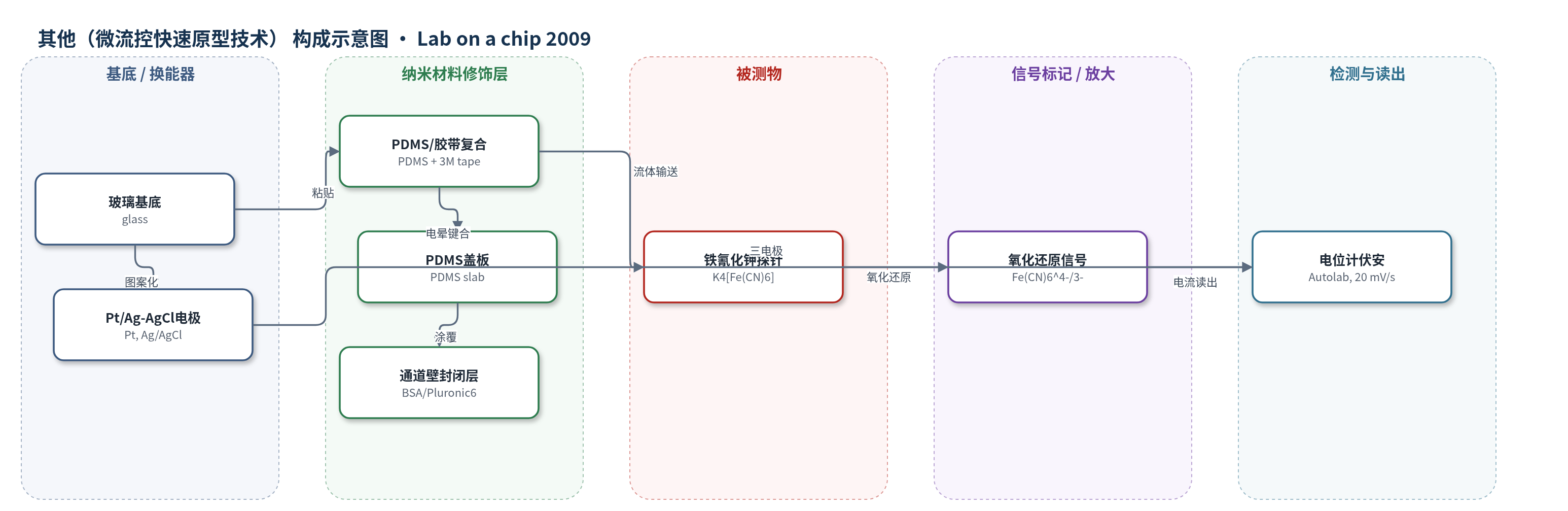
点击图片查看大图 · 依据论文自动绘制
传感器类型
其他(微流控快速原型技术)
检测对象
铁氰化钾(potassium ferrocyanide, K4[Fe(CN)6])、未指定生物分子(biomolecules);样品基质:1.0 M KCl 溶液/微流道
检测原理
该装置未使用特异性生物识别元件,而是将微流控通道与三电极电化学池集成。PDMS/胶带复合通道将含 4 mM 铁氰化钾的 1.0 M KCl 溶液输送至工作电极、Pt 对电极和 Ag/AgCl 参比电极。在电位计扫描下,Fe(CN)6^4-/3- 在工作电极界面发生可逆氧化还原电子转移,产生法拉第电流;循环伏安峰电流理论上随铁氰化钾浓度变化。通道壁用 BSA 或 Pluronic6 封闭,减少生物分子非特异吸附和气泡。原文仅以铁氰化钾验证电极功能,未描述针对特定生物分析物的识别、放大或定量检测机制。
检测灵敏度
原文未报告 LOD、线性范围、灵敏度斜率或相关系数。
效应效果
键合强度测试显示 PDMS/胶带复合与玻璃的失效压力为 586 ± 34 kPa,高于氧等离子体键合报道的最大 510 kPa,满足多数微流道通常低于 100 kPa 的压力需求。染色液流动测试显示通道无泄漏、无堵塞,双色流保持层流且无异常混合。二维微流控系统可在 CAD 设计后约 60 min 内完成,其中复合与 PDMS 板制备约 50–60 min,切割约 2–3 min,粘贴约 1 min。电化学伏安结果与标准烧杯实验接近,并测试多种生物分子时工作良好;胶带偶发吸附生物分子产生气泡,可用 BSA 或 Pluronic6 消除。
传感器的构成
- 基底/换能器电极:玻璃基底,图案化 Pt 对电极与 Ag/AgCl 参比电极,提供三电极电化学界面。
- 微流控通道层:PDMS/双面胶复合(PDMS + 3M Double Coated Tape 444),刻字机切割形成微流道并密封。
- 盖板/键合层:PDMS 板,经电晕放电与 PDMS/胶带复合键合,封闭通道。
- 工作电极:附加电极阵列,置于储液腔另一侧,通过流体与对/参比电极电连接(原文未注明材料)。
- 信号探针:4 mM 铁氰化钾(K4[Fe(CN)6])溶于 1.0 M KCl,作为可逆氧化还原电化学探针。
- 表面封闭层:BSA 或 Pluronic6,涂覆通道壁以减少生物分子非特异吸附和气泡。
- 读出系统:Eco Chemie Autolab 电位计,三电极循环伏安,扫描速率 20 mV s−1。
中文摘要
本文提出一种基于 PDMS 与双面聚合物胶带复合材料的微流控系统快速原型方法。由于 PDMS 疏水且表面能低,难以用胶带粘合,也不兼容刻字机胶带法。作者将脱气液态 PDMS 旋涂于双面胶上并固化,形成 PDMS/胶带复合层,再用刻字机按 CAD 设计切割微流道,经电晕放电与 PDMS 板键合,撕去背纸后可直接粘附到玻璃、塑料或金属化玻璃/硅等基底。该方法无需洁净室和紫外曝光,可快速、低成本地集成膜、微电极和微加热器。文中演示了标准微流道与反应器、集成纳米多孔氧化铝膜的核酸提取系统,以及连接 Pt 对电极、Ag/AgCl 参比电极和工作电极阵列的电化学生物传感器。键合强度足以承受典型微流道压力,为微流控传感器件的快速制备提供了简便途径。
英文摘要
Rapid prototyping of microfluidic systems using a combination of double-sided tape and PDMS (polydimethylsiloxane) is introduced. PDMS is typically difficult to bond using adhesive tapes due to its hydrophobic nature and low surface energy. For this reason, PDMS is not compatible with the xurography method, which uses a knife plotter and various adhesive coated polymer tapes. To solve these problems, a PDMS/tape composite was developed and demonstrated in microfluidic applications. The PDMS/tape composite was created by spinning it to make a thin layer of PDMS over double-sided tape. Then the PDMS/tape composite was patterned to create channels using xurography, and bonded to a PDMS slab. After removing the backing paper from the tape, a complete microfluidic system could be created by placing the construct onto nearly any substrate; including glass, plastic or metal-coated glass/silicon substrates. The bond strength was shown to be sufficient for the pressures that occur in typical microfluidic channels used for chemical or biological analysis. This method was demonstrated in three applications: standard microfluidic channels and reactors, a microfluidic system with an integrated membrane, and an electrochemical biosensor. The PDMS/tape composite rapid prototyping technique provides a fast and cost effective fabrication method and can provide easy integration of microfluidic channels with sensors and other components without the need for a cleanroom facility.