组成图示
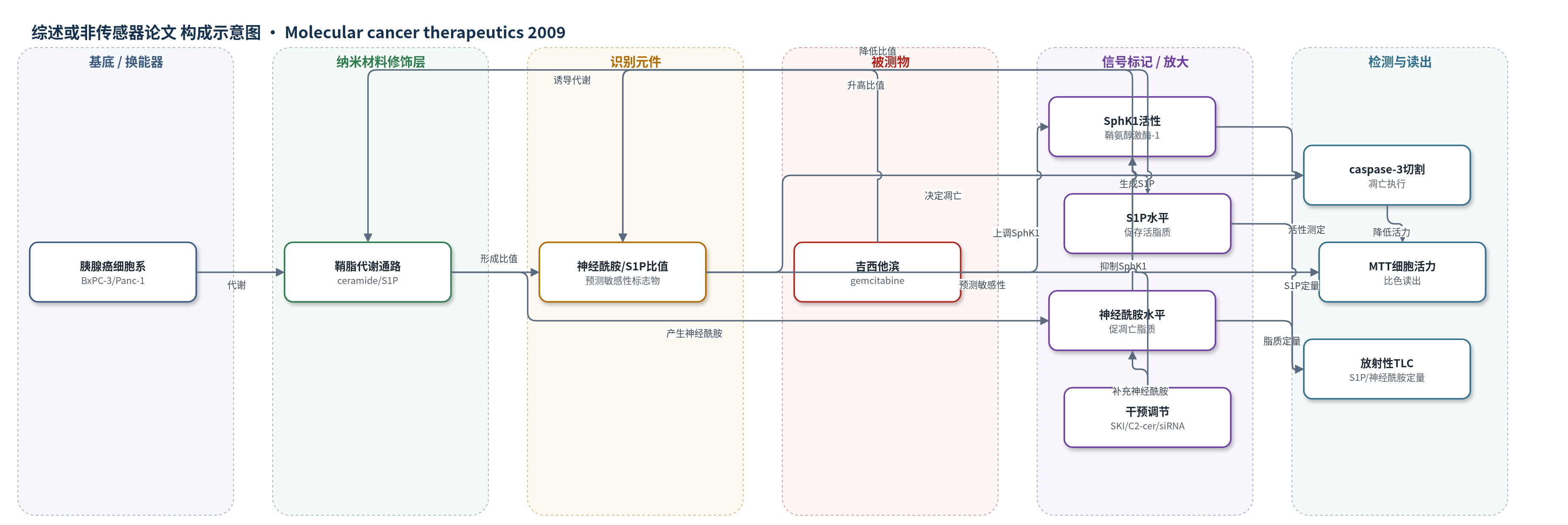
点击图片查看大图 · 依据论文自动绘制
传感器类型
综述或非传感器论文
检测对象
胰腺癌细胞对吉西他滨(gemcitabine)的敏感性/耐药性;样品基质:人胰腺癌细胞系(BxPC-3、Panc-1、Capan-1、MiaPaCa-2)及胰腺组织阵列。
检测原理
该文将细胞内神经酰胺(ceramide)与鞘氨醇-1-磷酸(S1P)的比值视为预测胰腺癌细胞对吉西他滨敏感性的“生物传感器”。吉西他滨进入细胞后诱导酸性鞘磷脂酶水解鞘磷脂生成神经酰胺,同时上调 SphK1 表达与活性;SphK1 将鞘氨醇磷酸化为 S1P,使促存活信号增强。若细胞基础 SphK1 活性高、S1P 高而神经酰胺低,ceramide/S1P 比值低,凋亡阈值难以达到,表现为耐药;若比值高,则神经酰胺通过脂质筏、PTEN/PP2A 抑制 PI3K/Akt 并降低 NF-κB/Bcl-xL,促进 caspase-3 切割和凋亡。使用 SKI 抑制 SphK1、C2-神经酰胺补充神经酰胺或 siRNA 沉默 SphK1,可提高比值,使 MTT 活力随吉西他滨浓度下降更明显;过表达 SphK1 则降低比值并增强耐药。
检测灵敏度
—
效应效果
在 BxPC-3 与 Panc-1 中,Panc-1 对吉西他滨更耐药;基础神经酰胺低 2.5 倍、S1P 高 1.8 倍,ceramide/S1P 比值低 2.2±0.4 倍,SphK1 活性高 2±0.4 倍,而 SphK1 mRNA 无差异。在 Capan-1 和 MiaPaCa-2 中,SphK1 活性越高,吉西他滨处理后细胞活力越高。1 μmol/L C2-神经酰胺或 1 μmol/L SKI 预处理可显著降低 Panc-1 对吉西他滨的存活率,使其接近 BxPC-3 水平;SphK1 siRNA 使 SphK1 活性降低约 2 倍并增强敏感性。过表达 SphK1 使 Panc-1 和 BxPC-3 对吉西他滨更耐药。免疫组化显示 60 例胰腺腺癌导管细胞 SphK1 强阳性,10 例正常胰腺仅弱阳性。未报告 RSD、回收率或与 ELISA/HPLC/qPCR 的对比。
传感器的构成
- 非传感器论文:未报道基底/换能器电极材料。
- 标志物层:细胞内神经酰胺(ceramide)/鞘氨醇-1-磷酸(S1P)比值,用于预测吉西他滨敏感性。
- 调控层:鞘氨醇激酶-1(SphK1)、SKI 抑制剂、C2-神经酰胺类似物、SphK1 siRNA,用于改变比值。
- 读出层:MTT 比色法、caspase-3 免疫印迹、放射性 TLC 定量 S1P/神经酰胺,反映细胞命运。
中文摘要
克服胰腺癌对化疗药吉西他滨的耐药仍是治疗这一致命癌症的挑战。靶向鞘脂代谢以提高肿瘤化疗敏感性近来成为有前景的策略。促存活鞘氨醇-1-磷酸(S1P)与促凋亡神经酰胺等鞘脂之间细胞内水平的精细平衡决定细胞命运。在控制该代谢的酶中,肿瘤相关蛋白鞘氨醇激酶-1(SphK1)在许多肿瘤中过表达,通过产生 S1P 促进存活;SphK1 抑制剂正用于临床试验,以增强上皮性卵巢癌和前列腺癌细胞对多种化疗药的敏感性。我们在此报道,细胞内神经酰胺/S1P 比值是预测胰腺癌细胞对吉西他滨敏感性的关键生物传感器。低神经酰胺/S1P 比值与高 SphK1 活性相关,并与胰腺癌细胞对吉西他滨的显著固有耐药性相关。值得注意的是,通过药理学(SphK1 抑制剂或神经酰胺类似物)或小干扰 RNA 方法上调细胞内神经酰胺水平或降低 SphK1 活性,提高神经酰胺/S1P 比值,可增强胰腺癌细胞对吉西他滨的敏感性。相反,通过上调 SphK1 活性降低该比值,则促进这些细胞对吉西他滨的耐药。因此,开发靶向鞘脂代谢的新型药理学策略,与吉西他滨联合使用,可能成为克服胰腺癌对该药耐药的一种有趣而有前景的方法。
英文摘要
Defeating pancreatic cancer resistance to the chemotherapeutic drug gemcitabine remains a challenge to treat this deadly cancer. Targeting the sphingolipid metabolism for improving tumor chemosensitivity has recently emerged as a promising strategy. The fine balance between intracellular levels of the prosurvival sphingosine-1-phosphate (S1P) and the proapoptotic ceramide sphingolipids determines cell fate. Among enzymes that control this metabolism, sphingosine kinase-1 (SphK1), a tumor-associated protein overexpressed in many cancers, favors survival through S1P production, and inhibitors of SphK1 are used in ongoing clinical trials to sensitize epithelial ovarian and prostate cancer cells to various chemotherapeutic drugs. We here report that the cellular ceramide/S1P ratio is a critical biosensor for predicting pancreatic cancer cell sensitivity to gemcitabine. A low level of the ceramide/S1P ratio, associated with a high SphK1 activity, correlates with a robust intrinsic pancreatic cancer cell chemoresistance toward gemcitabine. Strikingly, increasing the ceramide/S1P ratio, by using pharmacologic (SphK1 inhibitor or ceramide analogue) or small interfering RNA-based approaches to up-regulate intracellular ceramide levels or reduce SphK1 activity, sensitized pancreatic cancer cells to gemcitabine. Conversely, decreasing the ceramide/S1P ratio, by up-regulating SphK1 activity, promoted gemcitabine resistance in these cells. Development of novel pharmacologic strategies targeting the sphingolipid metabolism might therefore represent an interesting promising approach, when combined with gemcitabine, to defeat pancreatic cancer chemoresistance to this drug.