组成图示
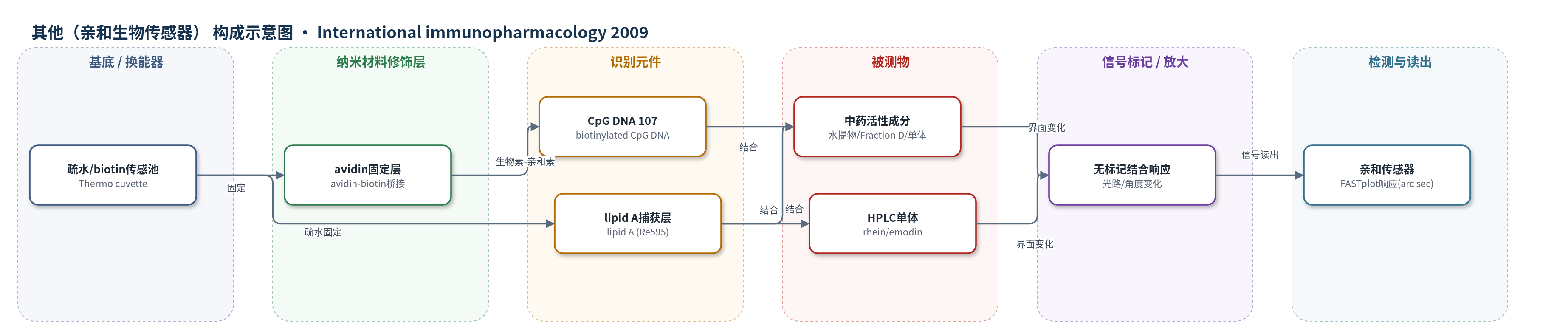
点击图片查看大图 · 依据论文自动绘制
传感器类型
其他(亲和生物传感器)
检测对象
中药抗CpG DNA活性成分(Radix et Rhizoma Rhei水提物、Fraction D、rhein大黄酸、emodin大黄素),样品基质:中药水提物/组分/单体溶液(PBST或PBS/AE稀释)
检测原理
该亲和生物传感器以固定化CpG DNA 107或lipid A作为捕获/识别分子。CpG DNA 107经生物素标记后通过avidin-biotin相互作用固定于biotin-cuvette表面;lipid A直接固定于疏水cuvette表面。中药水提物、Fraction D或单体注入传感池后,若含有能与CpG DNA或lipid A结合的成分,则发生特异性结合,使传感界面质量/折射特性改变,导致反射激光光路或共振角偏移。仪器以arc seconds记录响应,结合量越大响应越高,因此响应随被测物浓度增加而升高。结合后用PBST洗涤,并用HCl/NaOH再生表面。该过程无酶促或核酸扩增放大,主要依赖直接亲和结合产生的光学信号。
检测灵敏度
原文未报告LOD、线性范围、灵敏度斜率或相关系数。
效应效果
78种中药水提物中14种对CpG DNA 107结合响应>100 arc sec,范围108.7–573.2 arc sec,大黄活性最高之一。Fraction D剂量依赖结合CpG DNA和lipid A,抑制CpG DNA 1826与LPS诱导RAW264.7细胞TNF-α释放,并降低CpG DNA诱导的TLR9 mRNA表达。体内以1.2×10^10 CFU/kg热灭活大肠杆菌攻击,Fraction D 100 mg/kg使3日生存率由10%升至60%(p<0.05),150 mg/kg更显著(p<0.01)。HPLC分离的rhein和emodin纯度>90%;rhein抑制两种刺激诱导的TNF-α,emodin仅抑制CpG DNA诱导的TNF-α,联用协同但弱于Fraction D。
传感器的构成
- 传感池基底:Thermo Labsystem疏水cuvette或biotin-cuvette,作为光学亲和传感界面与固定化载体
- 固定化桥接层:avidin固定于biotin-cuvette,用于捕获生物素化CpG DNA 107
- 识别/捕获元件:biotinylated CpG DNA 107(5′-TGGCGCGGGGCG-3′,磷酸硫代骨架)固定于avidin表面,用于结合中药活性成分
- 替代识别/捕获元件:lipid A(Salmonella Re595)固定于疏水cuvette,用于评估组分对脂多糖相关靶点的结合
- 信号标记物:无外源标记物,中药成分直接结合固定化CpG DNA/lipid A,界面变化产生光学响应
- 封闭剂:BSA 1.5 mg/ml,封闭非特异性结合位点
中文摘要
细菌DNA/CpG DNA是脓毒症发病关键分子,阻止其结合受体被认为最有前景。本研究以CpG DNA为靶标,用亲和生物传感器技术从78种中药水提物中筛选抗CpG DNA成分。大黄(Radix et Rhizoma Rhei)水提物结合能力最高。经硅胶柱和HPLC分离,获得活性组分Fraction D。体外显示Fraction D高亲和结合CpG DNA和lipid A,剂量依赖抑制LPS与CpG DNA诱导RAW264.7细胞释放TNF-α,并降低CpG DNA上调的TLR9 mRNA表达。体内可保护受致死量热灭活大肠杆菌攻击的小鼠。HPLC进一步分离鉴定出大黄酸(rhein)和大黄素(emodin);rhein抑制CpG DNA和LPS诱导的TNF-α,emodin仅抑制CpG DNA诱导的TNF-α,二者联用协同,构成Fraction D活性。该研究建立了中药抗CpG DNA成分筛选平台。
英文摘要
Bacterial DNA/CpG DNA is recognized as a key molecule during the pathogenesis of sepsis. Therefore, preventing CpG DNA from binding to its receptor is considered as the most promising strategy. In the present experiments, Radix et Rhizoma Rhei had the highest CpG DNA-binding ability among the seventy-eight traditional Chinese herbs. After the isolation of silica gel chromatography and high performance liquid chromatography (HPLC) and evaluation with affinity biosensor, the active fraction was confirmed and named Fraction D. It was found that in vitro, Fraction D bound to both CpG DNA and lipid A with high affinity, and strongly inhibited LPS- and CpG DNA-induced TNF-alpha release from RAW264.7 cells in a dose-dependent manner. Furthermore, Fraction D reduced the expression of TLR9 mRNA up-regulated by CpG DNA. In vivo, Fraction D protected mice challenged with lethal heat-killed E. coli. Using HPLC method, two monomers with high affinity for CpG DNA were isolated and identified as rhein and emodin. Rhein could significantly reduce CpG DNA- and LPS-induced TNF-alpha release, but emodin only reduced CpG DNA-induced TNF-alpha release. Rhein in combination with emodin could play synergistic inhibitory effect on both CpG DNA and LPS-induced TNF-alpha release, which contributed to the bioactivity of Fraction D. In conclusion, we successfully established the platform to screen anti-CpG DNA components of traditional Chinese herbs using affinity biosensor technology, got active Fraction D from Radix et Rhizoma Rhei and determined rhein and emodin as the main bioactive ingredients in Fraction D.