组成图示
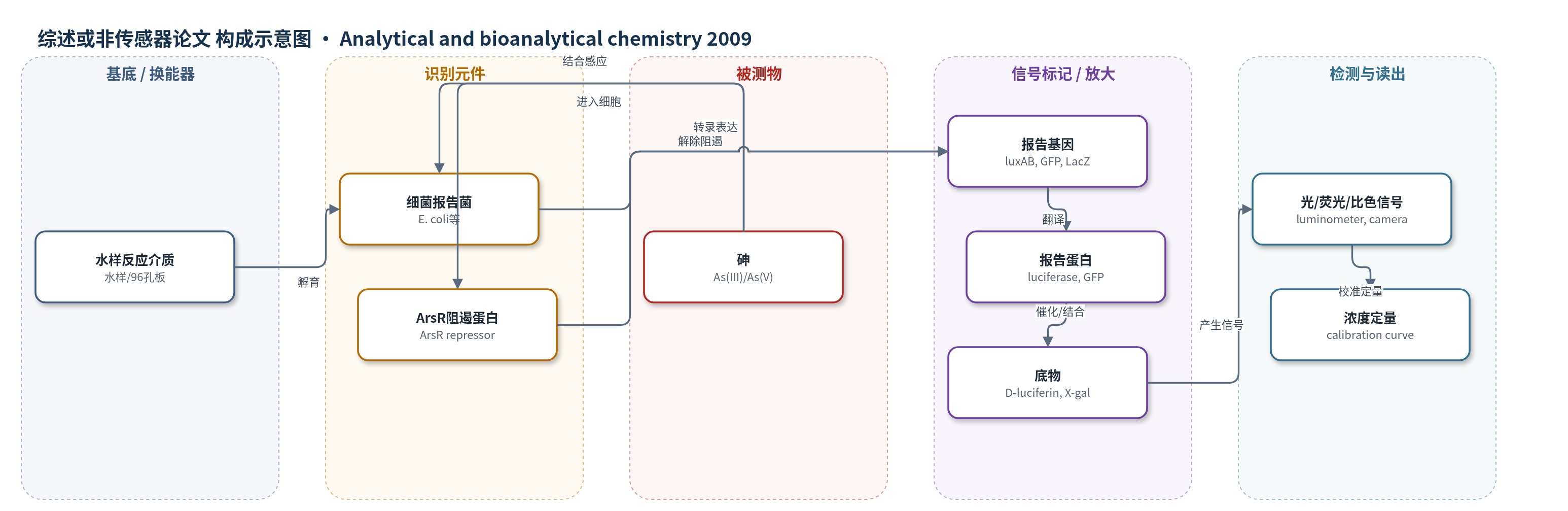
点击图片查看大图 · 依据论文自动绘制
传感器类型
综述或非传感器论文
检测对象
砷(arsenic, As;As(III)、As(V));样品基质:天然水/地下水/饮用水,亦提及水稻、蟹尿、人血、土壤水提取液
检测原理
细菌报告菌携带天然 ars 操纵子-启动子和 ArsR 阻遏蛋白。无砷时,ArsR 结合操纵子并抑制下游防御基因及融合报告基因转录。样品中的 As(V) 可被细胞内 ArsC 还原为 As(III),As(III) 进入细胞后结合 ArsR,使其构象改变并降低 DNA 亲和力,RNA 聚合酶启动报告基因转录。报告蛋白(荧光素酶、GFP、β-半乳糖苷酶、细胞色素 c 过氧化物酶等)的表达量或活性随砷浓度增加而升高,形成基因表达放大。随后加入 D-luciferin、decanal、X-gal 等底物,产生生物发光、荧光、比色或化学发光信号,经 luminometer、荧光相机或分光光度计读出,并按校准曲线反推样品砷浓度。
检测灵敏度
线性范围: 257μg/L–26 mg/L (E. coli MC1061 pTOO21, As(III));线性范围: 8–78μg/L (E. coli DH5α pJAMA-arsR, As(III));线性范围: 1–100μg/L (E. coli pIRC140, As(III));线性范围: 4–30μg/L (E. coli DH5α pArsR-ABS-CCP, As(III));线性范围: 20–5,000μg/L (E. coli DH5α pArsR-ABS-CCP-R45I/R48T, As(III));线性范围: 257–7,800μg/L (B. subtilis BR151 pTOO21, As(III));线性范围: 22–7,800μg/L (B. subtilis pMUTin-23, As(III));线性范围: 8–257μg/L (S. aureus RN4220 pTOO21, As(III))
效应效果
作者强调细菌生物检测法比原子吸收、原子荧光、ICP 和 HPLC 更简单、低成本,且传感器细胞可自我繁殖。传统汞溴水比色法在低于 50 μg/L 时准确性差,易出现假阳性和假阴性;细菌报告菌可在 10 μg As/L 饮用水标准附近甚至更低浓度产生响应。部分大肠杆菌菌株已用于越南地下水现场比较分析,孵育 2–4 h 后读取信号。枯草芽孢杆菌可形成芽孢,室温长期保存,但复活化需 12–14 h。长期储存后细胞即时反应能力下降,因此多用新鲜或冻存细胞。文中未报告 RSD、加标回收率或与 ELISA/HPLC 的定量对比,但认为其适合现场、低成本、多基质砷检测。
传感器的构成
- 识别元件:细菌细胞(Escherichia coli、Bacillus subtilis、Staphylococcus aureus、Rhodopseudomonas palustris)及 ArsR 转录阻遏蛋白,感应 As(III)/As(V) 并启动报告基因表达
- 信号标记物:报告蛋白基因(luxAB 细菌荧光素酶、firefly luciferase、GFP、β-galactosidase/LacZ、cytochrome c peroxidase、CrtI)与 arsR 操纵子-启动子融合,表达量随砷浓度变化
- 信号底物:D-luciferin、decanal、dodecanal、X-gal、Accelerator-II 等,与报告蛋白反应产生生物发光、荧光、比色或化学发光信号
- 反应介质/基底:水样悬浮液、96-well plate、culture tube、4-mL cuvette、paper strip、microfluidics device 或 fiberoptics,用于孵育和信号采集
- 读出装置:luminometer、fluorescence microscope/camera、spectrophotometer,测量光强、荧光或颜色变化
中文摘要
天然水体中砷污染是全球性问题,大量人口饮用水中砷浓度可能超标。传统检测技术如原子吸收、原子荧光、电感耦合等离子体及高压液相色谱虽然准确,但成本高、耗时长,且难以满足现场快速检测需求。本文综述了基于细菌的生物检测法作为检测地下水和天然水中砷的新兴方法。其核心是基因改造的细菌传感器-报告菌株,如大肠杆菌、枯草芽孢杆菌、金黄色葡萄球菌和红假单胞菌等。当细胞暴露于砷时,天然 ArsR 阻遏蛋白感应亚砷酸盐并解除对报告基因的转录抑制,使荧光素酶、绿色荧光蛋白、β-半乳糖苷酶或细胞色素 c 过氧化物酶等报告蛋白表达。通过测量报告蛋白的量或活性,可定量推断样品中砷浓度。部分菌株已用于现场比较分析,未来将向光纤、微流控等微型化平台发展,线虫和蛤类也可能成为新型生物检测体系。
英文摘要
Arsenic contamination of natural waters is a worldwide concern, as the drinking water supplies for large populations can have high concentrations of arsenic. Traditional techniques to detect arsenic in natural water samples can be costly and time-consuming; therefore, robust and inexpensive methods to detect arsenic in water are highly desirable. Additionally, methods for detecting arsenic in the field have been greatly sought after. This article focuses on the use of bacteria-based assays as an emerging method that is both robust and inexpensive for the detection of arsenic in groundwater both in the field and in the laboratory. The arsenic detection elements in bacteria-based bioassays are biosensor-reporter strains; genetically modified strains of, e.g., Escherichia coli, Bacillus subtilis, Staphylococcus aureus, and Rhodopseudomonas palustris. In response to the presence of arsenic, such bacteria produce a reporter protein, the amount or activity of which is measured in the bioassay. Some of these bacterial biosensor-reporters have been successfully utilized for comparative in-field analyses through the use of simple solution-based assays, but future methods may concentrate on miniaturization using fiberoptics or microfluidics platforms. Additionally, there are other potential emerging bioassays for the detection of arsenic in natural waters including nematodes and clams.