组成图示
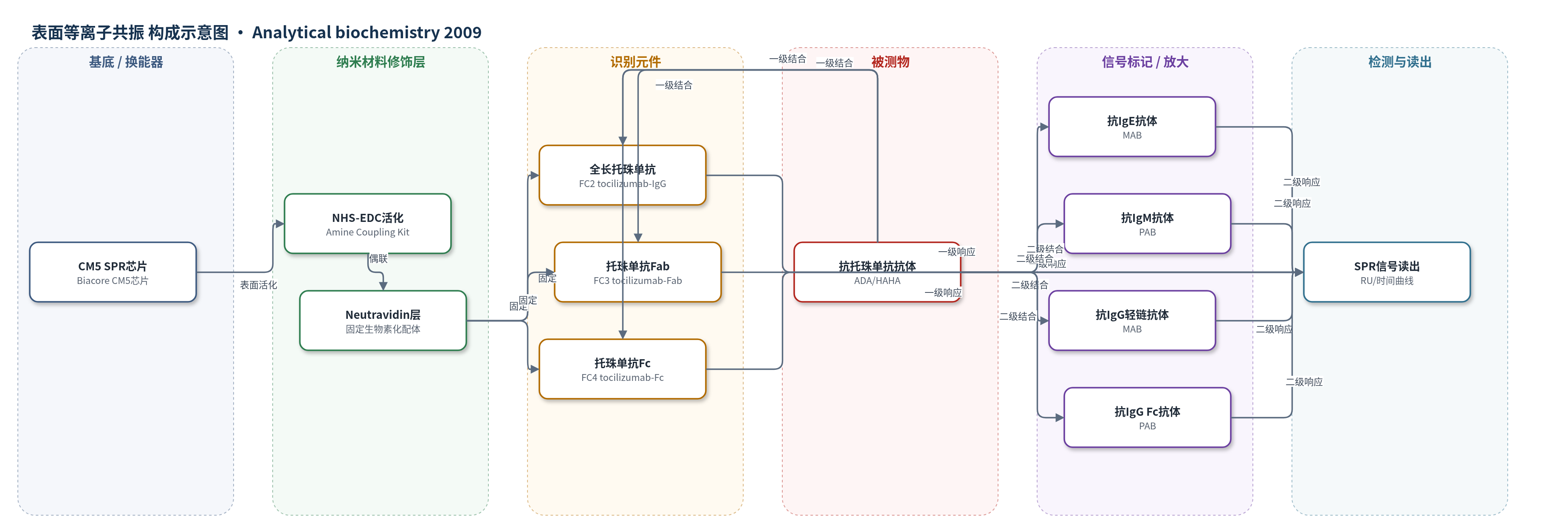
点击图片查看大图 · 依据论文自动绘制
传感器类型
表面等离子共振(SPR)生物传感器
检测对象
人抗托珠单抗抗体(human anti-tocilizumab antibodies, ADA/HAHA)、抗人IgG Fc抗体/类风湿因子(anti-Fc antibody/rheumatoid factor, RF);样品基质:类风湿关节炎患者血清、健康志愿者血清
检测原理
CM5芯片经NHS-EDC活化后偶联neutravidin,再固定生物素化托珠单抗全长、Fab和Fc片段。血清样品中的抗托珠单抗抗体(ADA)与相应固定化抗原结合,形成一级结合事件;结合质量改变芯片表面折射率,Biacore 2000通过表面等离子共振实时记录共振单位(RU)变化,RU增量与结合ADA量正相关。随后不再生,依次注入抗IgE、抗IgM、抗IgG轻链和抗IgG Fc二级检测抗体,它们与已结合ADA的相应免疫球蛋白部位结合,产生二级响应,用于确认抗体性质并区分IgG、IgM、IgE同种型。通过比较全长、Fab和Fc流路的响应模式,可判断ADA结合区域,并区分药物特异性ADA与抗Fc类风湿因子等非特异性反应。
检测灵敏度
理论灵敏度(assay sensitivity): 一级响应 6.8–36 μg/ml,二级响应 8.6–20.0 μg/ml(参考标准当量);LLRD: 10–40 μg/ml;校准曲线范围: 400 ng/ml–50 μg/ml(原血清浓度)。
效应效果
方法经78个芯片/测量系列验证,配体残余活性均>50%;120次再生后活性通常约100%,罕见降至约50%,常规限制109次再生。标准品4/10℃短期稳定性回收率为81.2%–106.9%,阳性对照4/25℃保存4个月回收率为80.2%–117.7%。以30名健康志愿者和30名类风湿关节炎患者血清确定各响应cutoff(均值+3SD),芯片间CV为3%–27%,故每片新芯片重新评估cutoff。可溶性IL-6R加标10–600 ng/ml时,>0.31 μg/ml(全长)和>0.63 μg/ml(Fab)可致一级假阳性,但二级响应阴性可识别。方法用于确认ELISA筛查ADA,可区分特异性ADA与抗Fc类风湿因子,并识别IgG、IgM、IgE同种型及时间过程。
传感器的构成
- SPR换能器/芯片:Biacore CM5芯片,提供表面等离子共振检测界面
- 表面活化/偶联层:NHS-EDC活化后偶联neutravidin,用于固定生物素化配体并降低非特异背景
- 捕获识别层:生物素化全长托珠单抗(tocilizumab-IgG)、生物素化Fab片段(tocilizumab-Fab)和生物素化Fc片段(tocilizumab-Fc),分别固定于FC2、FC3、FC4,用于捕获抗托珠单抗抗体并区分结合区域
- 二级识别/信号标记:抗人IgE单克隆抗体(MAB<human IgE>)、抗人IgM多克隆抗体(PAB<human IgM>)、抗人IgG轻链单克隆抗体(MAB<human IgG(LC)>)和抗人IgG Fc多克隆抗体(PAB<human IgG(Fc)>),用于二级响应判断同种型
- 阳性对照/标准:兔抗托珠单抗多克隆抗体与人IgG、IgM或IgE偶联缀合物,以及小鼠抗人Fc单克隆抗体-人IgG(Fab)缀合物,用于质量控制和同种型模拟
- 再生/条件化:100 mM H3PO4再生液去除结合复合物;HBS-P缓冲液及含CM-dextran/人血清稀释缓冲液用于样品稀释和芯片条件化
- 空白对照:FC1未结合配体,用于空白信号扣除
中文摘要
本文描述了一种基于Biacore表面等离子共振(SPR)技术同时分析人抗人抗体(HAHA)结合区域和免疫球蛋白同种型的方法。该方法通过每个样品11次单项测量,在一个生物传感器芯片的四个平行流路中分别固定全长托珠单抗及其Fc和Fab片段,实现对抗药抗体(ADA)的差异结合分析。通过检测连续样品在单次运行中的响应模式,可获得患者完整的时间特异性免疫原性谱,包括强度、同种型、特异性和动力学。具有功能活性的标准缀合物用于全程监控方法性能;模拟不同同种型多克隆人ADA的阳性对照由兔抗托珠单抗多克隆抗体与人IgM、IgG或IgE偶联获得。文中展示了方法验证,并应用于6例接受人源化IgG1抗IL-6R抗体托珠单抗治疗的类风湿关节炎患者。该方法可区分特异性ADA与药物非特异性反应(如类风湿因子),并能区分IgG、IgM和IgE同种型,从而在单个患者水平描述ADA形成和消失的时间过程。
英文摘要
This article describes the simultaneous Biacore analysis of human anti-human antibodies (HAHAs) with respect to the binding region and the isotype by a combination of 11 single measurements per sample. The multiplexing single assay setup made efficient use of the four parallel flow cells on one biosensor chip by immobilization of full-length antibody and its constant (Fc) and antigen binding (Fab) fragments for differential binding analysis of anti-drug antibodies (ADAs). Thereby, a complete time-specific immunogenicity profile (intensity, isotype, specificity, and kinetics) of a patient could be obtained by assessing the response patterns of serially collected samples analyzed in a single measurement run. The use of functionally active standard conjugates allowed control of the assay performance throughout the whole procedure. The positive control standard conjugates mimicking polyclonal human ADAs of different isotypes were obtained by conjugating polyclonal rabbit antibodies against the therapeutic antibody to human immunoglobulin (Ig) M, IgG, or IgE. In this article, the qualification of the assay is demonstrated and the application of the methodology to six representative rheumatoid arthritis patients treated with the therapeutic humanized IgG1 antibody tocilizumab (anti-IL-6R) is shown to illustrate the versatility of the assay. The presented method allows one to differentiate specific ADAs from drug-unspecific responses (e.g., rheumatoid factors). In addition, the method can be used to discriminate between isotype responses of the IgG, IgM, and IgE types and, thereby, allows one to describe the time course of specific ADA formation and its disappearance on the single patient level.