组成图示
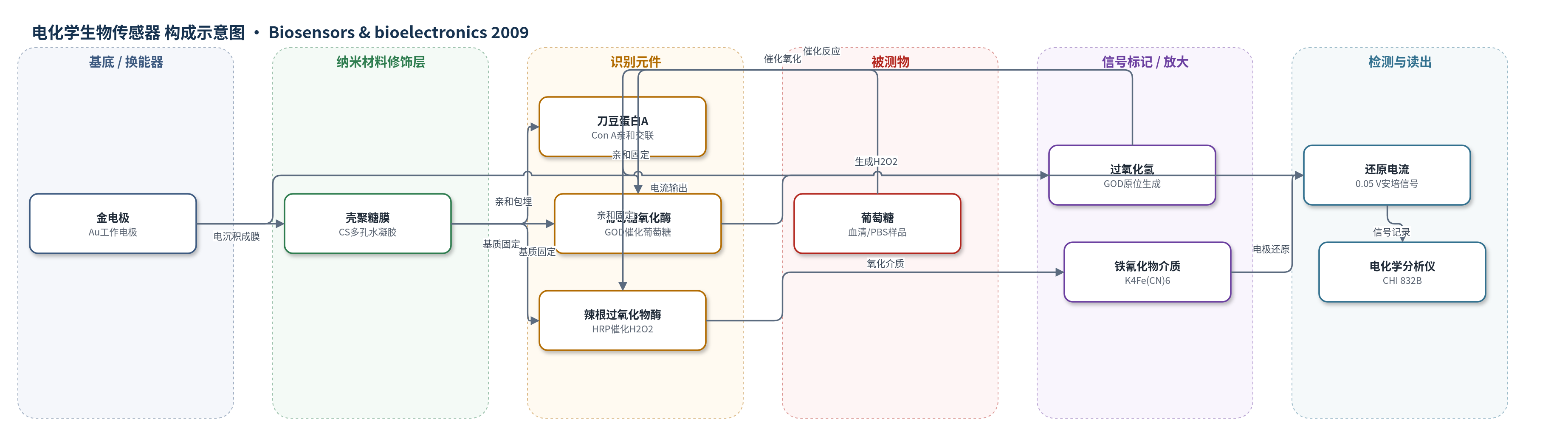
点击图片查看大图 · 依据论文自动绘制
传感器类型
电化学生物传感器
检测对象
葡萄糖(glucose);样品基质:人血清、PBS缓冲液
检测原理
传感器以金电极为基底,电沉积形成含Con A、HRP和GOD的CS多孔复合膜。检测时,样品中的葡萄糖在GOD催化下与O2反应生成葡萄糖酸-1,5-内酯和H2O2;H2O2随即在HRP催化下氧化K4Fe(CN)6中的Fe(CN)6^4-,生成Fe(CN)6^3-。在0.05 V恒电位下,Fe(CN)6^3-在电极表面被还原为Fe(CN)6^4-,产生与葡萄糖浓度成正比的还原电流。Con A通过生物特异性亲和将双酶稳定固定于CS网络,多孔结构促进物质扩散;双酶原位生成H2O2避免外源H2O2对HRP的抑制,从而提高灵敏度、响应速度和稳定性。
检测灵敏度
LOD: 6.7 × 10⁻⁷ M;线性范围: 1.0 × 10⁻⁶–2.2 × 10⁻⁴ M;灵敏度: 1.18 μA mM−1;R^2 = 0.9993
效应效果
该传感器响应迅速,加入葡萄糖后7 s内达到稳态电流的95%。选择性方面,10 mM蔗糖、果糖、乳糖和麦芽糖对100 μM葡萄糖无干扰,仅1.0 mM抗坏血酸产生显著干扰。重现性良好,80 μM葡萄糖连续7次测定RSD为2.9%,6个独立制备传感器RSD为3.8%。4 ℃保存5周后仍保留约89%初始响应。人血清样品100倍稀释后测定,回收率为96%–101%,与医院临床测定值接近。与文献方法相比,其LOD 6.7×10⁻⁷ M(约0.67 μM)略高于0.5 μM的nano-Au-PANI-GOD-GCE,但低于1.5 μM、2 μM、13 μM和58 μM的相应电极;引入Con A后灵敏度由0.235 μA mM−1提高至1.18 μA mM−1。
传感器的构成
- 基底电极:金电极(Au electrode),经Al2O3抛光、piranha溶液及电化学清洗,作为工作电极与电子换能基底。
- 生物复合膜:壳聚糖(CS)水凝胶,在−1.2 V电沉积8 min原位形成多孔膜,提供生物相容固定基质。
- 亲和交联层:刀豆蛋白A(Con A),与CS及糖蛋白HRP/GOD生物特异性结合,原位包埋并交联固定双酶。
- 识别催化元件:葡萄糖氧化酶(GOD),催化葡萄糖氧化生成H2O2。
- 识别催化元件:辣根过氧化物酶(HRP),催化H2O2与K4Fe(CN)6反应。
- 电子介质:K4Fe(CN)6(Fe(CN)6^3-/4-),在0.05 V下传递电子产生安培信号。
- 电化学池:Ag/AgCl参比电极与Pt辅助电极,构成三电极体系用于CV、EIS和安培检测。
中文摘要
本文报道了一种基于一步电沉积原位形成生物复合膜构建辣根过氧化物酶(HRP)与葡萄糖氧化酶(GOD)双酶生物传感器的简单策略。该策略利用刀豆蛋白A(Con A)作为双功能交联剂,凭借其生物特异性亲和作用,将HRP和GOD原位包埋于生物相容性壳聚糖(CS)基质中,并在金电极表面形成HRP–GOD/Con A/CS复合膜。扫描电镜显示该复合膜具有高度多孔表面。所制备的双酶生物传感器对葡萄糖具有快速安培响应,线性范围为1.0×10−6至2.2×10−4 M,检出限为6.7×10⁻⁷ M。该传感器可直接用于血清中葡萄糖的测定。由于引入Con A以及双酶体系原位生成过氧化氢(H2O2),传感器表现出较高稳定性。该一步构建方法在生物相容环境中无需手工操作,直接简便。
英文摘要
One-step construction of horseradish peroxidase (HRP) and glucose oxidase (GOD) bienzyme biosensor was established based on a simple and controllable electrodeposition approach by in-situ formation of biocomposite film on electrode. With hydrogen peroxide (H(2)O(2)) instantly generated by GOD-catalyzed oxidation of glucose, quantitative measurement of glucose could be achieved. In the proposed electrodeposition strategy, Concanavalin A (Con A) was applied as bifunctional cross-linker for in-situ incorporating of HRP-GOD in biocompatible chitosan (CS) matrix due to its biospecific affinity interaction with CS and glycoproteins. Scanning electron microscopy showed that the HRP-GOD/Con A/CS biocomposite film possessed highly porous surface. The developed bienzyme biosensor exhibited a fast amperometric response for the determination of glucose. The linear response of the developed biosensor for the determination of glucose ranged from 1.0x10(-6) to 2.2x10(-4) M with a detection limit of 6.7x10(-7) M. The biosensor can be used to determine glucose in serum directly. The biosensor presented high stability owing to the design of the introduction of Con A and instant generation of H(2)O(2) with bienzyme system. The one-step construction of biosensor based on non-manual technique in biocompatible environment was direct and facile.