组成图示
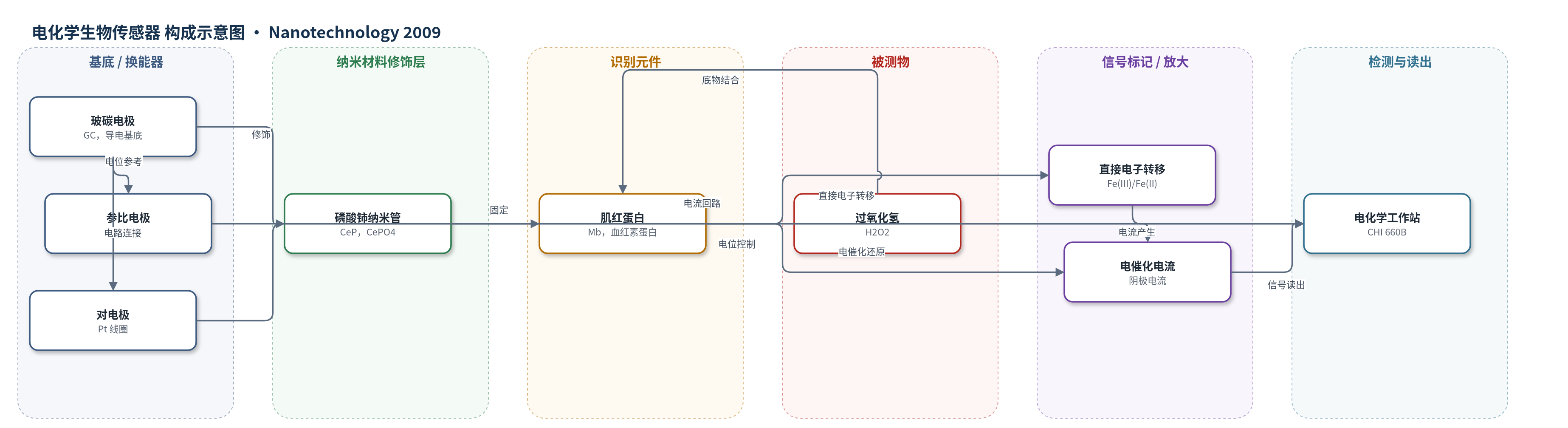
点击图片查看大图 · 依据论文自动绘制
传感器类型
电化学生物传感器
检测对象
过氧化氢(H2O2);样品基质:0.1 M PBS(pH 7.5)缓冲液
检测原理
CeP 纳米管以物理吸附方式固定 Mb,使其血红素中心暴露于电极界面并保持天然构象。在循环伏安过程中,Mb 的 Fe(III)/Fe(II) 中心与 GC 电极之间发生直接电子转移,形成准可逆氧化还原峰。当 H2O2 存在时,底物扩散进入 Mb–CeP 三维网络并到达 Mb 活性位点,被 Mb 催化还原;电极表面通过电子转移将催化反应转化为可测的阴极电流。H2O2 浓度越高,电催化阴极电流越大,在 0.01–2 mM 范围内呈线性响应。CeP 纳米管的高比表面积和立体结构提高了 Mb 负载量、电子转移速率及底物可及性,从而增强灵敏度;该体系未使用额外化学放大或标记物。
检测灵敏度
LOD: 0.5 ± 0.05 μM;线性范围: 0.01–2 mM;灵敏度: 14.4 ± 1.2 μA mM−1
效应效果
该电极对 H2O2 重现性良好:5 个独立电极校准曲线斜率 RSD 为 2.4%;0.1 mM H2O2 十次测定 RSD 为 3.2%。稳定性方面,4 ℃ PBS 中储存 10 h 响应无明显变化,对 0.1 mM H2O2 的响应两周内保持初始值 95%,优于 Mb–SWCNT–CTAB 体系(两周后仅保持 78%)。线性范围 0.01–2 mM 宽于多种 Mb 固定体系,检测限 0.5 ± 0.05 μM 与 TiO2–MWCNT 等相当,灵敏度 14.4 ± 1.2 μA mM−1 具有竞争力。作者认为 CeP 纳米管可作为血红素蛋白/酶与电极集成的通用生物传感平台。
传感器的构成
- 基底/换能器电极:玻碳电极(GC, glassy carbon electrode),直径 3 mm,提供导电基底并作为电化学换能器。
- 纳米材料修饰层:磷酸铈纳米管(CeP, cerium phosphate nanotubes, CePO4),单斜晶相,平均宽 15–20 nm,形成立体网络,增大有效表面积并促进电子转移。
- 识别元件/固定层:肌红蛋白–磷酸铈复合物(Mb–CeP),肌红蛋白(Mb, myoglobin)自发吸附于 CeP 表面,经离心洗涤去除松散分子,保持天然构象并实现直接电子转移与电催化。
- 支持电解质:0.1 M 磷酸盐缓冲液(PBS, pH 7.5),提供离子导电、稳定蛋白构象并维持反应环境。
- 电化学读出装置:CHI 660B 电化学工作站,配合饱和甘汞电极(SCE)和铂线圈对电极,记录循环伏安与电催化电流。
中文摘要
本文通过水热法合成单斜晶相磷酸铈(CeP)纳米管,并经 X 射线衍射(XRD)和透射电子显微镜(TEM)表征。该一维纳米材料平均宽度为 15–20 nm,长度可达数微米,具有中空管状结构。作者将 CeP 纳米管用作电极基底,用于血红素蛋白/酶的固定与直接电化学研究,并以肌红蛋白(Mb)为模型分子。循环伏安结果表明,Mb 固定于 CeP 纳米管后仍能保持天然构象,并与电极发生有效直接电子转移,在 pH 7.5 下呈现一对准可逆氧化还原峰,氧化还原峰位于 −(367 ± 3) mV,表观电子转移速率常数为 (9.1 ± 1.4) s−1。该 Mb–CeP/GC 电极对过氧化氢(H2O2)的电催化还原表现出良好性能,检测限为 0.5 ± 0.05 μM,线性范围为 0.01–2 mM,灵敏度为 14.4 ± 1.2 μA mM−1,且稳定性和重现性良好。CeP 纳米管可作为整合血红素蛋白/酶与电极的简单有效生物传感平台,为多种酶的电化学应用提供分析途径。
英文摘要
Cerium phosphate (CeP) nanotubes have been synthesized and confirmed by x-ray diffraction (XRD) and transmission electron microscopy (TEM). The 1D nanomaterial has a monoclinic crystal structure with a mean width of 15-20 nm and a length up to several micrometers. The nanotubes have been employed as electrode substrates for immobilization and direct electrochemistry of heme proteins/enzymes with myoglobin (Mb) as a model. The electrochemical characteristics of the Mb-CeP/GC electrode were studied by voltammetry. After being immobilized on the nanotubes, Mb can keep its natural structure and undergo effective direct electron transfer reaction with a pair of well-defined redox peaks at -(367 +/- 3) mV (pH 7.5). The apparent electron transfer rate constant is (9.1 +/- 1.4) s(-1). The electrode displays good features in the electrocatalytic reduction of H(2)O(2), and thus can be used as a biosensor for detecting the substrate with a low detection limit (0.5 +/- 0.05 microM), a wide linear range (0.01-2 mM), high sensitivity (14.4 +/- 1.2 microA mM(-1)), as well as good stability and reproducibility. CeP nanotubes can become a simple and effective biosensing platform for the integration of heme proteins/enzymes and electrodes, which can provide analytical access to a large group of enzymes for a wide range of bioelectrochemical applications.