组成图示
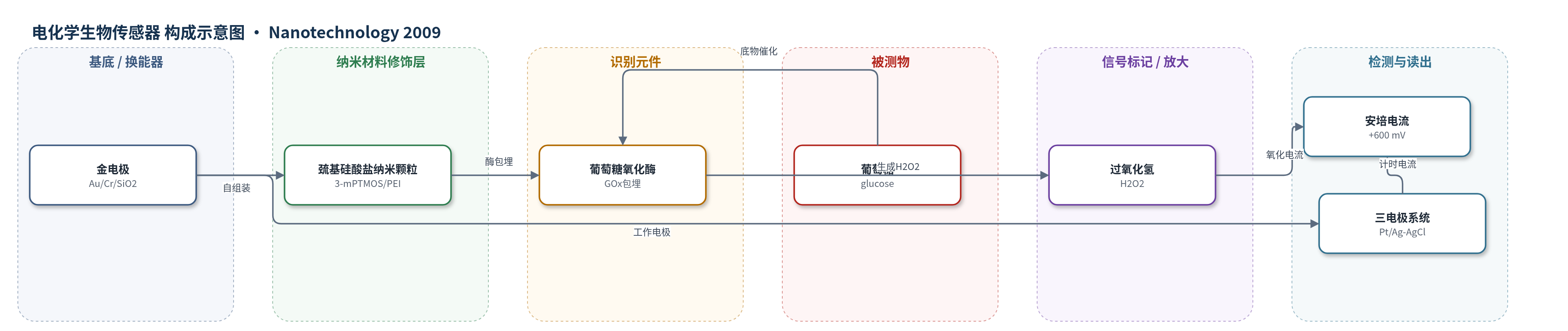
点击图片查看大图 · 依据论文自动绘制
传感器类型
电化学生物传感器
检测对象
葡萄糖(glucose, Glc);样品基质为10 mM PBS(pH 7.4)缓冲液加标
检测原理
该传感器以金电极为工作电极,巯基硅酸盐纳米颗粒通过表面游离巯基与金形成Au–S键自组装,将包埋的葡萄糖氧化酶(GOx)固定于电极界面。葡萄糖扩散至电极表面后,被GOx催化氧化为葡萄糖酸并生成过氧化氢(H2O2)。在+600 mV施加电位下,H2O2发生电化学氧化,产生与葡萄糖浓度相关的安培电流。因此,葡萄糖浓度越高,单位时间内生成的H2O2越多,氧化电流越大。该方法没有使用HCR、RCA或CRISPR-Cas等核酸放大策略,而是依靠酶催化产生H2O2实现信号转换;一锅中性包埋有助于保持酶活性,巯基化颗粒则提供可重复的金属表面固定化途径。
检测灵敏度
线性范围: up to 4 mM glucose;灵敏度: 109 nA mM−1
效应效果
作者未报告选择性、抗干扰、长期稳定性、RSD或实际样品加标回收率。表征显示无酶巯基颗粒平均直径约100–200 nm,NTA峰径153 nm、DLS峰径181 nm;包埋β-半乳糖苷酶后呈双峰分布,较大颗粒经蔗糖梯度分离后酶活性显著更高。巯基颗粒可自组装于金电极,1–10 mg/mL浓度下表面负载增加;NEM封闭巯基或无巯基TMOS颗粒均不结合,表明Au–S结合具有特异性。GOx电极在+600 mV对葡萄糖线性响应至4 mM,灵敏度109 nA mM−1,与先前数据一致。方法约30 min完成,中性室温且无氨/醇,适合构建生物传感器和生物催化表面。
传感器的构成
- 基底/换能器电极:200 nm Au/50 nm Cr/SiO2金电极,作为工作电极提供导电基底与自组装界面
- 纳米材料修饰层:巯基硅酸盐纳米颗粒(thiol-silicate nanoparticles),由3-mPTMOS与PEI缩合形成,表面游离巯基自组装固定于Au
- 识别/催化元件:葡萄糖氧化酶(GOx)包埋于巯基硅酸盐纳米颗粒内,催化葡萄糖氧化生成H2O2
- 被测物:葡萄糖(glucose, Glc),在10 mM PBS(pH 7.4)中加标
- 信号产物:过氧化氢(H2O2),在+600 mV发生电化学氧化产生安培电流
- 电化学读出:三电极系统(Pt对电极、Ag/AgCl参比电极、μAutolab-III FRA12/GPES4),计时电流法读出
中文摘要
本文报道了一种利用仿生聚合物进行一锅中性合成巯基硅酸盐纳米颗粒的新方法。该方法以3-巯基丙基三甲氧基硅烷(3-mPTMOS)为硅烷前驱体,在聚乙烯亚胺(PEI)和磷酸盐缓冲液存在下于室温、中性pH条件缩合,快速制备表面含游离巯基的纳米颗粒。由于颗粒表面带有反应性巯基,可直接通过Au–S键合自组装到金等金属表面,从而构建纳米结构生物催化或生物传感器界面。作者进一步将酶引入同一合成体系,实现酶在巯基硅酸盐纳米颗粒内的包埋。包埋β-半乳糖苷酶后,颗粒呈现双峰尺寸分布:较小峰与无酶颗粒相近,较大峰明显更大。通过蔗糖梯度离心分离两种颗粒后,比色检测表明较大颗粒含有显著更多的酶活性。由于含酶巯基纳米颗粒可被分离并保留巯基功能化表面,该方法有望用于需要催化功能化表面的多种工艺和设备,包括生物传感器和生物催化反应器。
英文摘要
A novel one-pot neutral synthesis using bioinspired polymers to fabricate thiol-nanoparticles is presented. The thiol-particles may be directly tethered to metal surfaces such as gold, allowing the production of self-assembled nanostructured biocatalytic or biosensor surfaces. This one-pot method has also been used to entrap enzymes within the thiol-nanoparticles; it is apparent that once enzyme entrapment is carried out a bimodal distribution of particles is formed, with particles of one mode being very similar in size to thiol-nanoparticles without enzyme entrapped, and particles of the other mode being much larger in size. To this end, efforts have been made to separate the two modes of particles for the sample containing enzyme and it has been observed that the larger mode thiol-nanoparticles do indeed contain significant amounts of enzyme in comparison to the smaller mode ones. As the enzyme-containing thiol-nanoparticles can now be isolated, this means that there are many future possibilities for the use of thiol-particles containing enzyme, as they may be used in a wide range of processes and devices which require catalytic functionalized surfaces, such as biosensors and biocatalytic reactors.