组成图示
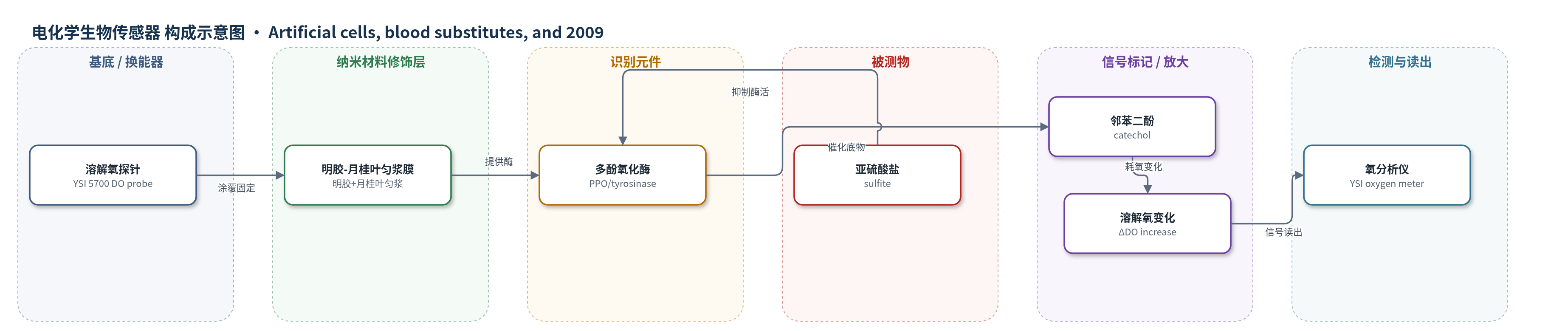
点击图片查看大图 · 依据论文自动绘制
传感器类型
电化学生物传感器
检测对象
亚硫酸盐(sulfite);样品基质:食品样品,文中实际检测泡菜水(pickle water)
检测原理
该传感器为抑制型酶生物传感器。月桂叶匀浆中的多酚氧化酶(PPO)固定在溶解氧探头膜表面。反应体系中先加入邻苯二酚,PPO 催化其氧化生成邻醌并消耗溶解氧,使 DO 下降并达到稳态。当加入亚硫酸盐后,亚硫酸盐作为还原剂/抑制剂抑制 PPO 的铜催化氧化活性,酶促耗氧速率降低,反应液中溶解氧浓度回升。溶解氧探头将 DO 变化转换为电信号,由氧分析仪记录。亚硫酸盐浓度越高,PPO 受抑制越强,ΔDO 越大,从而在 25–200 mM 范围内形成线性校准关系。
检测灵敏度
LOD: 25 mM;线性范围: 25–200 mM;R^2 = 0.9905;斜率: 0.0031(图3,ΔDO mg/L 对浓度)
效应效果
传感器在 35 °C 下孵育 5 h 后保留 70.6% 初始活性;在 pH 8.5、4 °C 下孵育 5 h 后损失 11.8% 活性;连续 15 次测量中,第 11 次仍保留 94% 初始活性,操作稳定性良好。实际泡菜水样品无需前处理即可检测,结果与酶法参考方法一致:三个样品参考值分别为 1.52、1.61、1.57 mg/mL,传感器测得均为 1.6 mg/mL,相对误差约 5.2%、0.6%、1.9%。文中未报告 RSD 与选择性/抗干扰数据。作者认为该方法简单、经济、可靠,适用于食品中亚硫酸盐检测。
传感器的构成
- 换能器/基底:YSI 5700 系列溶解氧(DO)探针,作为氧电极换能器,检测反应液中溶解氧浓度变化
- 生物活性层:月桂叶(Laurus nobilis L.)组织匀浆,提供多酚氧化酶(PPO/tyrosinase)作为识别与催化元件
- 成膜固定层:明胶(gelatin, type 3, 225 Bloom),与匀浆混合形成可涂覆膜并辅助固定生物材料
- 交联固定层:戊二醛(glutaraldehyde, 2.5% v/v),交联固定生物活性层,提高稳定性
- 反应底物:邻苯二酚(catechol),被 PPO 催化氧化并消耗 O2,形成基础耗氧信号
- 工作缓冲液:0.05 M Tris-HCl 缓冲液(pH 8.5),维持酶活性与反应环境
- 被测物:亚硫酸盐(sulfite),抑制 PPO 活性,使耗氧下降、溶解氧上升
中文摘要
亚硫酸盐是常见食品防腐剂和抗氧化剂,可防止浅色果蔬褐变并抑制发酵食品中微生物生长,但部分人群对其敏感,严重时可危及生命。本文报道一种基于月桂叶(Laurus nobilis L.)组织匀浆的电化学生物传感器,用于食品中亚硫酸盐检测。月桂叶匀浆富含多酚氧化酶(PPO,酪氨酸酶),该酶可催化邻苯二酚氧化并消耗溶解氧;亚硫酸盐作为还原剂抑制 PPO 活性,使耗氧速率下降,溶解氧浓度升高。传感器以溶解氧探头为换能器,将月桂叶匀浆与明胶混合后涂覆于探头膜表面,并用戊二醛交联固定。研究优化了温度与 pH,考察了热稳定性、pH 稳定性和操作稳定性。结果表明,传感器在亚硫酸盐一定浓度范围内呈线性响应,方法简单、经济、可靠,可用于食品样品中亚硫酸盐的快速检测。
英文摘要
Of all the food additives for which the FDA has received adverse reaction reports, the ones that most closely resemble true allergens are sulfur-based preservatives. Sulfites are used primarily as antioxidants to prevent or reduce discoloration of light-colored fruits and vegetables, such as dried apples and potatoes, and to inhibit the growth of microorganisms in fermented foods such as wine. This work aims to prepare an electrochemical biosensor based on bay leaf tissue homogenate that contains polyphenol oxidase enzyme abundantly for sulfite detection in foods. The principle of the biosensor is based on the inhibition effect of sulfites on polyphenol oxidase in the bioactive layer. Optimum conditions for the biosensor, such as temperature and pH, were investigated. Some stability parameters of the biosensor were also identified. The biosensor showed a linear calibration graph in the range of 25-100 microM sulfite. The biosensor presents a very simple, economical, reliable, and feasible method for sulfite detection in foods.