组成图示
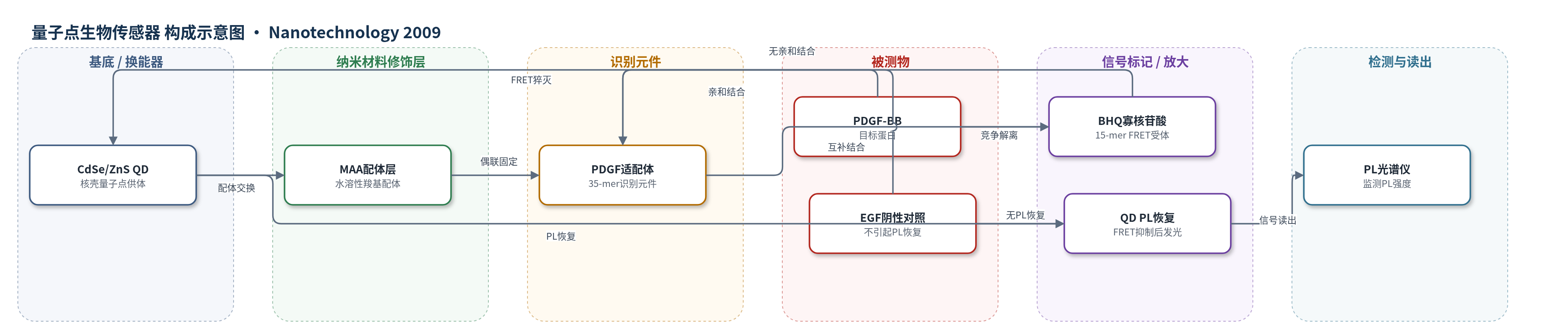
点击图片查看大图 · 依据论文自动绘制
传感器类型
量子点生物传感器
检测对象
血小板源性生长因子-BB(PDGF-BB,platelet derived growth factor-BB),样品基质为 PBS 缓冲液(pH 7.4,25 ℃)
检测原理
CdSe/ZnS QD 经 MAA 配体交换后,通过 EDC-NHS 将 5′-氨基 PDGF 适配体偶联到 QD 表面。BHQ 标记的 15-mer 寡核苷酸与 35-mer PDGF 适配体部分互补结合,使 BHQ 靠近 QD;由于 QD 发射光谱与 BHQ 吸收光谱重叠,激发 QD 后能量经 FRET 非辐射转移至 BHQ,PL 被猝灭。加入 PDGF-BB 后,PDGF-BB 与适配体亲和力(Kd ~0.1 nM)高于 BHQ 寡核苷酸,诱导适配体结合/构象变化并竞争解离 BHQ 寡核苷酸,QD 与 BHQ 距离增大,FRET 效率下降,PL 强度恢复。PL 恢复程度随 PDGF-BB 浓度增加而线性增强,通过 PL 光谱仪读取恢复强度实现定量检测。该策略以猝灭剂解离作为信号转换机制,避免依赖单一构象变化带来的弱信号。
检测灵敏度
LOD: ∼0.4 nM;线性范围: 0–1.6 nM
效应效果
该传感器在 PBS 缓冲液(25 ℃、pH 7.4)中通过 PL 恢复检测 PDGF-BB,检测限约 0.4 nM,优于先前报道的约 1.0 nM,线性范围 0–1.6 nM。选择性方面,表皮生长因子(EGF)作为结构相关但无适配体亲和力的阴性对照,在 0–1.2 nM 范围内不能引起 PL 恢复,说明 PL 恢复主要来自 PDGF-BB 与适配体的特异性结合,而非非特异性干扰。作者认为猝灭剂寡核苷酸解离策略可避免金纳米颗粒聚集不均或供受体距离不规则造成的弱信号问题,并有望扩展到其他 DNA 或蛋白的高精度传感应用。论文未报告稳定性、重现性 RSD、实际样品加标回收率或与 ELISA/HPLC/qPCR 的对比数据。
传感器的构成
- 换能器/信号源:CdSe/ZnS 核壳量子点(QD),作为 FRET 供体并产生光致发光(PL)信号
- 表面配体层:巯基乙酸(MAA),取代 TOPO 提供水溶性羧基和巯基结合位点
- 偶联试剂:EDC 与 NHS,活化 MAA 羧基并与适配体氨基形成酰胺键
- 识别元件:5′-氨基(C6)修饰 PDGF 适配体(35-mer),特异性结合 PDGF-BB
- 信号标记/猝灭元件:BHQ 标记寡核苷酸(15-mer),与适配体部分互补结合并作为 FRET 受体猝灭 QD PL
中文摘要
本研究利用量子点(QD)供体与黑孔猝灭剂(BHQ)受体之间荧光共振能量转移(FRET)的变化,实现了对血小板源性生长因子(PDGF)-BB的高灵敏、高特异检测。通过配体交换法成功合成 CdSe/ZnS QD/巯基乙酸(MAA)/PDGF 适配体生物偶联物。将携带 BHQ 且与 PDGF 适配体部分序列互补的寡核苷酸结合到适配体上,通过 FRET 使 QD 光致发光(PL)猝灭。加入目标 PDGF-BB 后,由于其对适配体的亲和力高于猝灭剂寡核苷酸,BHQ 寡核苷酸从适配体上解离,QD 的 PL 恢复。传感器检测限约 0.4 nM,PL 强度-浓度曲线在 1.6 nM 内保持线性。表皮生长因子(EGF)作为阴性对照不能引起 PL 恢复,表明该生物传感器具有良好的选择性。
英文摘要
High-sensitivity, high-specificity detection of platelet derived growth factor (PDGF)-BB was realized using the change in fluorescence resonance energy transfer (FRET) occurring between quantum dot (QD) donors and black hole quencher (BHQ) acceptors. CdSe/ZnS QD/mercaptoacetic acid (MAA)/PDGF aptamer bioconjugates were successfully synthesized using ligand exchange. Black hole quencher (BHQ)-bearing oligonucleotide molecules showing partial sequence matching to PDGF aptamer were attached to PDGF aptamers and photoluminescence (PL) quenching was obtained through FRET. By adding target PDGF-BB to the bioconjugates containing BHQs, PL recovery was detected due to detachment of BHQ-bearing oligonucleotide from the PDGF aptamer as a result of the difference in affinity to the PDGF aptamer. The detection limit of the sensor was approximately 0.4 nM and the linearity was maintained up to 1.6 nM in the PL intensity versus concentration curve. Measurement of PL recovery was suggested as a strong tool for high-sensitivity detection of PDGF-BB. Epidermal growth factor (EGF), the negative control molecule, did not contribute to PL recovery due to lack of binding affinity to the PDGF aptamers, which demonstrates the selectivity of the biosensor.