组成图示
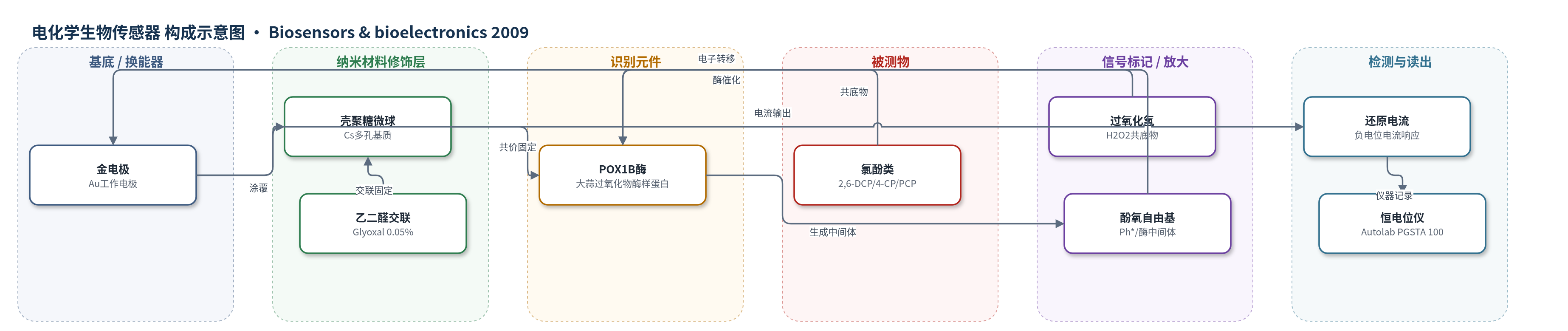
点击图片查看大图 · 依据论文自动绘制
传感器类型
电化学生物传感器
检测对象
2,6-二氯酚(2,6-dichlorophenol, 2,6-DCP)、4-氯酚(4-chlorophenol, 4-CP)、五氯酚(pentachlorophenol, PCP);样品基质:实验在PBS缓冲液中进行,应用目标为环境水样/废水
检测原理
POX1B固定于壳聚糖微球中,血红素可直接与金电极电子转移(E0=147 mV vs. SCE)。在含H2O2的PBS中,POX1B先与H2O2反应生成Compound I,Compound I氧化酚(Ph)生成Compound II和酚氧自由基Ph*,Compound II再被酚还原再生酶。电极在-0.35或-0.48 V vs. SCE将Ph*及氧化酶中间体还原,产生还原电流。酚浓度越高,生成的自由基/中间体越多,电流越大,呈线性响应。该过程无需介质,酶催化循环实现信号放大。
检测灵敏度
LOD: 2,6-二氯酚 1×10^-8 mol L^-1;4-氯酚和五氯酚 1×10^-12 mol L^-1;线性范围: 2,6-二氯酚 1×10^-8–2×10^-5 mol L^-1;4-氯酚和五氯酚 1×10^-12–2×10^-5 mol L^-1;灵敏度: 2,6-二氯酚 1.5×10^6 μA L mol^-1;4-氯酚 1.9×10^9 μA L mol^-1;五氯酚 0.9×10^9 μA L mol^-1
效应效果
传感器无介质工作,壳聚糖空白对照对H2O2和2,6-二氯酚无响应。温度15–30 ℃响应线性增加(回归因子0.99),40 ℃达平台;pH 5.8–7.4无明显影响。RSD为1.5%、5%、3.6%(2,6-二氯酚、4-氯酚、五氯酚)。4 ℃ PBS保存3个月仍保持全部原始响应,无需再生;游离POX1B 3个月仅损失10%。响应时间<1 s。灵敏度高于石墨-聚四氟乙烯-GOD-HRP电极(4-氯酚4.1×10^4、五氯酚2.4×10^3 μA L mol^-1),Km,app更低(4-氯酚0.42 μM、五氯酚0.11 μM)。作者认为其低成本、可重复,适合废水酚类原位实时监测。
传感器的构成
- 工作电极:金电极(Au),作为传感换能器
- 修饰层:壳聚糖微球(chitosan microspheres, Cs),多孔聚合物基质,固定化POX1B并促进底物扩散
- 交联层:乙二醛(glyoxal, 0.05%),低浓度交联壳聚糖微球,增强稳定性并避免酶失活
- 识别/催化元件:POX1B(大蒜过氧化物酶样蛋白),共价固定于壳聚糖,催化酚与H2O2反应
- 共底物:过氧化氢(H2O2, 1×10^-5 mol L^-1),驱动POX1B催化氧化酚类
- 信号读出:恒电位计时电流/循环伏安(Autolab PGSTA 100),在负电位检测还原电流
中文摘要
本研究报道了一种基于从大蒜中纯化得到的新型蛋白POX1B的酚类化合物监测生物传感器。该蛋白具有类似过氧化物酶的生化性质。酶通过共价连接固定化于壳聚糖微球中。采用傅里叶变换红外光谱、扫描电子显微镜和循环伏安法对传感器进行表征。FT-IR证明POX1B共价结合到壳聚糖,SEM显示POX1B在壳聚糖微球中高分散。壳聚糖中POX1B的氧化还原电位为147 mV vs. SCE,明显高于文献中辣根过氧化物酶体系,表明其具有优异的直接电子转移行为。所得无介质POX1B生物传感器对氯酚衍生物在10 pM至10 μM宽范围内表现出电催化活性,并对2,6-二氯酚、4-氯酚和五氯酚具有较高灵敏度。4-氯酚的检出限为1 pM,表观米氏常数Km,app为0.42 μM,电化学响应时间小于1 s。该传感器可用于环境废水中酚类污染物的快速直接监测。
英文摘要
A biosensor for the monitoring of phenolic compounds based on a new protein named POX(1B) purified from garlic which demonstrates similar biochemical properties to peroxidase is investigated. The enzyme was immobilized into chitosan microspheres with covalent link. The properties of the biosensor were analyzed with Fourier transform-infrared spectroscopy (FT-IR), scanning electron microscopy (SEM) and cyclic voltammetry (CV). FT-IR demonstrates the covalent attachment of POX(1B) into chitosan and SEM shows high dispersion of the POX(1B) into the chitosan microspheres. The redox potential of POX(1B) in chitosan is 147 mV vs. SCE, which is much higher than reported works using HRP, demonstrating excellent direct electrochemical behaviour of the POX(1B). The electrocatalytic activity of the obtained biosensor towards chlorophenols derivatives in a large range from 10 pM to 10 microM was demonstrated. The mediator free POX(1B)-based biosensor exhibited high sensitivity towards 2,6-dichlorophenol, 4-chlorophenol and pentachlorophenol. A detection limit of 1 pM in the case of 4-chlorophenol was demonstrated with kinetic constant K(m,app) of 0.42 microM with high rapidity of electrochemical response of the biosensor of 1 s.