组成图示
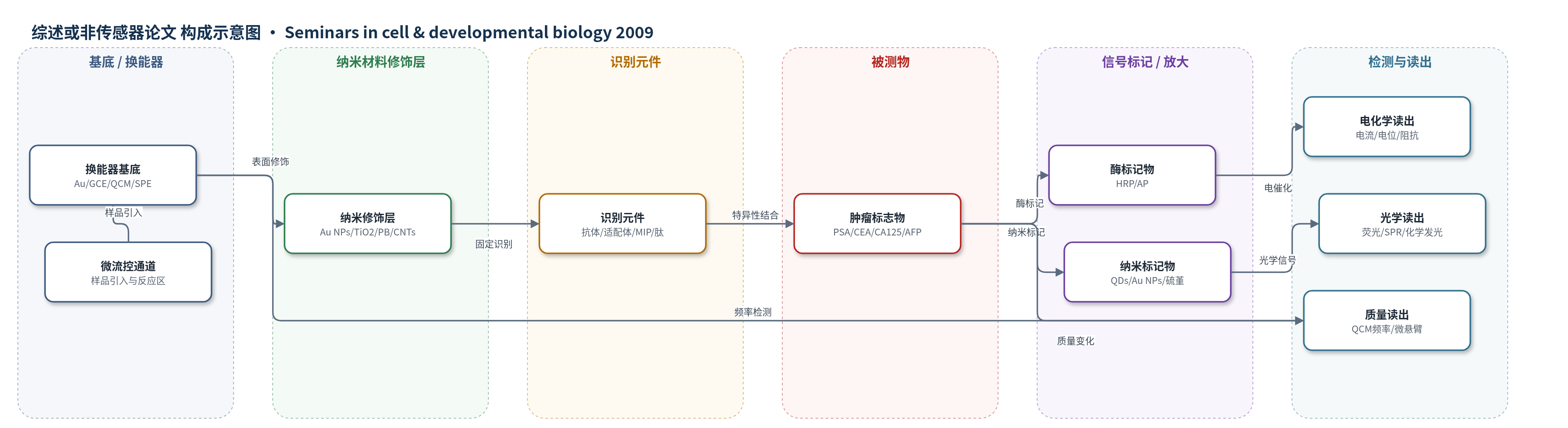
点击图片查看大图 · 依据论文自动绘制
传感器类型
综述或非传感器论文
检测对象
前列腺特异性抗原(PSA)、癌胚抗原(CEA)、糖类抗原125(CA125)、甲胎蛋白(AFP)、人绒毛膜促性腺激素(hCG)、铁蛋白(ferritin)、糖类抗原19-9(CA19-9)、糖类抗原15-3(CA15-3);样品基质:血清、血液、尿液、其他体液及组织/细胞样品
检测原理
本文未限定单一传感器,其原理可概括为:抗体、适配体、MIP或肽等识别元件固定在电、光或质量换能器表面,与肿瘤标志物发生特异性结合。电化学体系中,HRP/AP标记的抗体催化底物生成电活性产物,引起电流、电位或阻抗变化;无标记体系则通过DNA杂交、界面电容/导电性变化或金纳米颗粒修饰改变法拉第阻抗。光学体系中,结合事件改变荧光、SPR或化学发光信号;质量体系中,结合增重使QCM频率下降或微悬臂弯曲。纳米材料如Au NPs、QDs、CNTs和导电聚合物纳米线可放大信号、提高信噪比并支持多重检测,信号强度通常随标志物浓度增加而增强。
检测灵敏度
综述未报道单一传感器;文中列举的代表性数值:LOD: 1 ng ml−1(AFP and CEA);LOD: 0.4 ng ml−1(CEA);LOD: 0.25 ng l−1(PSA);LOD: 0.15 ng ml−1(PSA);LOD: 300 fM(PSA);LOD: 0.2 U ml−1(CA19-9);LOD: 0.4 U ml−1(CA125);线性范围: 5–500 ng ml−1(AFP);线性范围: 0.6–17 ng ml−1, 17–200 ng ml−1(CEA);线性范围: 0.5–3.0 ng ml−1, 3.0–120 ng ml−1(CEA);线性范围: 2–14 U ml−1(CA125);线性范围: 0.1–100 ng ml−1(ferritin);线性范围: 25–1500 U ml−1(hCG);线性范围: 0.2–60 μg ml−1(PSA)
效应效果
本文未报道单一传感器的RSD、回收率或抗干扰实验,无统一选择性/稳定性数据。综述强调生物传感器相比活检和ELISA更快速、便携、低成本,可现场多重检测;文中LOD可达0.15 ng ml−1(PSA)、0.4 ng ml−1(CEA)、1 ng ml−1(AFP/CEA)。抗体选择性高,但单克隆稳定性与成本限制储存;MIP和适配体更稳定,但特异性/灵敏度通常低于抗体。Au NPs、QDs、CNTs和导电聚合物纳米线可增强信号并支持多重分析;微流控有助于POC。未来需解决多重阵列、背景、样品处理与商业化问题。
传感器的构成
- 基底/换能器:金电极(Au)、玻碳电极(GCE)、石英晶体(QCM)、微悬臂、丝网印刷电极(SPE),承担电、光或质量信号转换
- 纳米修饰层:金纳米颗粒(Au NPs)、二氧化钛溶胶-凝胶(TiO2 sol-gel)、普鲁士蓝(PB)、碳纳米管(CNTs)、导电聚合物纳米线,用于固定识别元件或增强信号
- 识别元件:单克隆/多克隆抗体(mAb/pAb)、适配体(aptamer)、分子印迹聚合物(MIP)、噬菌体展示肽,特异性识别肿瘤标志物
- 信号标记物:辣根过氧化物酶(HRP)、碱性磷酸酶(AP)、量子点(QDs)、胶体金纳米颗粒(Au NPs)、硫堇(thionine),将识别事件转换为电或光信号
- 样品处理层:微流控芯片、侧流层析(lateral flow)、膜分离系统,用于血液、尿液等样品引入与反应
- 读出系统:电化学工作站、SPR仪、QCM仪、荧光/化学发光检测仪,输出电流、电位、阻抗、频率或光信号
中文摘要
即时检测诊断装置为癌症标志物的快速、灵敏检测与分析提供了可行选择。随着全球癌症诊断病例增加以及因疾病发现过晚导致的死亡上升,生物传感器可在癌症早期诊断中发挥重要作用。基因组学和蛋白质组学等新分子工具正被用于研究患者分子谱,并结合生物信息学产生新数据,以阐明新的疾病生物标志物。与许多疾病一样,寻找仅与某一类疾病相关且特异、灵敏的标志物较为困难;此外,生物标志物在体液中的水平会随不同疾病状态和分期而变化。因此,癌症诊断通常需要评估多种分子标志物,包括蛋白质、肽、基因标志物过表达/低表达以及基因突变。本综述概述了当前可用的生物传感器技术、癌症标志物诊断中正在研发和研究的领域,并展望了该技术的未来前景。
英文摘要
Point-of-care diagnostic devices present a viable option for the rapid and sensitive detection and analysis of cancer markers. With the growing number of cancer cases being diagnosed worldwide and the increased number of fatalities due to late disease detection, biosensors can play an important role in the early diagnosis of cancer. Molecular profiles of patients are being increasingly studied using new molecular tools such as genomic and proteomic techniques. These methods combined with bioinformatics tools are generating new data which is being employed in the elucidation of new disease biomarkers. As with many disease conditions finding specific and sensitive markers that are associated with only one type of the disease can be difficult. In addition to this, the level of the biomarkers in biological fluids can vary depending on different disease conditions and stages. A number of molecular markers are therefore usually evaluated for cancer diagnosis and these can include proteins, peptides, over/under expression of gene markers and gene mutations. This review provides an overview of the biosensor technology available today, areas which are currently being developed and researched for cancer markers diagnosis-and a consideration of future prospects for the technology.