组成图示
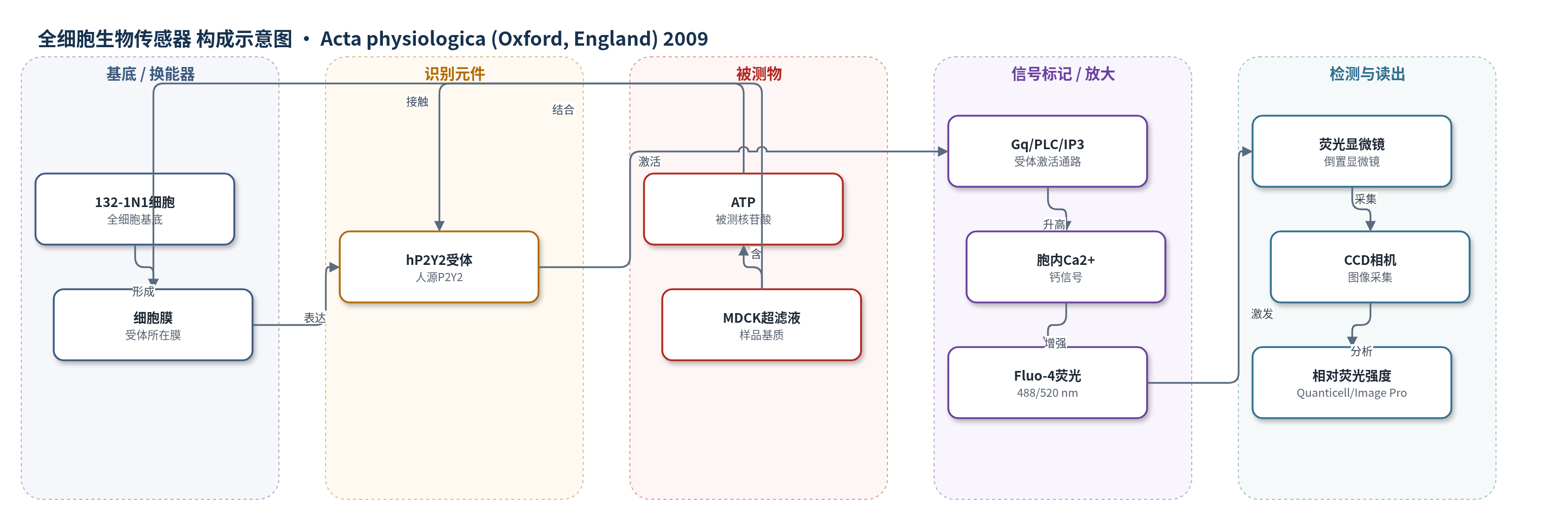
点击图片查看大图 · 依据论文自动绘制
传感器类型
全细胞生物传感器
检测对象
ATP(腺苷三磷酸,ATP);样品基质:MDCK细胞超滤液/灌流液(含流动诱导释放的核苷酸)
检测原理
132-1N1星形胶质瘤细胞经转染表达人源P2Y2受体(hP2Y2),作为全细胞ATP生物传感器。当含ATP的MDCK细胞超滤液接触细胞时,ATP与hP2Y2结合,激活Gq/PLC/IP3通路,引起内质网钙释放和/或钙内流,使胞内Ca2+浓度升高。细胞预装载Fluo-4-AM,Ca2+结合Fluo-4后荧光增强;488 nm激发、>520 nm发射的荧光强度随ATP浓度增加而升高。通过浓度-响应曲线可将超滤液诱导的荧光变化粗定量为ATP浓度(约60 nM)。野生型132-1N1细胞不表达P2受体,对ATP无响应,用作阴性对照。
检测灵敏度
灵敏度: 10^-8 M(原文称对ATP高度敏感);超滤液 ATP 粗定量: ~60 nM
效应效果
该全细胞ATP生物传感器对ATP具有受体依赖性选择性:转染hP2Y2的132-1N1细胞对ATP产生钙荧光响应,野生型132-1N1细胞对MDCK超滤液无响应,但可正常响应carbachol,提示背景低。100 µM ATP作为阳性对照。MDCK超滤液诱导的荧光变化经浓度-响应曲线粗定量为约60 nM ATP。apyrase和suramin可消除下游报告细胞流动诱导钙反应,ATP清除剂/P2拮抗剂使纤毛依赖流动反应降低约55%,支持信号来自核苷酸/P2受体。作者认为该传感器足以检测纤毛流动诱导的ATP释放,并提示核苷酸信号可放大肾小管机械响应。
传感器的构成
- 全细胞基底:132-1N1 astrocytoma cells(作为ATP生物传感器细胞,提供细胞膜与胞内钙信号转导)
- 识别元件:human P2Y2 receptor (hP2Y2)(转染表达于132-1N1细胞膜,识别ATP)
- 信号标记物:Fluo-4-AM(钙指示剂,胞内Ca2+升高引起荧光增强)
- 读出装置:倒置荧光显微镜、CCD相机、Quanticell/Image Pro(488 nm激发、>520 nm发射,记录相对荧光强度)
中文摘要
目的:灌流液流动变化可升高肾上皮细胞内钙浓度,培养肾上皮细胞需初级纤毛感知细微流动变化;在灌流肾小管中该流动反应由核苷酸经P2Y2受体介导,但机械应力作用于初级纤毛是否释放核苷酸尚不清楚。本研究检测纤毛依赖的流动反应中是否释放核苷酸并参与流动诱导的钙信号。方法:MDCK细胞装载Fluo-4-AM,在37℃半开放单室或封闭双室灌流系统中观察。结果:ATP清除剂和P2受体拮抗剂使纤毛依赖流动反应降低约55%;亚阈值ATP使肾上皮对流动变化更敏感;流动增加使超滤液ATP浓度短暂升高,由生物传感器细胞测得。以无纤毛非融合MDCK细胞作为报告细胞,其本身不响应流动;将融合有纤毛细胞置于上游后,下游非融合细胞出现流动诱导钙升高,该反应可被apyrase和suramin消除。结论:初级纤毛感知细微流动变化可诱导核苷酸释放,并放大上皮细胞钙信号。
英文摘要
AIM: Changes in perfusate flow produce increases in [Ca(2+)](i) in renal epithelial cells. Cultured renal epithelia require primary cilia to sense subtle changes in flow. In perfused kidney tubules this flow response is caused by nucleotide signalling via P2Y(2) receptors. It is, however, not known whether nucleotides are released by mechanical stress applied to renal primary cilia. Here we investigate whether nucleotides are released during the cilium-dependent flow response and contribute to the flow-induced, cilium-dependent [Ca(2+)](i) signal.
METHODS: MDCK cells loaded with Fluo-4-AM were observed at 37 degrees C in semi-open single or closed-double perfusion chambers.
RESULTS: Our data suggest a purinergic component of the cilium-dependent flow-response: (1) ATP scavengers and P2 receptor antagonists reduced (55%) the cilium-dependent flow-response; (2) ATP added at subthreshold concentration sensitized the renal epithelia to flow changes; (3) increases in fluid flow transiently enhanced the ATP concentration in the superfusate (measured by biosensor-cells). To test if nucleotides were released in sufficient quantities to stimulate renal epithelia we used non-confluent MDCK cells without cilia as reporter cells. We confirmed that non-confluent cells do not respond to changes in fluid flow. Placing confluent, ciliated cells upstream in the in-flow path of the non-confluent cells made them responsive to fluid flow changes. This phenomenon was not observed if either non-confluent or de-ciliated confluent cells were placed upstream. The [Ca(2+)](i)-response in the non-confluent cells with ciliated cells upstream was abolished by apyrase and suramin.
CONCLUSION: This suggests that subtle flow changes sensed by the primary cilium induces nucleotide release, which amplifies the epithelial [Ca(2+)](i)-response.