组成图示
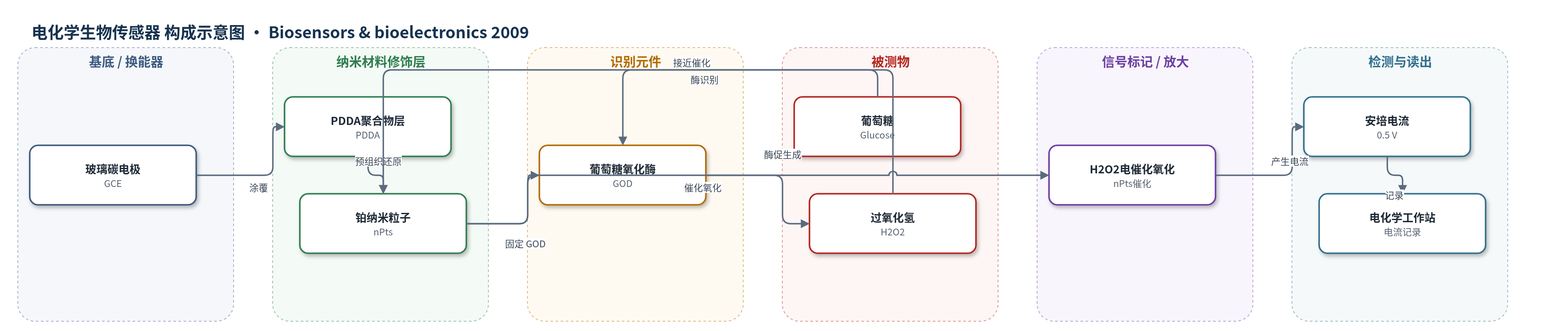
点击图片查看大图 · 依据论文自动绘制
传感器类型
电化学生物传感器
检测对象
过氧化氢(H2O2,磷酸盐缓冲液 PBS,pH 7.2)、葡萄糖(Glucose,氧饱和 PBS,中性 pH)
检测原理
该传感器以玻璃碳电极为基底,PDDA通过静电作用预组织H2PtCl6前驱体,再经NaBH4还原形成铂纳米粒子(nPts)集合体。对于H2O2直接检测,H2O2在0.5 V下于nPts表面发生电催化氧化,电子经GCE导出形成安培电流;电流随H2O2浓度升高而增大,呈线性响应。nPts的高比表面和集合体效应降低氧化过电位、增强信噪比,并避免多晶Pt因表面氧化物失活。对于葡萄糖检测,GOD识别并催化葡萄糖氧化生成H2O2,生成的H2O2再被nPts电催化氧化,从而将葡萄糖浓度转换为电流信号。
检测灵敏度
H2O2: LOD: 0.5 nM (S/N = 5);线性范围: 0.5 nM to 4 mM;灵敏度: 9.15 μA/mM。Glucose: LOD: 90 nM (S/N = 3);灵敏度: 0.0187 μA/μM;R^2 = 0.99;KappM: 212 μM。
效应效果
该电极在0.5 V下对H2O2的灵敏度为9.15 μA/mM,线性范围达0.5 nM–4 mM,检测限0.5 nM(S/N=5),检测电位比其他Pt纳米粒子电极低50–100 mV,且LOD显著低于文献报道的42、50、25和7.5 nM。流注入重复注入响应可重复,电极未观察到失活;储存1周后前5天电流稳定,5天后电流下降22%,长期操作无可见变化。葡萄糖生物传感器灵敏度为0.0187 μA/μM,R^2=0.99,LOD为90 nM(S/N=3),KappM为212 μM,可在中性pH微摩尔水平检测葡萄糖。原文未报告选择性、抗干扰、RSD及实际样品加标回收率。
传感器的构成
- 工作电极基底:玻璃碳电极(GCE),提供导电换能器与电子传导通道
- 聚合物修饰层:聚二烯丙基二甲基氯化铵(PDDA),阳离子聚合物,通过静电作用预组织H2PtCl6前驱体
- 纳米材料修饰层:铂纳米粒子(nPts),由H2PtCl6经NaBH4化学还原生成,平均粒径约17 nm,提供H2O2电催化氧化活性位点
- 识别元件(葡萄糖传感):葡萄糖氧化酶(GOD),催化葡萄糖氧化并生成H2O2
中文摘要
本文报道了一种基于聚合物支撑铂纳米粒子(nPts)的高灵敏电化学平台,用于在无氧化还原介质和酶参与下对过氧化氢(H2O2)进行亚纳摩尔水平的安培检测。铂纳米粒子通过化学还原预先组织在电极表面的前驱体制备,并经场发射扫描电镜、X射线衍射、光谱和电化学方法表征。阳离子聚合物聚二烯丙基二甲基氯化铵(PDDA)通过静电作用辅助金属前驱体预组织。电极表面铂纳米粒子平均粒径约17 nm,对H2O2氧化表现出优异电催化活性,在较低正电位下实现H2O2氧化。与多晶铂电极不同,该纳米粒子电极不易因表面氧化物及溶液中其他物种而失活,且粒子负载量可调控电催化活性。电极灵敏度为9.15 μA/mM,线性响应可达3 mM;在中性溶液流体力学条件下可检测0.5 nM(S/N=5)的H2O2,并具有良好的稳定性。其优异性能归因于铂纳米粒子的高催化活性及纳米粒子集合体行为。作者进一步以葡萄糖氧化酶(GOD)为模型,展示了该平台在中性pH下微摩尔水平葡萄糖安培生物传感的应用。
英文摘要
Highly sensitive electrochemical platform based on polymer supported Pt nanoparticles (nPts) for the amperometric sensing of H(2)O(2) at sub-nanomolar level without any redox mediator or enzyme is developed. The nPts are generated by the chemical reduction of precursor pre-organized on the electrode surface and characterized by field emission scanning electron microscopy, X-ray diffraction, spectral and electrochemical measurements. The cationic polymer poly(diallyldimethylammonium) chloride was used to assist the pre-organization of metal precursor. nPts on the electrode surface have an average size of 17 nm. The nanoparticles show excellent electrocatalytic activity towards oxidation of H(2)O(2) at less positive potential than the polycrystalline Pt electrode. Unlike the polycrystalline Pt electrode, the nanoparticle-based electrode does not undergo deactivation by surface oxides and other species in solution. Particle loading on the electrode surface controls the electrocatalytic activity. The nanoparticle-based electrode is highly sensitive (9.15 microA/mM) and display linear response up to 3 mM. It could detect 0.5 nM (S/N=5) of H(2)O(2) under hydrodynamic condition in neutral solution and the electrode is highly stable. The detection limit achieved is significantly lower than the other nanoparticle-based electrodes. The excellent performance of the electrode is ascribed to the good catalytic activity of the particle and ensemble behavior of the nanoparticle-modified electrode. The analytical performance of the electrode in the development of glucose biosensor is demonstrated. The biosensor is used for the sensing of glucose in the micromolar level in neutral pH.