组成图示
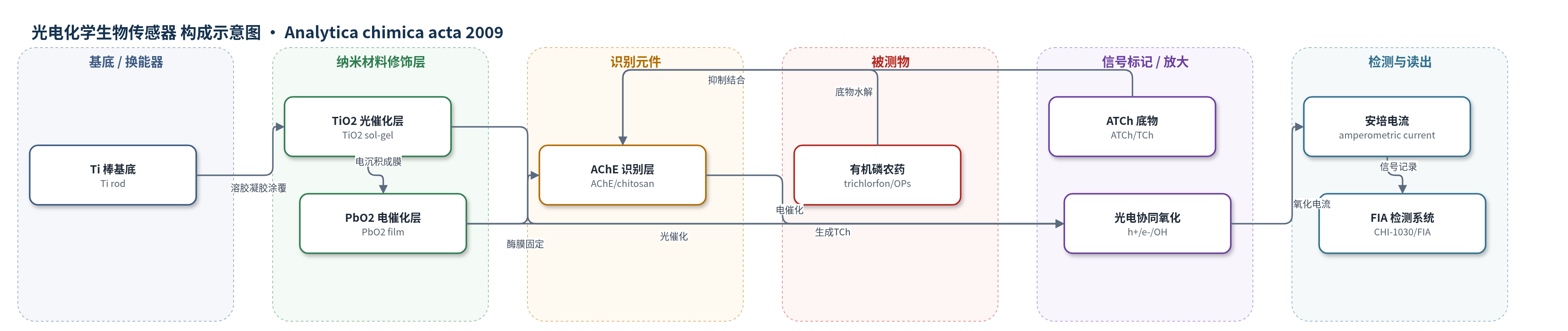
点击图片查看大图 · 依据论文自动绘制
传感器类型
光电化学生物传感器
检测对象
有机磷农药(organophosphorus pesticides, OPs;以三氯fon trichlorfon 为例);样品基质:PBS 加标溶液及蔬菜(芹菜、花椰菜、韭葱)实际样品。
检测原理
AChE 催化 ATCh 水解生成 TCh 和乙酸;TCh 在 PbO2/TiO2/Ti 工作电极表面被氧化。UV 照射 TiO2 产生光生电子-空穴对,空穴氧化吸附水生成 •OH,并与 PbO2 在 0.30 V 下的电催化氧化共同形成光电协同催化,降低 TCh 氧化电位并放大氧化电流。未受抑制时,注入 ATCh 产生初始电流 A0;OPs 与 AChE 结合使其活性受抑制,TCh 生成减少,后续注入 ATCh 的电流 Ai 降低。抑制率随 OPs 浓度和孵育时间增加,因此安培电流变化与 OPs 浓度呈负相关。光电协同催化提高灵敏度,实现低 LOD。
检测灵敏度
LOD: 0.1 nM;线性范围: 0.01-20 μM;KappM: 1.34 mM;R^2 = 0.9969(Michaelis-Menten);GC 对比: y = 1.1604x - 0.0280, r2 = 0.9964;实际样品: y = 1.1075x - 2.2397, R2 = 0.9998
效应效果
KappM 为 1.34 mM。传感器在 0.30 V(vs. SCE)工作,较常见安培 OPs 传感器低数百毫伏,抗干扰较好:0.1 μM 敌敌畏、甲胺磷、对硫磷及 0.1 M NO3-、SO42- 下电流保持 95-106%。与 GC 法比较 0.05-1.0 μM 三氯fon,y=1.1604x-0.0280,r2=0.9964。芹菜、花椰菜、韭葱加标 200-1000 nM,结果低约 10%,y=1.1075x-2.2397,R2=0.9998。连续 9 次 RSD 4.92%;25 次后保留 93% 活性,4 ℃ 保存 5 个月保留 90%。PAM/ATCh 可再生酶。
传感器的构成
- 基底电极:Ti 棒(Ti rod)作为工作电极基底与导电支撑。
- 光催化修饰层:TiO2 纳米颗粒溶胶凝胶膜(TiO2 sol-gel,粒径约 50 nm),提供 UV 光催化活性。
- 电催化修饰层:PbO2 纳米颗粒膜(PbO2,粒径约 100 nm),提供硫胆碱电催化氧化。
- 识别元件:乙酰胆碱酯酶(AChE,electric eel AChE)滴涂固定,催化 ATCh 水解。
- 酶固定膜:壳聚糖(chitosan,1.0 mg/mL)与 AChE 混合成膜,增强固定与凝胶化。
- 信号底物:乙酰硫胆碱(ATCh)注入后水解为硫胆碱(TCh),TCh 被氧化产生安培电流。
- 三电极检测单元:SCE 参比电极与 Pt 对电极,配合工作电极完成安培检测。
- 光激发单元:12 W 石英 UV 灯(λmax=253.7 nm)与石英窗光化学池,激发 TiO2 产生光生载流子。
中文摘要
本研究开发了一种基于光电协同催化的高灵敏安培生物传感器,用于流动注射分析系统中有机磷农药的检测。乙酰胆碱酯酶(AChE)通过吸附法固定于纳米结构 PbO2/TiO2/Ti 上,该结构同时作为工作电极。该策略可有效催化硫胆碱的氧化反应,使 AChE/PbO2/TiO2/Ti 生物传感器在 0.30 V(vs. SCE)下检测底物,电位比已报道方法低数百毫伏。作者制备并研究了 PbO2/TiO2/Ti 和 TiO2/Ti 电极,并用原子力显微镜表征。优化影响因素后,所得流动系统具有快速、灵敏、稳定的响应。表观 Michaelis-Menten 常数 KappM 为 1.34 mM。对三氯fon 的线性抑制响应范围为 0.01-20 μM,检出限为 0.1 nM。该生物传感器结果与色谱法高度一致,并成功用于实际样品检测。
英文摘要
In this study, a highly sensitive amperometric biosensor based on photoelectro-synergistic catalysis for detecting organophosphorus pesticides (OPs) in flow-injection analysis (FIA) system has been developed. The acetylcholinesterase enzyme (AChE) was immobilized by adsorption into the nanostructured PbO2/TiO2/Ti, which also acted as the working electrode. This strategy was found to catalyze the oxidative reaction of thiocholine effectively, make the AChE/PbO2/TiO2/Ti biosensor detect the substrate at 0.30 V (vs. SCE), hundreds milli-volts lower than others reported. PbO2/TiO2/Ti and TiO2/Ti electrodes were prepared and investigated with atomic force microscope (AFM). Factors influencing the performance were optimized. The resulting flow system offered a fast, sensitive, and stable response. A value of 1.34 mM for the apparent Michaelis-Menten constant (K(M)(app)) was obtained. A wide linear inhibition response for trichlorfon was observed in the range of 0.01-20 microM with the detection limit of 0.1 nM. The results using this biosensor agreed very well with chromatographic method and we also examined the real samples successfully in this work.