组成图示
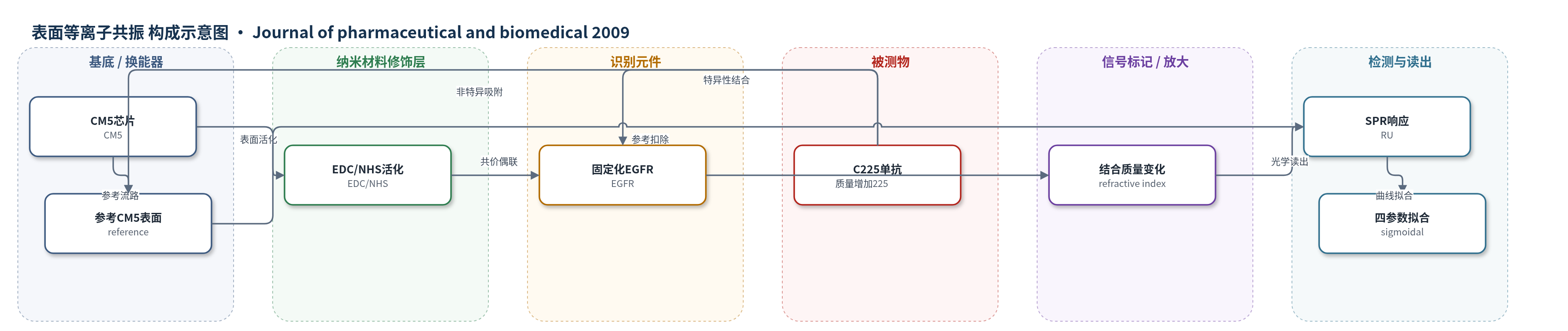
点击图片查看大图 · 依据论文自动绘制
传感器类型
表面等离子共振(SPR)生物传感器
检测对象
西妥昔单抗(Cetuximab, C225);样品基质:猴血清(monkey serum,20% 猴血清稀释样品)
检测原理
CM5 芯片表面经 EDC/NHS 活化后,通过胺偶联将 EGFR 共价固定,形成识别层。猴血清中未标记 C225 在流动相中流过芯片时,与固定化 EGFR 特异性结合,使传感器表面附近溶液质量浓度和折射率发生变化,导致 SPR 共振条件改变,Biacore 3000 以响应单位(RU)实时读出。参考流路扣除非特异吸附,净响应随 C225 浓度升高而增大,并用四参数 sigmoidal 模型拟合。检测无需标记或酶放大,信号直接来自抗原–抗体结合质量;测定后用 10 mM HCl + 1 M NaCl 再生表面。
检测灵敏度
LOD: 0.05 μg/mL(原文报告为定量下限);线性范围: 0.05–50 μg/mL(原文为可靠响应范围)
效应效果
方法批内 CV 为 3.20%–8.89%,批间 CV 为 5.93%–11.11%;批内准确度 92%–107.52%,批间准确度 90%–106.88%。定量下限 0.05 μg/mL 的准确度为 99.14%,CV 为 1.8%。固定化 EGFR 经 100 次再生后准确度 98.40%、CV 0.69%,结合能力变化小于 5%。50% 人血清、50% 大鼠血清、抗 CD20 单抗、人 γ-球蛋白和 HER2 抗体均不干扰,测定值接近 5 μg/mL,CV 3.7%–11.8%,准确度 90%–106%。作者认为该方法无需标记、样品用量少、可实时测定,灵敏度与 ELISA 相当,是首次用光学生物传感器定量猴血清 C225,并支持恒河猴非线性药代动力学研究。
传感器的构成
- 基底/换能器:CM5 传感器芯片(CM5,羧甲基葡聚糖基质)与 Biacore 3000 光学 SPR 换能器,提供表面等离子共振信号读出
- 活化层:EDC/NHS 胺偶联试剂,活化 CM5 表面羧基以形成氨基反应位点
- 识别元件:表皮生长因子受体 EGFR(170 kD),共价偶联于芯片表面,特异性结合 C225
- 封闭剂:1 M 乙醇胺(pH 8.5),封闭未反应位点,降低非特异结合
- 参考表面:未偶联 EGFR 的 CM5 参考流路,用于扣除非特异吸附与基线漂移
- 运行介质:HBS 缓冲液(10 mM HEPES、0.15 M NaCl、3.4 mM EDTA、0.05% P-20)及含 1 mg/mL 羧甲基葡聚糖的样品稀释液,维持流动与样品稳定
- 再生液:10 mM HCl + 1 M NaCl,洗脱 C225 并恢复 EGFR 结合能力
中文摘要
本研究开发并验证了一种基于表面等离子共振(SPR)的猴血清中 cetuximab(C225)定量方法。将未标记抗体样品注入固定有表皮生长因子受体(EGFR)的传感器表面,通过 SPR 响应准确测定 C225 浓度。方法在猴血清中的可靠响应范围为 0.05–50 μg/mL,可用四参数 sigmoidal 模型拟合;固定化 EGFR 室温下至少耐受 100 次再生。批内和批间 CV 分别为 3.20%–8.89% 和 5.93%–11.11%,准确度分别为 92%–107.52% 和 90%–106.88%。50% 人血清、50% 大鼠血清、抗 CD20 单抗、人 γ-球蛋白和 HER2 抗体不干扰测定。这是首次用光学生物传感器定量猴血清 C225。方法用于恒河猴单次静脉滴注 C225 药代动力学:7.5、24 和 75 mg/kg 剂量下,Cmax 为 168±28 至 1624±113 μg/mL,AUC0–∞ 为 15739±1059 至 295017±44533 μg·h/mL,t1/2 为 2.7±0.7 至 6.7±0.1 h,呈非线性药代动力学。
英文摘要
A novel assay method has been developed and validated, using surface plasmon resonance (SPR), for quantitation of cetuximab (C225) in monkey serum. By injecting non-labeled antibody samples onto a biosensor surface on which epidermal growth factor receptor (EGFR) was immobilized, the concentration of C225 can be accurately measured. This assay has a range of reliable response from 0.05 to 50 microg/ml C225 in monkey serum, which was well fitted with a sigmoidal model. The immobilized EGFR was found to be stable for at least 100 regeneration cycles at room temperature. Intra- and inter-assay CVs ranged from 3.20% to 8.89% and from 5.93% to 11.11%, accuracy from 92% to 107.52% and from 90% to 106.88%, respectively. Matrices such as 50% human serum, 50% Sprague Dawley rat serum, chimeric recombinant anti-CD20 monoclonal antibody, human gamma-globulin and chimeric recombinant her2 antibody did not interfere with C225 analysis on the sensor surface. This is the first report on the quantitation of C225 in monkey serum by an optical biosensor technology. This method was used to characterize the pharmacokinetics of C225 in rhesus monkeys. After a single-dose of intravenous infusion administration of 7.5, 24 and 75 microg/kg, average C(max) ranged from 168+/-28 to 1624+/-113 microg/ml, and AUC(0-infinity) ranged from 15,739+/-1059 to 295,017+/-44,533 microg h/ml. C225 elimination followed a bi-exponential profile with t(1/2) ranging from 2.7+/-0.7 to 6.7+/-0.1 h. It was non-linear serum pharmacokinetics of C225 across the investigated dosage range in monkeys (7.5-75 mg/kg).