组成图示
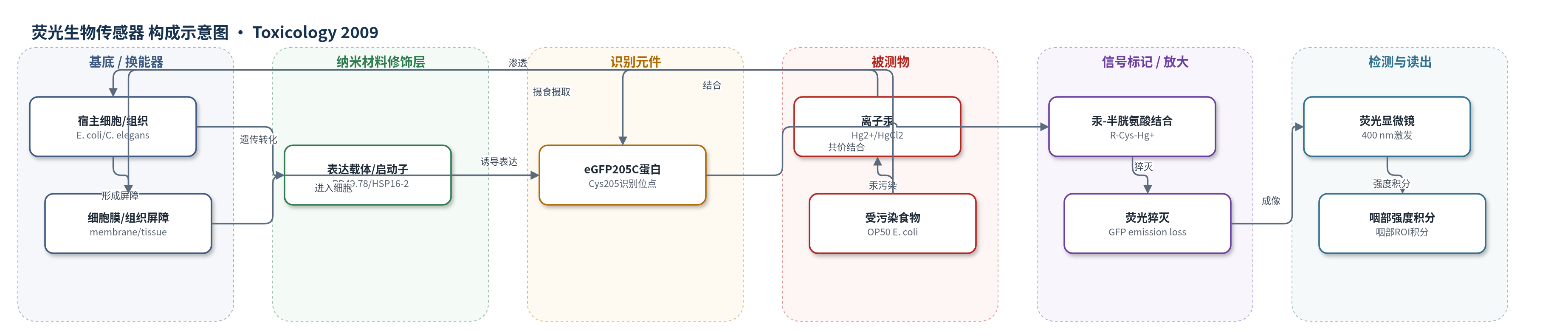
点击图片查看大图 · 依据论文自动绘制
传感器类型
荧光生物传感器
检测对象
离子汞/汞(II)(Hg2+,以 HgCl2 形式暴露);样品基质:LB 琼脂垫/LB 肉汤中的活体大肠杆菌、秀丽隐杆线虫,以及受 HgCl2 污染的 OP50 大肠杆菌食物。
检测原理
eGFP205C 是一种改造的绿色荧光蛋白,其 Cys205 巯基作为识别位点。当 Hg2+ 进入细胞或组织后,与 Cys205 形成共价的 R-Cys-Hg+ 结合态,改变蛋白局部电子环境并引起绿色荧光猝灭。荧光强度下降幅度与结合汞量相关:汞浓度越高或食物链中污染程度越高,传感器荧光损失越大。该过程无需电极、纳米材料或酶催化放大,直接以荧光蛋白作为换能器;通过 400 nm 激发荧光显微镜或分光光度计检测咽部/细胞区域平均荧光强度,即可实时反映离子汞摄取动力学。
检测灵敏度
原文未报告明确 LOD、线性范围、灵敏度斜率或 R^2;仅报告 2 nM HgCl2 可显著猝灭,2 pM 无显著变化,2 nM 食物链摄食约 20% 猝灭,2 μM 约 55% 猝灭,2 nM 浸泡约 80% 猝灭。
效应效果
该传感器对离子汞高度特异:Ni2+、Zn2+、Cd2+、Co2+、Fe2+、Fe3+、Cu2+、H2O2、胡桃醌和百草枯均不引起显著猝灭;GSH、β-ME、DDT 可屏蔽但透析后恢复。野生型 GFP 在 100 μM 或 1 mM Hg2+ 下无显著下降。活体中 E. coli 40–60 s 可见猝灭,C. elegans 暴露 2 nM HgCl2 后 75 s 显著下降、约 4 min 基本消失;食物链 2 nM 污染细菌 3 min 约 20% 猝灭,2 μM 约 55%,直接浸泡 2 nM 约 80%。作者认为可用于非侵入实时活体成像、食物链汞传递、螯合剂评价和生物修复研究。
传感器的构成
- 无外部基底/电极:本传感器为活体荧光蛋白传感器,不依赖电极或纳米修饰层
- 表达载体:pPD49.78 质粒(线虫中由 HSP16-2 应激启动子驱动 eGFP205C 表达)
- 表达载体:pET151 质粒(大肠杆菌中表达 eGFP205C)
- 宿主生物:E. coli K12/BL21-AI 或 C. elegans(活体表达传感器并作为成像对象)
- 识别/换能蛋白:eGFP205C(改造自 Aequorea victoria eGFP 的绿色荧光蛋白,Cys205 作为 Hg2+ 结合位点,结合后荧光猝灭)
- 纯化标签:HIS-tag(用于亲和层析纯化 eGFP205C,非识别位点)
- 信号读出装置:Zeiss Axioplan 荧光显微镜或 Varian 荧光分光光度计(400 nm 激发,检测荧光强度变化)
中文摘要
汞是强毒物,因生物累积性,长期低剂量暴露即可造成严重健康危害。尽管汞与蛋白质相互作用已知,但其在生物体内的摄取和动态过程仍不清楚,尤其细胞或组织内的浓度与分布。本研究应用近期开发的一种生物传感器(eGFP205C,一种经改造的绿色荧光蛋白)实现活体条件下离子汞摄取的非侵入实时成像。结果表明,汞离子可在数分钟内被原核生物大肠杆菌和真核生物秀丽隐杆线虫摄取;即使表达传感器的细胞被周围组织层覆盖,仍能检测到这种快速摄取,提示细胞壁或组织并非该金属的显著屏障。此外,该生物传感器适用于直接成像汞通过食物链的摄取。结果显示,离子汞可在较长时间内保持可利用状态,并能快速污染表面及嵌入组织细胞。
英文摘要
Mercury is a strong poison that poses significant and immediate hazards to human health. Due to its bioaccumulative properties, even small amounts of the metal are usually very poisonous or lethal when absorbed over long periods of time. Even though the possible dangers of mercury interactions with proteins are well understood, little is known about its uptake and dynamics within an organism. In particular, the concentration and distribution of the metal within a cell or a tissue are only poorly understood. In this study, we describe the application of a recently developed biosensor [Chapleau R.R., Blomberg R., Ford P.C., Sagermann M., 2008. Design of a highly specific and non-invasive biosensor suitable for real-time in vivo imaging of mercury(II) uptake. Protein Sci. 17(4), 614-622] that facilitates unprecedented non-invasive real-time imaging of ionic mercury uptake by an organism under in vivo conditions. Specifically, we here show that mercury ions can be taken up from the environment within minutes by prokaryotic as well as eukaryotic organisms. This rapid uptake can still be detected if the sensor expressing cells are shielded by layers of surrounding tissues suggesting that neither individual cell walls nor tissues provide a serious barrier for the metal. Furthermore, we show that this biosensor is suitable for the direct imaging of mercury uptake through the food chain. Our results suggest that ionic mercury remains available for extended periods of time and can rapidly contaminate surface as well as embedded tissue cells.