组成图示
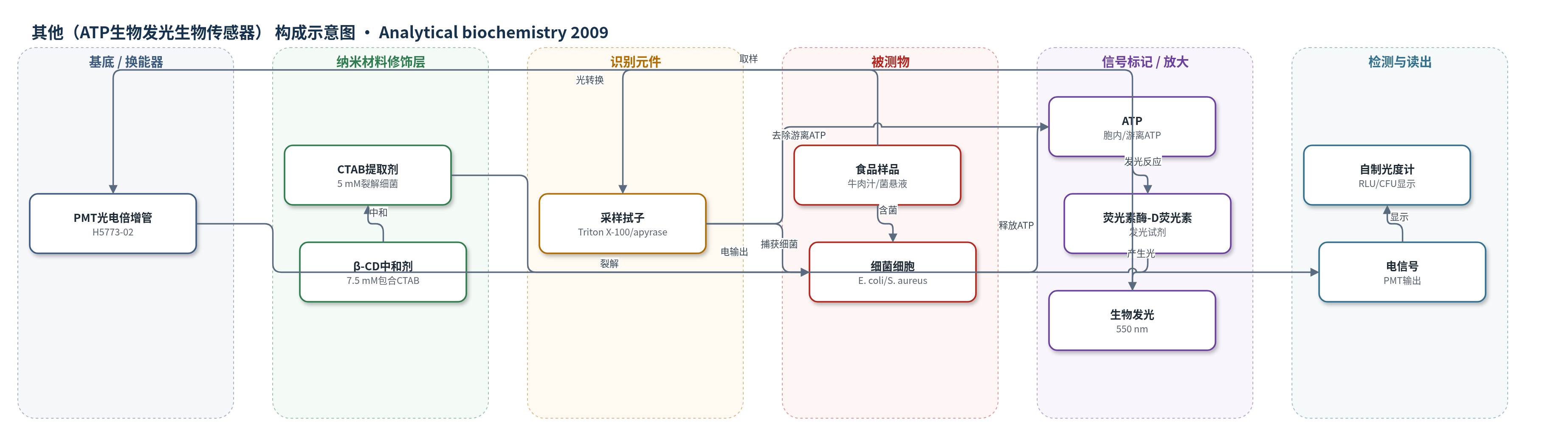
点击图片查看大图 · 依据论文自动绘制
传感器类型
其他(ATP生物发光生物传感器)
检测对象
细菌计数(bacterial count,CFU/ml);样品基质:食品(牛肉汁/beef juice)、标准菌悬液(E. coli、S. aureus)
检测原理
该传感器以细菌胞内ATP为定量信号源。采样拭子预先含有apyrase,可水解样品中游离或体细胞ATP,减少非细菌ATP干扰;CTAB裂解细菌细胞并释放胞内ATP,β-CD随后与残留CTAB形成包合物,消除其对荧光素酶的抑制。释放的ATP进入微管,在Mg2+存在下与荧光素酶–D-荧光素试剂发生酶促发光反应,产生生物发光。发光强度与ATP浓度成正比,而ATP含量与活菌数近似相关(约0.47 fg/cell)。PMT将光信号转换为电信号,自制光度计输出RLU或CFU/ml。该过程无需培养,5 min内完成。
检测灵敏度
线性范围: 10^3–10^8 CFU/ml;相关系数: 0.925 (n=22);log-log斜率: 0.398(E. coli)、0.376(S. aureus)、0.384(总菌)
效应效果
在优化条件下,传感器5 min内完成检测,对大肠杆菌和金黄色葡萄球菌在10^3–10^8 CFU/ml范围内线性良好,相关系数0.925(n=22)。14支传感器检测1.37×10^7 CFU/ml大肠杆菌悬液,CV为5.92%,重现性满意。真实牛肉汁样品中,传感器结果与平板计数法在10^3–10^8 CFU/ml范围内线性相关,相关系数0.964,表明可快速评估食品细菌污染。传感器采用一次性敏感元件,成本低、操作简便,适合HACCP体系中的现场快速监测。
传感器的构成
- 检测器/换能器:光电倍增管(PMT,Hamamatsu H5773-02)与自制光度计,将生物发光转换为电信号并输出RLU/CFU。
- 采样器:手柄、定位环、长螺钉和拭子;拭子预湿Tris–acetate含Triton X-100(0.03%, w/v)和apyrase(4 U/ml),用于取样并水解游离/体细胞ATP。
- 卡盒:聚丙烯/聚碳酸酯注塑件,底部密封ATP提取剂(CTAB,5 mM,150 μl)和中和剂(β-CD,7.5 mM,150 μl),铝箔分隔,用于裂解细菌并中和残留CTAB。
- 微管:透明小管,储存发光试剂(荧光素酶0.075 mg/ml、D-荧光素0.25 mg/ml、EDTA 2.5 mM、Mg2+ 25 mM、BSA 2.5 mg/ml、DTT 2.5 mM、Tris–acetate 25 mM pH 7.8),用于ATP发光反应。
- 识别/分析物捕获:细菌细胞(E. coli、S. aureus或食品中总菌)附着于拭子并进入卡盒,胞内ATP作为定量信号源。
- 信号标记/放大:荧光素酶–D-荧光素体系,在Mg2+存在下催化ATP产生生物发光,无额外信号放大。
- 抑制控制:β-CD与残留CTAB形成包合物,消除对荧光素酶的抑制;apyrase去除非细菌ATP干扰。
中文摘要
本文报道了一种基于腺苷三磷酸(ATP)生物发光快速检测细菌计数的一次性生物传感器。该传感器由关键敏感元件和用作检测元件的光电倍增管(PMT)组成。一次性敏感元件包括采样器、用于化学提取细菌胞内ATP的卡盒,以及使提取的ATP与荧光素–荧光素酶试剂反应产生生物发光的小管。生物发光信号经PMT转换为相应电信号,并用自制光度计测量。作者优化了影响ATP提取量的参数,包括ATP提取剂类型、提取剂浓度及相应中和试剂。在最优条件下,传感器在5 min内对标准菌在10^3至10^8 CFU/ml浓度范围内呈线性响应,相关系数为0.925(n=22)。此外,传感器测得的真实食品样品细菌计数与传统平板计数法结果良好相关。该传感器具有低成本、操作简便、响应快速等特点,可潜在应用于食品工业、环境监测等领域的细菌污染快速评估。
英文摘要
A biosensor for rapid detection of bacterial count based on adenosine 5'-triphosphate (ATP) bioluminescence has been developed. The biosensor is composed of a key sensitive element and a photomultiplier tube used as a detector element. The disposable sensitive element consists of a sampler, a cartridge where intracellular ATP is chemically extracted from bacteria, and a microtube where the extracted ATP reacts with the luciferin-luciferase reagent to produce bioluminescence. The bioluminescence signal is transformed into relevant electrical signal by the detector and further measured with a homemade luminometer. Parameters affecting the amount of the extracted ATP, including the types of ATP extractants, the concentrations of ATP extractant, and the relevant neutralizing reagent, were optimized. Under the optimal experimental conditions, the biosensor showed a linear response to standard bacteria in a concentration range from 10(3) to 10(8) colony-forming units (CFU) per milliliter with a correlation coefficient of 0.925 (n=22) within 5min. Moreover, the bacterial count of real food samples obtained by the biosensor correlated well with those by the conventional plate count method. The proposed biosensor, with characteristics of low cost, easy operation, and fast response, provides potential application to rapid evaluation of bacterial contamination in the food industry, environment monitoring, and other fields.