组成图示
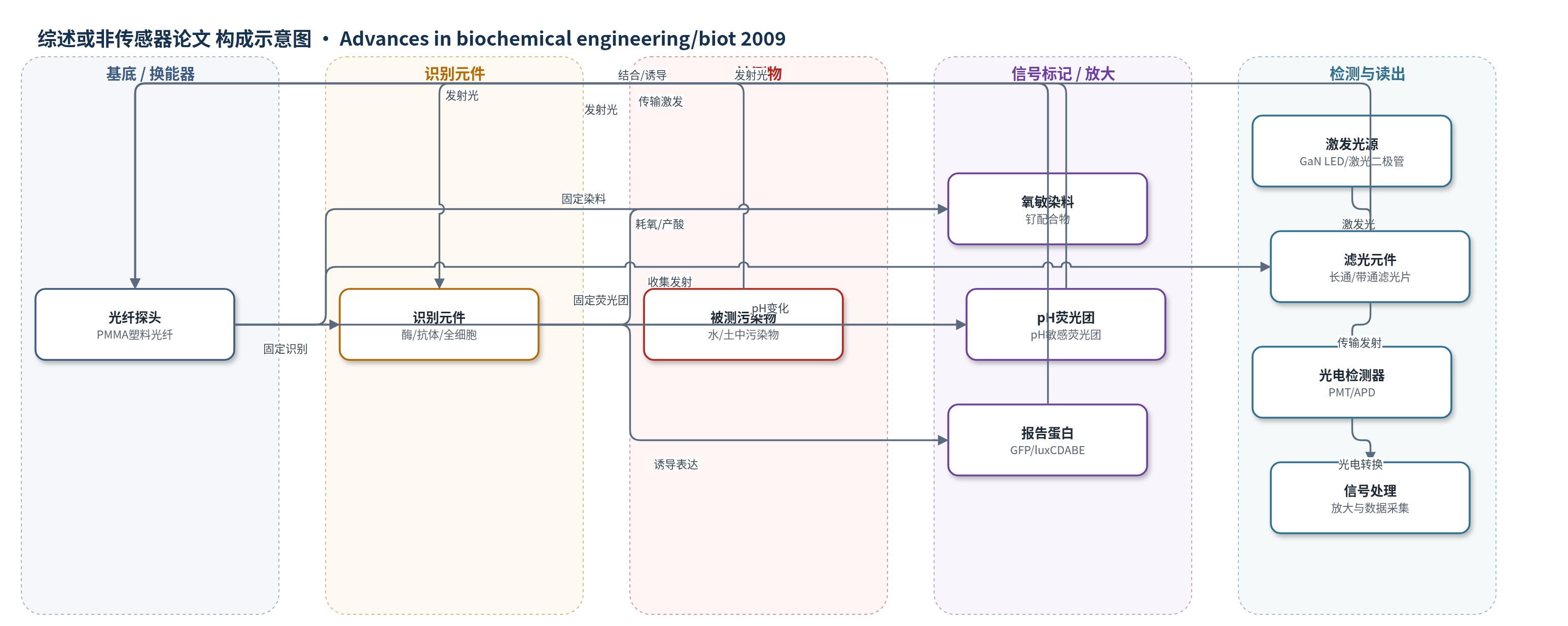
点击图片查看大图 · 依据论文自动绘制
传感器类型
综述或非传感器论文
检测对象
乙醇(ethanol)、甲苯(toluene)、苯并[a]芘(BaP)、1,2-二氯乙烷(DCA)、多氯联苯(PCBs)、毒杀芬(endosulfan)、莠去津(atrazine)、林丹(lindane)、二噁英(TCDD)、对氧磷(paraoxon)、三硝基甲苯(TNT)、汞离子(Hg2+)、铜离子(Cu2+)、镉(Cd)、铅(Pb)、铀(U)及BOD/毒性混合物;样品基质包括水样、地下水、废水、海水、土壤/土壤浸提液和气相样品。
检测原理
综述中的光致发光生物传感器通常以光纤探头为换能界面,将酶、抗体或全细胞固定于光纤端部。当被测物与识别元件作用时,酶促反应可消耗或产生氧气、质子,改变氧敏钌配合物或 pH 敏感荧光团的荧光/磷光强度;抗体竞争结合可置换荧光标记类似物,使发射光下降;诱导型报告菌则通过转录激活表达 GFP 或 luxCDABE,产生荧光或生物发光。激发光经 LED/激光二极管和滤光元件进入样品区,发射光由同一或另一光纤收集,经 PMT/APD 转为电信号。信号放大主要依赖酶催化、全细胞转录翻译和竞争免疫,PL 强度或寿命随污染物浓度单调变化。
检测灵敏度
LOD: < 250 ng L−1(BaP);LOD: 0.3 mg L−1(toluene);LOD: below 1 ng L−1(DCA);LOD: 100 fM(TCDD);LOD: 100 ng L−1 Hg2+;LOD: 370 ng L−1 Cd;LOD: 120 mg L−1 uranium;LOD: 24 mg L−1 MNNG;LOD: 10 mg L−1(TNT);线性范围: 0.5–9 mM(ethanol);线性范围: 2–90 mM(methanol);线性范围: 5–20 mg L−1(toluene);线性范围: 0.5–2 mg L−1(chloropropionate);线性范围: 1–10 mg L−1(BOD)
效应效果
综述指出,PL 生物传感器在环境样品中表现出一定实用潜力:光学 BOD 传感器在 1–10 mg L−1 范围内与标准法相关性良好,响应时间约 15 min,远短于标准 5 天法;诱导型甲苯传感器在受污染地下水中与 GC-MS 值有较好相关性;Hg2+ 报告菌在加标天然水中与标准方法吻合良好;毒杀芬酶传感器可检测 2 mg L−1,优于液相色谱约 1 mg L−1 的检出水平。但多数系统仍面临选择性、基质干扰、细胞存活、信号可逆性和长期稳定性挑战,作者强调需在真实基质中验证,并发展传感器阵列与现场光电硬件。
传感器的构成
- 综述中典型光致发光生物传感器构成(非单一器件):
- 1. 基底/换能器:PMMA 塑料光纤或光纤探头,传输激发光并收集发射光。
- 2. 激发源:GaN LED 或激光二极管,提供蓝光/紫外激发。
- 3. 滤光元件:长通/带通薄膜干涉滤光片或二向色镜,分离激发光与发射光。
- 4. 识别元件:酶(alcohol oxidase、OPH、DhlA)、抗体(anti-BaP、anti-PCB)或全细胞/报告菌(Pseudomonas、E. coli)。
- 5. 信号标记/换能材料:钌配合物氧敏染料、pH 敏感荧光团、GFP 或 luxCDABE 报告蛋白。
- 6. 检测器:PMT、APD 或 PIN-TIA,将 PL 信号转为电信号。
- 7. 读出电路:低噪声放大与数据采集,输出 PL 强度或寿命。
中文摘要
为监测和处理土壤与水体中的化学污染物,环境科学与工程领域需要快速、连续、原位测定污染物浓度。传统气相或液相色谱法准确但复杂、耗时、昂贵且需样品前处理,难以用于现场。生物传感器将生物组分与换能器耦合,将分析物与生物组分相互作用转化为可处理信号。本文聚焦光致发光(photoluminescence, PL)型生物传感器,先回顾荧光与磷光机制及光电硬件,包括激发光源、光纤、滤光元件、光电检测器与多路复用系统;随后按烃类与醇类、卤代有机物、硝基/磷/磺基等取代有机物、金属及其他无机物等类别,介绍酶、抗体和诱导型报告细胞等识别元件的 PL 传感实例;最后讨论生物需氧量与毒性等混合物整体评价方法,并展望环境生物传感器在连续监测、污染场地表征和修复评估中的应用前景。
英文摘要
For monitoring and treatment of soil and water, environmental scientists and engineers require measurements of the concentration of chemical contaminants. Although laboratory-based methods relying on gas or liquid chromatography can yield very accurate measurements, they are also complex, time consuming, expensive, and require sample pretreatment. Furthermore, they are not readily adapted for in situ measurements.Sensors are devices that can provide continuous, in situ measurements, ideally without the addition of reagents. A biosensor incorporates a biological component coupled to a transducer, which translates the interaction between the analyte and the biocomponent into a signal that can be processed and reported. A wide range of transducers have been employed in biosensors, the most common of which are electrochemical and optical. In this contribution, we focus on photoluminescence-based biosensors of potential use in the applications described above.Following a review of photoluminescence and a discussion of the optoelectronic hardware part of these biosensor systems, we provide explanations and examples of optical biosensors for specific chemical groups: hydrocarbons and alcohols, halogenated organics, nitro-, phospho-, sulfo-, and other substituted organics, and metals and other inorganics. We also describe approaches that have been taken to describe chemical mixtures as a whole (biological oxygen demand and toxicity) since most environmental samples contain mixtures of unknown (and changing) composition. Finally, we end with some thoughts on future research directions that are necessary to achieve the full potential of environmental biosensors.