组成图示
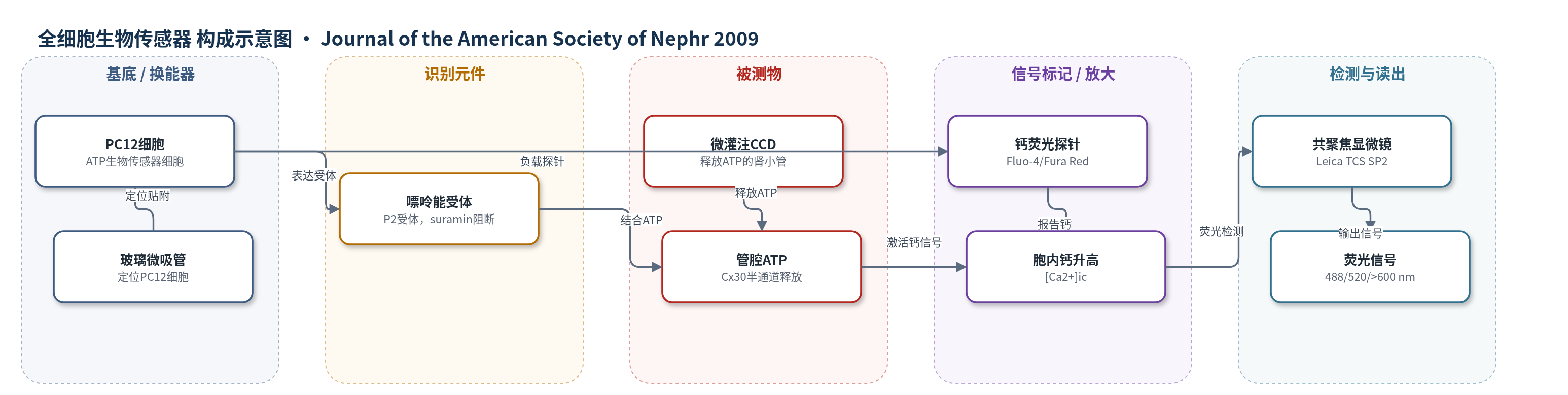
点击图片查看大图 · 依据论文自动绘制
传感器类型
全细胞生物传感器
检测对象
三磷酸腺苷(ATP);样品基质:离体微灌注小鼠皮质集合管(CCD)管腔液/肾小管液
检测原理
机械刺激(管腔流从2增至20 nl/min或浴槽低渗)使闰细胞顶膜Cx30半通道开放,ATP从细胞内释放至管腔。ATP扩散至贴附于管腔开口的PC12生物传感器细胞,结合其膜嘌呤能受体(P2受体),激活受体后引起胞内Ca2+升高。PC12细胞预先负载Fluo-4和Fura Red钙荧光探针,Ca2+结合探针导致荧光强度变化;共聚焦显微镜以488 nm激发,分别检测Fluo-4(520±20 nm)和Fura Red(>600 nm)发射,并校准为[Ca2+]ic。ATP浓度越高,钙信号和荧光变化越大。suramin阻断嘌呤能受体可消除信号,证明响应来自ATP而非其他因子。该法无核酸或酶催化放大,依赖细胞受体介导的钙信号作为生物换能。
检测灵敏度
EC50: 45.94 μM;半最大管腔流率: 6.97 nl/min;最大管腔ATP释放: 50-μM range
效应效果
选择性方面,ATP生物传感器响应在闰细胞旁显著高于主细胞旁(Δ[Ca2+]ic 432±14 vs 146±10 nM),在Cx30缺失小鼠中几乎消失,suramin完全阻断,且无细胞接触时无响应,说明信号依赖Cx30和嘌呤能受体。体内压力升高实验中,野生型尿量增加4.2倍、尿钠排泄增加5.2倍,而Cx30缺失小鼠仅2.6倍和2.8倍;最高压力期Na排泄为1.60±0.08 vs 1.00±0.15 μEq/min,尿量为10.6±1.6 vs 6.1±1.2 μl/min,GFR无差异。高盐饮食使Cx30缺失小鼠MAP升至103.0±2.4 mmHg,野生型75.0±1.7 mmHg,ENaC抑制剂benzamil可使其恢复正常。作者认为Cx30半通道介导的管腔ATP释放是压力利钠尿的重要远端肾单位组分。
传感器的构成
- 传感器细胞:PC12细胞(ATCC来源),作为ATP生物传感器细胞,感知管腔ATP
- 识别元件:PC12细胞膜嘌呤能受体(P2受体,可被suramin阻断),与ATP结合触发胞内钙升高
- 信号标记物:Fluo-4与Fura Red钙荧光探针(1 μM Fluo-4、3 μM Fura Red,25°C 15 min,250 μM sulfinpyrazone负载),报告[Ca2+]ic
- 样品接触界面:玻璃微吸管/微管(glass micropipette)将单个PC12细胞置于微灌注CCD管腔开口,直接接触IC或PC顶膜
- 细胞类型标记:rhodamine-conjugated peanut lectin标记IC顶膜;quinacrine标记PC酸性颗粒,用于定位
- 读出装置:Leica TCS SP2 AOBS MP共聚焦显微镜,488 nm激发,Fluo-4 520±20 nm、Fura Red >600 nm发射,校准为[Ca2+]ic
中文摘要
在肾小管中,ATP是盐和水重吸收的重要调节因子,但其释放机制尚不清楚。多种连接蛋白(Cx)亚型可形成机械敏感、允许ATP通过的半通道。我们将Cx30定位于远端肾单位细胞非连接性顶膜,并检验Cx30是否参与生理性ATP释放。我们在体外解剖、部分剖开并微灌注野生型和Cx30缺失小鼠皮质集合管,使用负载Fluo-4/Fura Red的PC12细胞作为ATP生物传感器,通过测量胞内钙并将细胞直接置于闰细胞或主细胞顶膜表面进行检测。管腔流增加或浴槽低渗诱发的ATP生物传感器响应在靠近闰细胞时比靠近主细胞时大约高3倍;这些响应在Cx30缺失小鼠制备物中不出现,且可被嘌呤能受体阻断剂消除。通过结扎远端主动脉、肠系膜和腹腔动脉诱导平均动脉压阶梯升高后,野生型小鼠尿量增加4.2倍,Cx30缺失小鼠增加2.6倍;尿钠排泄在野生型增加5.2倍,在Cx30缺失小鼠增加2.8倍。此外,Cx30缺失小鼠出现依赖上皮钠通道、对盐敏感的血压升高。综上,机械敏感Cx30半通道通过向管腔液释放ATP抑制盐和水重吸收,在压力利钠尿中发挥整合作用。
英文摘要
In the renal tubule, ATP is an important regulator of salt and water reabsorption, but the mechanism of ATP release is unknown. Several connexin (Cx) isoforms form mechanosensitive, ATP-permeable hemichannels. We localized Cx30 to the nonjunctional apical membrane of cells in the distal nephron and tested whether Cx30 participates in physiologically important release of ATP. We dissected, partially split open, and microperfused cortical collecting ducts from wild-type and Cx30-deficient mice in vitro. We used PC12 cells as ATP biosensors by loading them with Fluo-4/Fura Red to measure cytosolic calcium and positioning them in direct contact with the apical surface of either intercalated or principal cells. ATP biosensor responses, triggered by increased tubular flow or by bath hypotonicity, were approximately three-fold greater when positioned next to intercalated cells than next to principal cells. In addition, these responses did not occur in preparations from Cx30-deficient mice or with purinergic receptor blockade. After inducing step increases in mean arterial pressure by ligating the distal aorta followed by the mesenteric and celiac arteries, urine output increased 4.2-fold in wild-type mice compared with 2.6-fold in Cx30-deficient mice, and urinary Na(+) excretion increased 5.2-fold in wild-type mice compared with 2.8-fold in Cx30-deficient mice. Furthermore, Cx30-deficient mice developed endothelial sodium channel-dependent, salt-sensitive elevations in mean arterial pressure. Taken together, we suggest that mechanosensitive Cx30 hemichannels have an integral role in pressure natriuresis by releasing ATP into the tubular fluid, which inhibits salt and water reabsorption.