组成图示
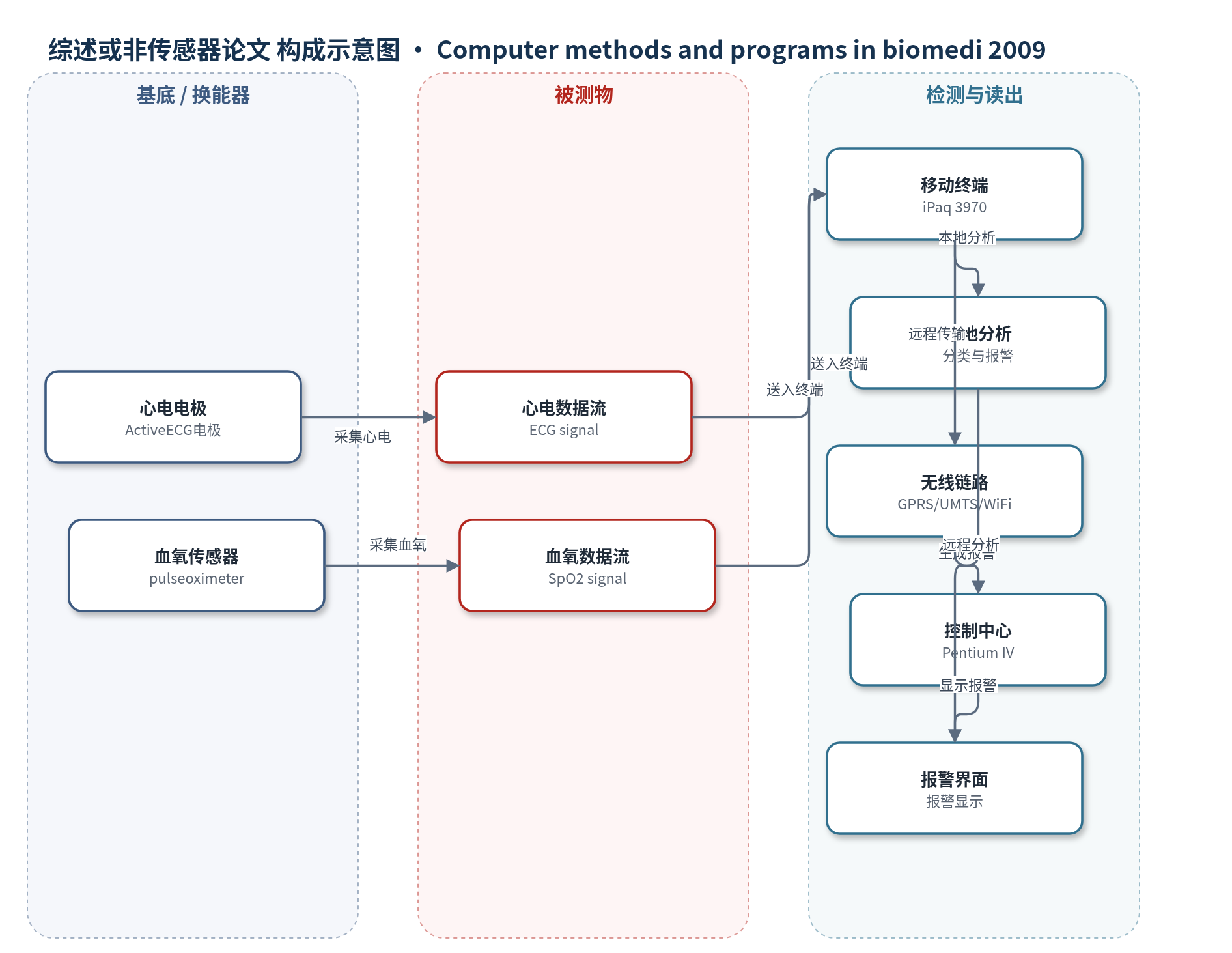
点击图片查看大图 · 依据论文自动绘制
传感器类型
综述或非传感器论文
检测对象
心脏心律失常(heart arrhythmias,ECG信号)、睡眠呼吸暂停(apnea episodes,SpO2信号)
检测原理
该系统不依赖化学识别元件,而是将生理信号转换为数字数据流。ECG电极把心肌电活动转换为电压样本,PDA按100–400 Hz采集;预处理去除基线漂移和工频干扰,检测P波、QRS复合波、T波及PR、QT、RR间期,再用决策规则对单个心跳分类,并对连续4个心跳进行节律分类。若节律属于VFL、IVR、VT、T或NOD,则触发高风险心律失常报警。SpO2脉搏血氧仪通过光电方式测量血氧饱和度,PDA以1 Hz采集;系统过滤伪迹、计算移动基线、ODI和TSA指标,并用Bagging/ADTree分类器判断呼吸暂停片段。异常事件使相应指标越限或分类结果改变,从而产生报警。
检测灵敏度
—
效应效果
作者用MIT-BIH心律失常数据库和Apnea-ECG数据库验证系统。心律失常监测对需3分钟内医疗干预的节律准确率为100%,1小时内为97.95%,预警性节律为95%;呼吸暂停监测准确率为96%,ROC-AUC为99%,分类器准确率大于97%。系统还在约20名患者中测试。与仅离线记录的Holter和家用呼吸暂停记录系统相比,该系统支持本地或远程实时分类,并给出最优配置:心律失常采用4 s粒度、压缩和本地分析;呼吸暂停采用2 s粒度、不压缩和本地分析。ECG压缩率约88%,SpO2压缩率约93.7%。
传感器的构成
- ECG传感器:ActiveECG电极与导联线,采集心电电压并生成ECG数据流
- 脉搏血氧传感器:非侵入式pulseoximeter,采集SpO2和脉搏值并生成SpO2数据流
- 移动终端:PDA(iPaq 3970),通过有线或蓝牙接收传感器数据并执行预处理、分类与报警
- 无线通信链路:GPRS、UMTS、WiFi或WiMAX,将数据流或报警发送至控制中心
- 控制中心:PC(Pentium IV),显示报警并支持医生远程分析
中文摘要
无线通信、移动设备和生物传感器技术的进步使能够随时随地监测人体生理信号的新型系统成为可能。本文提出一种面向移动生物传感器数据流(MBSDS)的三层架构,用于构建由佩戴式生物传感器产生连续数据流并传输至移动终端和控制中心的实时监测系统。该架构重点关注系统效率的三个关键问题:一是选择最优数据粒度,即启动一次新处理周期所需采集的输入数据包大小;二是评估是否采用压缩技术来存储和发送数据流,以平衡通信量、延迟与能耗;三是比较本地分析与远程分析的性能。作者以两个实际系统为例说明该架构的适用性:基于心电信号(ECG)的心脏心律失常实时监测系统,以及基于血氧饱和度(SpO2)信号的睡眠呼吸暂停监测系统。论文还给出通用成本模型,并针对两个系统完成参数定制与实验验证。
英文摘要
Innovation in the fields of wireless data communications, mobile devices and biosensor technology enables the development of new types of monitoring systems that provide people with assistance anywhere and at any time. In this paper we present an architecture useful to build those kind of systems that monitor data streams generated by biological sensors attached to mobile users. We pay special attention to three aspects related to the system efficiency: selection of the optimal granularity, that is, the selection of the size of the input data stream package that has to be acquired in order to start a new processing cycle; the possible use of compression techniques to store and send the acquired input data stream and; finally, the performance of a local analysis versus a remote one. Moreover, we introduce two particular real systems to illustrate the suitability and applicability of our proposal: an anywhere and at any time monitoring system of heart arrhythmias and an apnea monitoring system.