组成图示
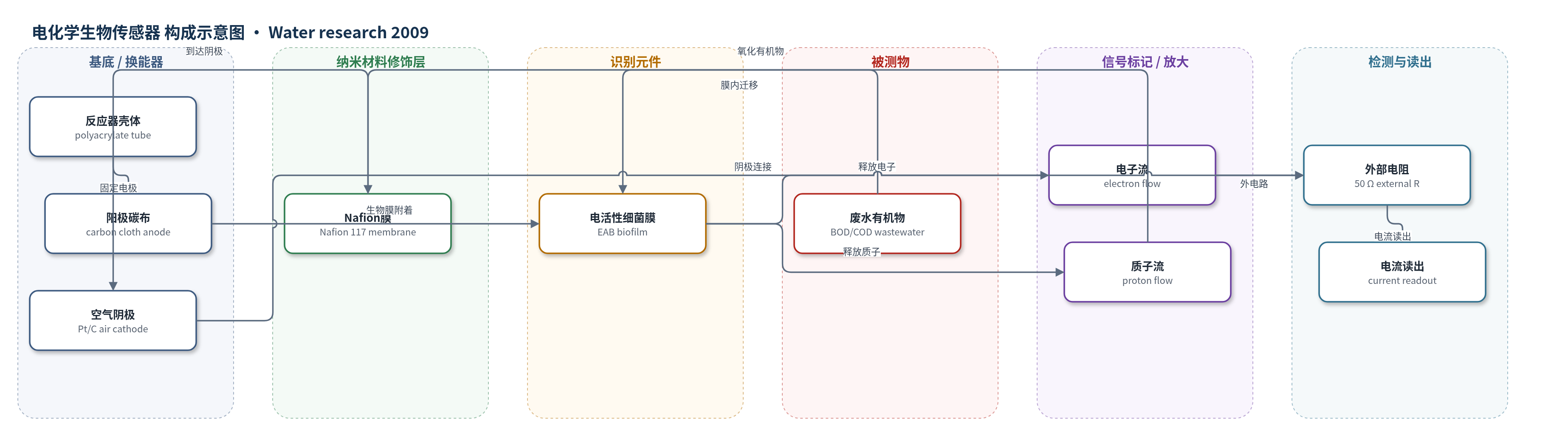
点击图片查看大图 · 依据论文自动绘制
传感器类型
电化学生物传感器
检测对象
生化需氧量(BOD)、化学需氧量(COD);样品基质:人工废水(artificial wastewater, AW)、真实污水处理厂废水(real wastewater, WW,初沉池出水)
检测原理
电活性细菌附着在碳布阳极上形成生物膜,将废水中的可生物降解有机物(BOD/COD)作为电子供体进行氧化。代谢产生的电子通过细胞外电子传递途径转移到阳极,质子则穿过 Nafion 117 膜迁移至空气阴极。阴极 Pt/C 催化剂促进溶解氧还原,外电路接入 50 Ω 电阻形成闭合回路,Pico 数据记录仪读取电流或电压。废水有机物浓度越高,单位时间内可被氧化的电子供体越多,稳态电流越大,因此电流输出与 BOD/COD 浓度呈正相关。小体积反应器缩短水力停留时间并降低欧姆损失,空气阴极改善氧供应,从而扩大线性范围并加快响应。
检测灵敏度
线性范围: 50–350 ppm COD(电流校准,r2 = 0.96);线性范围: 50–500 ppm COD(电荷校准,r2 = 0.93);BOD 线性上限: 350 mg BOD cm−3
效应效果
SCMFC 在固定 COD 下重复测量变异系数约 1%,160 ppm 时 RSD 为 0.53%,60 ppm 时为 0.22%;连续运行 7 个月电流总变化仅 15%。小体积反应器使上升响应时间缩短至 40 min,下降响应约 2 h,库仑效率由 6% 提高到 56%,有助于降低替代电子受体干扰。真实废水中电流与 COD 呈线性相关,与标准法结果一致(如 169±9 对 175±50 ppm、98.5±2.1 对 100±9 ppm)。30 ℃ 时稳态电流 0.55 mA,高于 25 ℃ 的 0.32 mA 和 20 ℃ 的 0.28 mA。作者认为其可用于污水处理厂初沉池出水的在线有机负荷监测。
传感器的构成
- 反应器壳体:聚甲基丙烯酸酯管(polyacrylate tube),构成单室流道并安装阳极、阴极与流口。
- 阳极电极:碳布(carbon cloth, BASF),作为电活性细菌附着基底并传递电子。
- 识别元件:电活性细菌(electrochemically-active bacteria, EAB)/厌氧污泥接种,氧化可生物降解有机物并产生电子。
- 电子供体:人工废水中的葡萄糖或真实废水中的可生物降解有机物(BOD/COD),作为微生物氧化的燃料。
- 质子交换膜:Nafion 117 阳离子交换膜,分隔阳极液与空气阴极并允许质子迁移。
- 空气阴极:Toray 碳纸负载铂催化剂(Pt/C, 0.3 mg Pt cm−2, 60% on Vulcan),催化氧还原反应。
- 密封与支撑:垫片(gasket)和钛网(titanium net),固定电极并密封反应室。
- 外部电路:外部电阻(external resistance, 50 Ω)与 Pico 数据记录仪/电压表,极化电池并读取电流/电压。
- 进料系统:蠕动泵(peristaltic pump)与 Marprene II 管,连续输送人工废水或真实废水。
中文摘要
传统五日生化需氧量(BOD5)测试耗时长、重现性差,难以用于污水处理过程控制与实时监测。本研究将单室微生物燃料电池(SCMFC)作为废水生物传感器,采用空气阴极,并系统评价其测量范围、响应时间、重现性和运行稳定性。以人工废水为燃料时,SCMFC 输出电流与 BOD 浓度在 350 mg BOD cm−3 以下呈线性关系,重现性高,并可在 7 个月内保持稳定运行。通过减少 75% 的阳极液体积,将反应器体积从 50 cm3 降至 12.6 cm3,使响应时间接近水力停留时间(约 40 min),并显著提高库仑效率。小体积 SCMFC 用于真实污水处理厂废水时,COD 浓度与电流输出之间获得良好线性相关,且与标准化学需氧量测定结果一致,表明该传感器可用于真实废水的在线有机负荷监测。
英文摘要
The traditional 5-day test of the biochemical oxygen demand (BOD(5) test) has many disadvantages, and principally it is unsuitable for process control and real-time monitoring. As an alternative, a single-chamber microbial fuel cell (SCMFC) with an air cathode was tested as a biosensor and the performance analysed in terms of its measurement range, its response time, its reproducibility and its operational stability. When artificial wastewater was used as fuel, the biosensor output had a linear relationship with the BOD concentration up to 350 mg BOD cm(-3); very high reproducibility; and stability over 7 months of operation. The system was further improved by reducing by 75% the total anolyte volume. In this way a response time close to the hydraulic retention time (HRT) of the biosensor (i.e. 40 min) was reached. When the small volume SCMFC biosensor was fed with real wastewater a good correlation between COD concentration and current output was obtained, demonstrating the applicability of this system to real effluents. The measurements obtained with the biosensor were also in accordance with values obtained with standard measurement methods.