组成图示
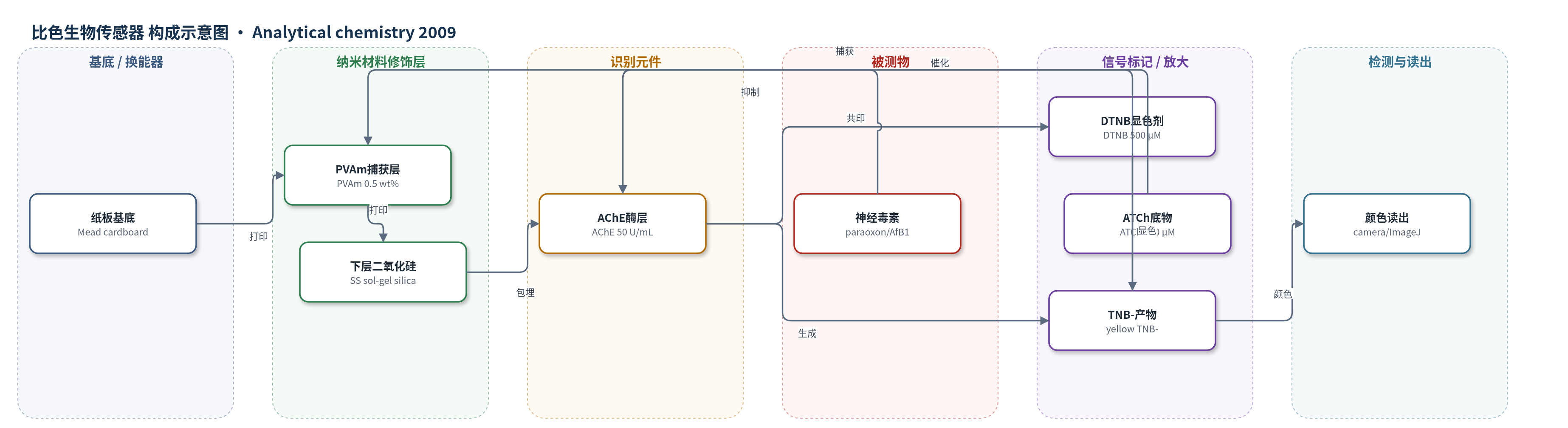
点击图片查看大图 · 依据论文自动绘制
传感器类型
比色生物传感器
检测对象
对氧磷(paraoxon)、黄曲霉毒素B1(aflatoxin B1, AfB1);样品基质:Tris缓冲液/水样或食品与环境样品(实验用含5%环己烷或甲醇的缓冲液)
检测原理
传感器将AChE包埋于纸面溶胶-凝胶二氧化硅中,PVAm作为阳离子捕获层。待测神经毒素(对氧磷或AfB1)与AChE结合并抑制其活性;随后加入底物ATCh,残余AChE催化ATCh水解为硫代胆碱(TCh),TCh与Ellman试剂DTNB反应生成黄色TNB-。TNB-被PVAm捕获并浓缩在有限区域,颜色强度与残余AChE活性成正比,因此随毒素浓度升高而降低。信号通过肉眼或数码相机图像分析读取,无需复杂仪器。
检测灵敏度
LOD: 对氧磷(paraoxon)∼100 nM;LOD: 黄曲霉毒素B1(aflatoxin B1, AfB1)∼30 nM;IC50: 对氧磷约1 µM;IC50: 黄曲霉毒素B1约100 nM
效应效果
该试纸响应时间<5 min,可用肉眼或数码相机+ImageJ定量读取,适合现场快速筛查。PVAm层可将黄色TNB-保留至少3周,溶胶-凝胶三明治结构使AChE在4 ℃保存60 d后仍保持>95%活性,并防止酶泄漏;无AChE对照无信号,说明颜色来自酶催化。对氧磷和AfB1均可检测,100 nM时AfB1抑制约45%,对氧磷约25%。作者认为其成本低、无需复杂仪器,可用于环境、食品和神经毒素监测;不足是需额外加入ATCh底物,尚需进一步实现无试剂化。
传感器的构成
- 基底:Mead品牌纸板纸(Mead brand cardboard paper substrate,白色疏水高岭土涂层),提供支撑与浸没/毛细流动
- 捕获层:聚乙烯胺(PVAm,1.5 MDa,0.5 wt%),阳离子层捕获并保留黄色TNB-产物
- 下封层:溶胶-凝胶二氧化硅(sodium silicate, SS-derived silica sol,30%甘油,0.1 wt% Triton X-100),包埋并固定酶
- 识别/催化层:乙酰胆碱酯酶(AChE,50 U/mL)与Ellman试剂5,5'-二硫代双(2-硝基苯甲酸)(DTNB,500 µM),AChE催化底物并产生显色反应
- 上封层:溶胶-凝胶二氧化硅(SS-derived silica sol,30%甘油,0.1 wt% Triton X-100),封包酶层防止泄漏与失活
- 信号产物:5-巯基-2-硝基苯甲酸根(TNB-,黄色),由AChE催化ATCh生成TCh后与DTNB反应形成
- 读出:肉眼或数码相机+ImageJ图像分析,读取颜色强度
中文摘要
本文报道了一种基于压电喷墨打印溶胶-凝胶生物墨水的纸基比色生物传感器,用于快速检测乙酰胆碱酯酶(AChE)抑制剂,如对氧磷和黄曲霉毒素B1等神经毒素。传感器先在纸面上打印阳离子聚乙烯胺(PVAm)捕获层,再依次打印溶胶-凝胶二氧化硅层、含AChE和Ellman显色试剂DTNB的酶层以及上层二氧化硅封包层,使酶被稳定包埋于纸面。检测时,神经毒素抑制AChE活性,随后加入底物ATCh,残余酶活催化生成硫代胆碱,与DTNB反应产生黄色TNB-并被PVAm捕获;颜色强度反映残余酶活,从而反比于毒素浓度。该试纸可在5 min内响应,肉眼或数码相机图像分析即可读取,对氧磷和黄曲霉毒素B1的检出限分别约为100 nM和30 nM,4 ℃保存60 d后酶活保持>95%,适用于现场快速筛查。
英文摘要
There is an increasing interest in new strategies to rapidly detect analytes of clinical and environmental interest without the need for sophisticated instrumentation. As an example, the detection of acetylcholinesterase (AChE) inhibitors such as neurotoxins and organophosphates has implications for neuroscience, drug assessment, pharmaceutical development, and environmental monitoring. Functionalization of surfaces with multiple reagents, including enzymes and chromogenic reagents, is a critical component for the effective development of "dipstick" or lateral flow biosensors. Herein, we describe a novel paper-based solid-phase biosensor that utilizes piezoelectric inkjet printing of biocompatible, enzyme-doped, sol-gel-based inks to create colorimetric sensor strips. For this purpose, polyvinylamine (PVAm, which captures anionic agents) was first printed and then AChE was overprinted by sandwiching the enzyme within two layers of biocompatible sol-gel-derived silica on paper. AChE inhibitors, including paraoxon and aflatoxin B1, were detected successfully using this sensor by measuring the residual activity of AChE on paper, using Ellman's colorimetric assay, with capture of the 5-thio-2-nitrobenzoate (TNB(-)) product on the PVAm layer. The assay provided good detection limits (paraoxon, approximately 100 nM; aflatoxin B1, approximately 30 nM) and rapid response times (<5 min). Detection could be achieved either by eye or using a digital camera and image analysis software, avoiding the need for expensive and sophisticated instrumentation. We demonstrate that the bioactive paper strip can be used either as a dipstick or a lateral flow-based biosensor. The use of sol-gel-based entrapment produced a sensor that retained enzyme activity and gave reproducible results after storage at 4 degrees C for at least 60 days, making the system suitable for storage and use in the field.