组成图示
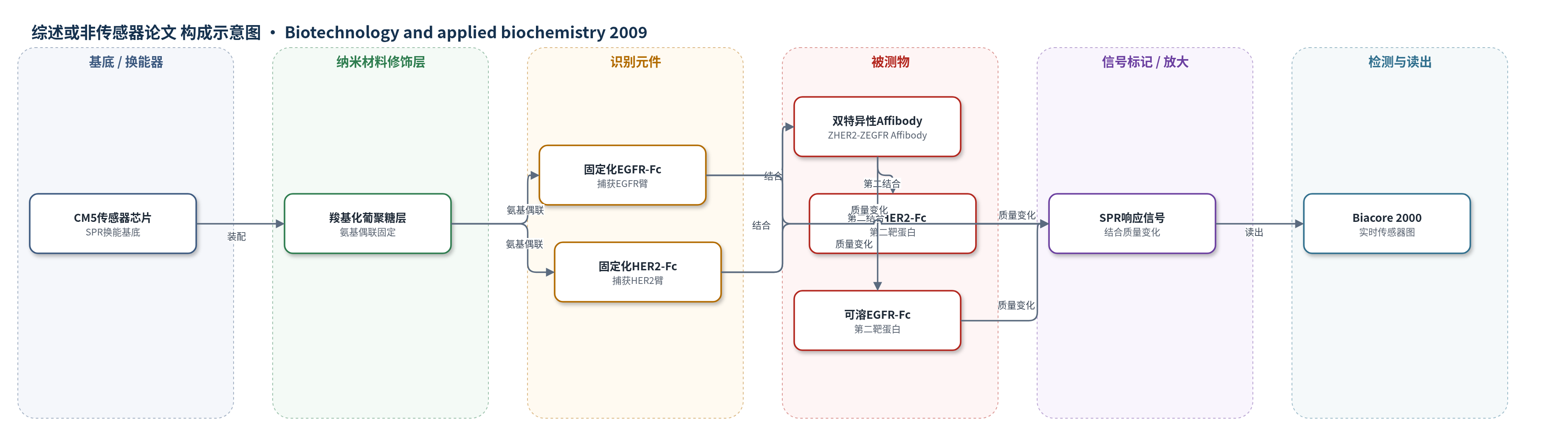
点击图片查看大图 · 依据论文自动绘制
传感器类型
综述或非传感器论文
检测对象
HER2(ErbB2)、EGFR;样品基质:重组蛋白溶液(hHER2-Fc、hEGFR-Fc、HER2-ECD)及细胞培养物(A-431、SK-OV-3、SKBR-3)
检测原理
Biacore SPR中,hHER2-Fc或hEGFR-Fc经氨基偶联固定于CM5芯片。双特异性Affibody流过时,HER2或EGFR臂与固定靶蛋白结合,引起界面质量/折射率变化,响应单位随结合量增加而升高,可拟合动力学。双结合时,先结合固定EGFR再注入可溶HER2-Fc可产生第二结合;反向固定HER2后注入可溶EGFR未检测到,提示空间位阻或可及性限制。细胞实验中,Alexa Fluor 488标记Affibody结合细胞表面受体产生荧光,由流式/共聚焦检测;LigandTracer用14C标记A-431,Affibody桥接A-431与SKBR-3,放射性计数反映细胞-细胞双结合。无酶促或核酸放大。
检测灵敏度
原文未报告LOD、线性范围、灵敏度斜率或R^2;报告KD: 22 pM (ZHER2:342)、5.4 nM (ZEGFR:1907)。
效应效果
该双特异性Affibody保留HER2和EGFR结合能力。与亲本二聚体相比,HER2表面结合类似(ZHER2:342)2,保持高结合率、低解离率;EGFR表面结合率和容量较低,但解离率相近。流式和免疫荧光中,过量(ZHER2:342)2或(ZEGFR:1907)2可分别竞争性阻断SK-OV-3或A-431结合,证明选择性。Biacore证实固定EGFR与可溶HER2可同时结合;微孔免疫荧光中A-431与可溶HER2-ECD同时结合,阴性(Ztaq)2无信号。LigandTracer中14C-A-431经Affibody桥接后与SKBR-3结合约为参考区3倍,2 h可见,阴性无结合。作者认为其可用于肿瘤双靶向成像与治疗。
传感器的构成
- 基底/换能器:CM5传感器芯片,羧基化葡聚糖层,用于SPR实时监测结合质量变化
- 固定化捕获层:hHER2-Fc、hEGFR、hEGFR-Fc,经氨基偶联固定于芯片,分别捕获HER2或EGFR结合臂
- 分析物/识别分子:双特异性Affibody (ZHER2:342)2-(G4S)3-(ZEGFR:1907)2,含HER2和EGFR结合Z结构域
- 对照分子:二聚体(ZHER2:342)2和(ZEGFR:1907)2,用于比较结合动力学
- 流动相:HBS缓冲液(10 mM Hepes、150 mM NaCl、3.4 mM EDTA、0.005% surfactant P20,pH 7.4)
- 再生/清洗:10 mM HCl,解离结合物并恢复芯片表面
- 荧光标记(细胞实验):Alexa Fluor 488标记Cys末端Affibody,用于流式和免疫荧光检测
中文摘要
HER2(人表皮生长因子受体2,ErbB2)和EGFR(表皮生长因子受体)在多种癌症中过表达,且常共表达,同时靶向两者有望提高分子成像与治疗的效率和选择性。本研究将二价HER2结合Affibody分子(ZHER2:342)2与二价EGFR结合Affibody分子(ZEGFR:1907)2通过(G4S)3连接子基因融合,构建约30 kDa的双特异性Affibody (ZHER2:342)2-(G4S)3-(ZEGFR:1907)2,在大肠杆菌中表达并纯化。利用Biacore生物传感器和流式细胞术证明其仍分别结合HER2和EGFR;通过实时生物特异性相互作用分析、免疫荧光显微镜和细胞-细胞相互作用分析,证明其可同时结合固定化EGFR与可溶HER2、EGFR过表达细胞与可溶HER2,以及HER2过表达SKBR-3细胞与EGFR过表达A-431细胞。该分子是首个报道的具有同时靶向HER2和EGFR潜力的双特异性亲和蛋白,可用于肿瘤成像和治疗。
英文摘要
HER2 (human epidermal-growth-factor receptor-2; ErbB2) and EGFR (epidermal-growth-factor receptor) are overexpressed in various forms of cancer, and the co-expression of both HER2 and EGFR has been reported in a number of studies. The simultaneous targeting of HER2 and EGFR has been discussed as a strategy with which to potentially increase efficiency and selectivity in molecular imaging and therapy of certain cancers. In an effort to generate a molecule capable of bispecifically targeting HER2 and EGFR, a gene fragment encoding a bivalent HER2-binding affibody molecule was genetically fused in-frame with a bivalent EGFR-binding affibody molecule via a (G4S)3 [(Gly4-Ser)3]-encoding gene fragment. The encoded 30 kDa affibody construct (ZHER2)2-(G4S)3-(ZEGFR)2, with potential for bs (bispecific) binding to HER2 and EGFR, was expressed in Escherichia coli and characterized in terms of its binding capabilities. The retained ability to bind HER2 and EGFR separately was demonstrated using both biosensor technology and flow-cytometric analysis, the latter using HER2- and EGFR-overexpressing cells. Furthermore, simultaneous binding to HER2 and EGFR was demonstrated in: (i) a sandwich format employing real-time biospecific interaction analysis where the bs affibody molecule bound immobilized EGFR and soluble HER2; (ii) immunofluorescence microscopy, where the bs affibody molecule bound EGFR-overexpressing cells and soluble HER2; and (iii) a cell-cell interaction analysis where the bs affibody molecule bound HER2-overexpressing SKBR-3 cells and EGFR-overexpressing A-431 cells. This is, to our knowledge, the first reported bs affinity protein with potential ability for the simultaneous targeting of HER2 and EGFR. The potential future use of this and similar constructs, capable of bs targeting of receptors to increase the efficacy and selectivity in imaging and therapy, is discussed.