组成图示
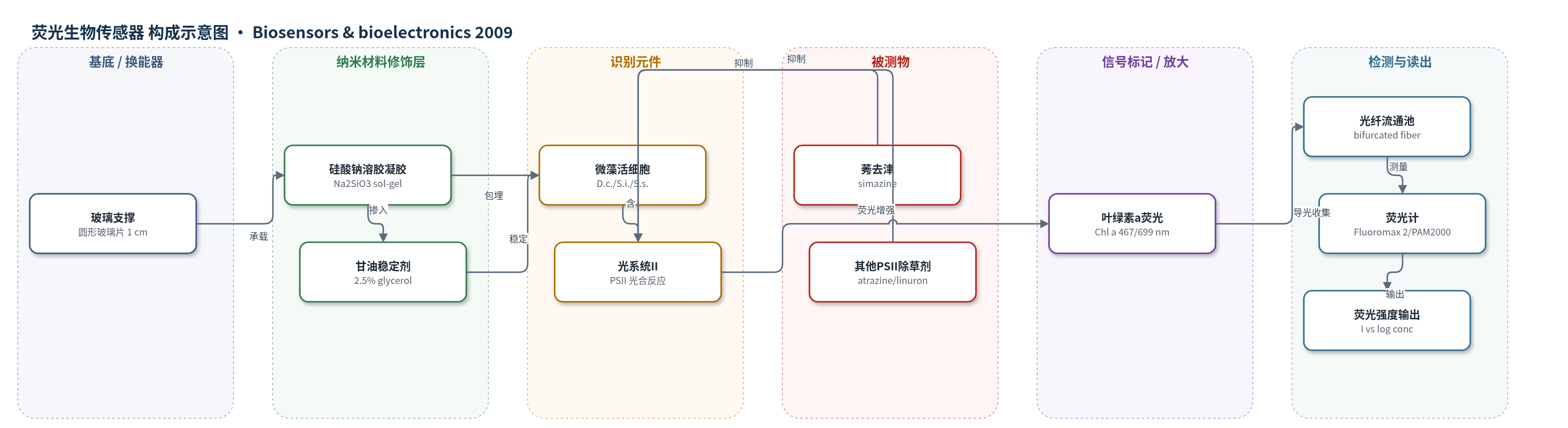
点击图片查看大图 · 依据论文自动绘制
传感器类型
荧光生物传感器
检测对象
莠去津(simazine)、阿特拉津(atrazine)、丙草津(propazine)、特丁津(terbuthylazine)、草净津(linuron);样品基质为 BG-11 培养基(模拟水样)
检测原理
传感器以活体微藻为识别元件,莠去津等 PSII 抑制剂进入溶胶-凝胶膜后与微藻光系统 II 结合,抑制电子传递和放氧,使光化学淬灭下降、叶绿素激发态寿命延长,从而引起叶绿素 a 荧光增强。检测时传感膜先暗适应 15 min,样品经流通池泵入,再用 467 nm 光激发 5 min,收集 699/702 nm 发射。荧光强度随除草剂浓度升高呈 S 形增加,用四参数 logistic 方程拟合,IC50 表示 50% 响应浓度。该体系无外加化学放大,但活细胞 PSII 抑制提供生物响应;联合敏感株与抗性株可区分莠去津与其他 PSII 抑制剂,提高选择性。
检测灵敏度
simazine: LOD: 3.6 μg L−1;动态校准范围: 19–860 μg L−1;IC50: 125 ± 14 μg L−1;r > 0.990;atrazine: LOD: 13.5 μg L−1;动态校准范围: 28–282 μg L−1;IC50: 88.2 ± 0.7 μg L−1;propazine: LOD: 7.6 μg L−1;动态校准范围: 20–540 μg L−1;IC50: 127 ± 2 μg L−1;terbuthylazine: LOD: 3.3 μg L−1;动态校准范围: 6–55 μg L−1;IC50: 18 ± 3 μg L−1;linuron: LOD: 4.1 μg L−1;动态校准范围: 9–149 μg L−1;IC50: 37 ± 6 μg L−1
效应效果
D.c. 传感器对莠去津可逆,基线恢复时间 <40 min;空白响应 RSD 为 5.6%(S.s. 3.3%、S.i. 2.5%),2.5% 甘油使重现性 <3%(无甘油约 15%)。荧光信号至少稳定 3 周。对阿特拉津、丙草津、特丁津和草净津均有响应,对 2,4-D(≤1 mg/L)和 Cu(II)(>0.5 mg/L)无显著干扰。认证标准 122±3 μg/L 莠去津测得 112±13 μg/L,HPLC 为 106±13 μg/L,t 检验无显著差异(P=0.05)。抗性株莠去津 LOD 提高 17 倍(64.6 vs 3.8 μg/L),但对阿特拉津/DCMU 响应相似,联合敏感/抗性株可提升选择性。作者认为其适合现场筛查,但短照射下未达饮用水 0.1 μg/L 限值。
传感器的构成
- 基底/支撑层:圆形玻璃支撑(circular glass support, 1 cm)承载溶胶-凝胶传感膜。
- 固定基质层:硅酸钠溶胶-凝胶(sodium silicate sol–gel, 2 M Na2SiO3, HCl 酸化, pH 9)包埋微藻并提供多孔保护。
- 稳定添加剂:甘油(glycerol, 2.5% w/w)降低包埋应力、提高膜稳定性与细胞存活。
- 识别元件:活体淡水绿微藻(D.c., S.i., S.s.;主要 D.c.)通过光系统 II(PSII)响应除草剂。
- 信号标记物:叶绿素 a(chlorophyll a)内源荧光,467 nm 激发、699/702 nm 发射。
- 光学换能/流通层:双分支光纤(bifurcated fiber-optic cable, 1 m)与自制流通池(flow-through cell)导光并输送 BG-11 样品。
- 读出装置:光谱荧光计(Fluoromax 2)或 PAM 荧光计(PAM2000)测量荧光强度。
中文摘要
本研究将三种淡水绿微藻——Dictyosphaerium chlorelloides(D.c.)、Scenedesmus intermedius(S.i.)和 Scenedesmus sp.(S.s.)包埋于硅酸钠溶胶-凝胶基质中,制备光纤生物传感器,利用叶绿素荧光信号增强定量莠去津(simazine)。研究评估了 pH 对溶胶-凝胶凝胶时间、藻密度对传感器响应以及甘油含量对膜稳定性的影响,并测试长期稳定性,荧光信号至少可稳定 3 周。D.c. 传感器对莠去津的检出限最低(3.6 μg/L),动态校准范围最宽(19–860 μg/L),IC50 为 125±14 μg/L。传感器经 HPLC-UV/DAD 验证。该传感器对抑制光系统 II 的三嗪类除草剂(莠去津、阿特拉津、丙草津、特丁津)和脲类除草剂草净津有响应,而对 2,4-D 和 Cu(II) 无显著响应。联合使用对莠去津敏感和抗性的两种基因型微藻传感器可进一步提高选择性。
英文摘要
Three microalgal species (Dictyosphaerium chlorelloides (D.c.), Scenedesmus intermedius (S.i.) and Scenedesmus sp. (S.s.)) were encapsulated in silicate sol-gel matrices and the increase in the amount of chlorophyll fluorescence signal was used to quantify simazine. Influence of several parameters on the preparation of the sensing layers has been evaluated: effect of pH on sol-gel gelation time; effect of algae density on sensor response; influence of glycerol (%) on the membrane stability. Long term stability was also tested and the fluorescence signal from biosensors remained stable for at least 3 weeks. D.c. biosensor presented the lowest detection limits for simazine (3.6 microg L(-1)) and the broadest dynamic calibration range (19-860 microg L(-1)) with IC(50) 125+/-14 microg L(-1). Biosensor was validated by HPLC with UV/DAD detection. The biosensor showed response to those herbicides that inhibit the photosynthesis at photosystem II (triazines: simazine, atrazine, propazine, terbuthylazine; urea based herbicides: linuron). However, no significant increases of fluorescence response was obtained for similar concentrations of 2,4-D (hormonal herbicide) or Cu(II). The combined use of two biosensors that use two different genotypes, sensitive and resistant to simazine, jointly allowed improving microalgae biosensor specificity.