组成图示
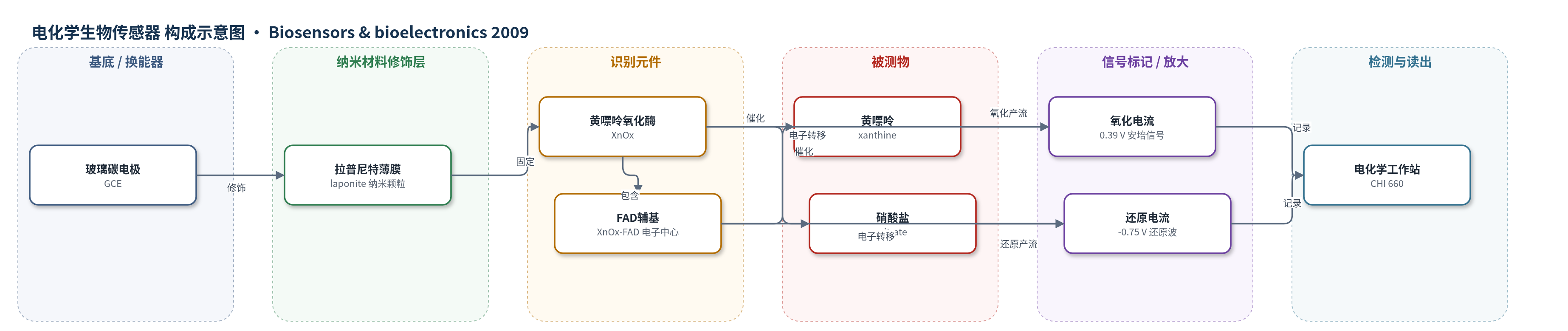
点击图片查看大图 · 依据论文自动绘制
传感器类型
电化学生物传感器
检测对象
黄嘌呤(xanthine,PBS pH 7.5)、硝酸盐(nitrate,PBS pH 5.0)
检测原理
拉普尼特纳米颗粒薄膜将黄嘌呤氧化酶(XnOx)固定于玻璃碳电极表面,其高表面能诱导酶取向吸附并暴露 FAD 辅基,使 FAD/FADH2 与电极发生直接电子转移。检测黄嘌呤时,在 +0.39 V 下 XnOx 催化黄嘌呤氧化,FAD 与电极直接电子转移维持催化循环,产生与黄嘌呤浓度成正比的氧化电流;检测硝酸盐时,在约 -0.75 V 出现还原波,电子由电极经 FAD、Fe-S 簇传递至 Mo 中心催化硝酸盐还原。信号随被测物浓度增加而增强,酶催化循环实现信号放大,无需外加电子媒介体。
检测灵敏度
黄嘌呤:LOD: 1.0 × 10^-8 M;线性范围: 3.9 × 10^-8–2.1 × 10^-5 M;灵敏度: 6.54 mA M^-1。硝酸盐:线性范围: 2 × 10^-5–3 × 10^-4 M;灵敏度斜率: 3.643 µA mM^-1(ΔIpc = -0.0646 - 3.643C);R^2 = 0.9945。
效应效果
该电极在 pH 5.0 PBS 中储存 20 天后循环伏安峰电流保持 84%,12 个独立制备电极的 CV 峰电流 RSD 为 1.2%,黄嘌呤传感器重现性 RSD 为 2.7%。黄嘌呤检测响应时间 5 s 内达到稳态电流的 95%,表观 Michaelis 常数 KappM 为 6.4×10^-5 M,接近游离 XnOx 的 4.5×10^-5 M。在 0.39 V 下,5 mM 葡萄糖、2 mM 苯甲酸钠、0.01 mM 抗坏血酸和 0.02 mM L-半胱氨酸无明显干扰;加入 12.8 µM 黄嘌呤的响应与无干扰时接近。与文献黄嘌呤传感器相比,其检出限较低、灵敏度较高且重现性较好。
传感器的构成
- 基底/换能器电极:玻璃碳电极(GCE,直径 3 mm),提供导电基底并实现直接电子转移
- 纳米材料修饰层:拉普尼特(laponite)纳米颗粒薄膜,提供高比表面积、高表面能和亲水微环境,固定 XnOx 并促进电子传递
- 识别元件:黄嘌呤氧化酶(XnOx),催化黄嘌呤氧化和硝酸盐还原,其 FAD 辅基与电极直接电子转移
- 工作介质:0.1 M 磷酸盐缓冲液(PBS),维持酶活性与电化学测试环境
中文摘要
本文首次将胶体拉普尼特(laponite)纳米颗粒用于构建第三代生物传感器,研究玻璃碳电极(GCE)上负载黄嘌呤氧化酶(XnOx)的直接电化学行为。XnOx/laponite 薄膜修饰电极在 0.1 M PBS(pH 5.0)中呈现一对稳定可逆循环伏安峰,峰电位约 -0.370 V(vs. SCE),归属于 XnOx 的 FAD 辅基。其形式电位随 pH 4.0–8.0 线性负移,斜率为 -54.3 mV/pH,表明该过程为两电子与两质子耦合转移。固定化 XnOx 保持良好生物活性,并对黄嘌呤氧化和硝酸盐还原表现出优异电催化性能。在 0.39 V 下,电极对黄嘌呤的安培响应在 3.9×10^-8–2.1×10^-5 M 范围内线性,检出限为 1.0×10^-8 M(S/N=3)。
英文摘要
In this work, colloidal laponite nanoparticles were further expanded into the design of the third-generation biosensor. Direct electrochemistry of the complex molybdoenzyme xanthine oxidase (XnOx) immobilized on glassy carbon electrode (GCE) by laponite nanoparticles was investigated for the first time. XnOx/laponite thin film modified electrode showed only one pair of well defined and reversible cyclic voltammetric peaks attributed to XnOx-FAD cofactor at about -0.370 V vs. SCE (pH 5). The formal potential of XnOx-FAD/FADH(2) couple varied linearly with the increase of pH in the range of 4.0-8.0 with a slope of -54.3 mV pH(-1), which indicated that two-proton transfer was accompanied with two-electron transfer in the electrochemical reaction. More interestingly, the immobilized XnOx retained its biological activity well and displayed an excellent electrocatalytic performance to both the oxidation of xanthine and the reduction of nitrate. The electrocatalytic response showed a linear dependence on the xanthine concentration ranging from 3.9 x 10(-8) to 2.1 x 10(-5)M with a detection limit of 1.0 x 10(-8)M based on S/N=3.