组成图示
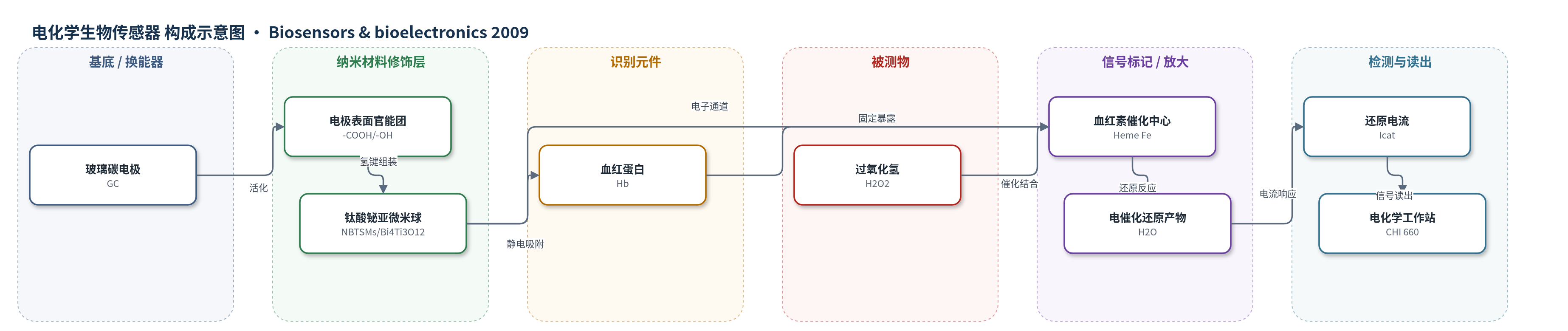
点击图片查看大图 · 依据论文自动绘制
传感器类型
电化学生物传感器
检测对象
过氧化氢(hydrogen peroxide, H2O2),样品基质为 20 mM PBS(pH 7.0)
检测原理
Hb 通过氢键和静电组装固定于 NBTSMs/GC 电极,NBTSMs 的层状纳米片结构提供纳米腔隙、氧空位和导电通道,使血红素中心保持天然构象并实现与电极的直接电子转移。加入 H2O2 后,Hb[Heme(FeIII)] 与 H2O2 反应生成 Compound I,Compound I 再与 H2O2 反应再生 FeIII 并释放 O2;电极上 FeIII 接受电子还原为 FeII,FeII 与 O2 结合后再被还原再生 FeIII,形成催化循环,总反应为 H2O2 + 2H+ + 2e− → 2H2O。H2O2 浓度升高使电催化还原电流增大,在 2.0×10⁻⁶–4.3×10⁻⁴ M 内线性响应,信号以循环伏安/安培电流读出。
检测灵敏度
LOD: 4.6 × 10⁻⁷ M (S/N = 3);线性范围: 2.0 × 10⁻⁶–4.3 × 10⁻⁴ M;灵敏度: 84 mA cm−2 M−1;R = 0.9999 (n = 11)
效应效果
该传感器无需交联剂,Hb 在 NBTSMs 中保持天然二级结构(UV-vis 405 nm Soret 峰和 FTIR amide I/II 基本不变)。对 60 μM H2O2 连续 6 次测量 RSD 为 2.6%,3 个独立电极间 RSD 为 3.1%;PBS 中浸泡 4 h 阴极峰电流下降小于 1.7%,20 天后保留 96.4% 初始响应。表观 ks 为 20.0±3.8 s−1,ΔEp 约 60 mV,KappM 204 μM,灵敏度 84 mA cm−2 M−1。线性范围较 Lu 等更宽,KappM 小于 Yang 等和 Xu 等,ks 大于 CNTs(1.16 s−1)和 BCNTs(1.56 s−1)。未报告选择性、抗干扰或实际样品回收率,作者认为可用于生物医学、食品和环境分析。
传感器的构成
- 基底/换能器电极:玻璃碳电极(GC),经 0.1 M HNO3 中 1.8 V 氧化和 -1.5 V 还原活化,表面含 -COOH、-OH 等官能团,提供氢键位点并作为电子换能器。
- 纳米材料修饰层:纳米片状钛酸铋亚微米球(NBTSMs,Bi4Ti3O12),通过氢键自组装于活化 GC,层状纳米片堆叠形成纳米腔隙与高活性位点,促进 Hb 固定和直接电子转移。
- 识别/催化元件:血红蛋白(Hb,bovine hemoglobin),在 pH 7.0 PBS 中带负电,通过静电吸附于正电荷 NBTSMs,保持天然二级结构,血红素中心与电极直接电子转移并电催化 H2O2 还原。
中文摘要
本文首次通过简便水热法合成由数十片 Bi4Ti3O12 纳米片堆叠构成的层状无机钙钛矿亚微米球(NBTSMs)。将其作为支持基质,通过氢键与静电联合组装过程构建氧化还原蛋白固定化与生物传感新平台。采用紫外-可见吸收、傅里叶变换红外光谱和电化学方法研究复合物的生物相容性、稳定性、重现性及电化学与电催化性能。结果表明,NBTSMs 基复合物是良好基质,可使蛋白有效保持天然结构和生物活性。利用 Bi4Ti3O12 层状材料优势,金属酶在 NBTSMs 酶电极上实现促进的直接电子转移,表观异相电子转移速率常数 ks 为 20.0±3.8 s−1。该 NBTSMs 生物传感器对过氧化氢还原显示显著电催化活性,表观 Michaelis-Menten 常数为 204 μM,线性范围为 2–430 μM,检出限为 0.46 μM(S/N=3)。这说明纳米片构建的 Bi4Ti3O12 亚微米球是氧化还原蛋白直接电化学及相关酶生物传感器构建的理想候选材料,可在生物医学、食品和环境分析检测中应用。
英文摘要
A layered inorganic perovskite sub-micrometer-scale material, nanoplated bismuth titanate (Bi(4)Ti(3)O(12)) sub-microspheres (NBTSMs) constructed with tens of Bi(4)Ti(3)O(12) nanoplates, was for the first time synthesized by a facile hydrothermal synthesis strategy. The NBTSMs were employed as a supporting matrix to explore a novel immobilization and biosensing platform of redox proteins through a combined hydrogen bond and electrostatic assembly process. Biocompatibility, stability, reproducibility, and electrochemical and electrocatalytic properties of the resulting NBTSMs-based composite were studied by UV-vis absorption, FTIR, and electrochemical methods. The research results revealed that the NBTSMs-based composite was a satisfying matrix for proteins to effectively retain their native structure and bioactivity. With advantages of the Bi(4)Ti(3)O(12) layered material, facilitated direct electron transfer of the metalloenzymes with an apparent heterogeneous electron transfer rate constant (k(s)) of 20.0+/-3.8s(-1) was acquired on the NBTSMs-based enzyme electrode. The NBTSMs-based biosensor demonstrated significant electrocatalytic activity for the reduction of hydrogen peroxide with an apparent Michaelis-Menten constant (204 microM), wide linear range (2-430 microM), and low detection limit (0.46 microM, S/N=3). These indicated that the nanoplate-constructed Bi(4)Ti(3)O(12) sub-microspheres were one of ideal candidate materials for direct electrochemistry of redox proteins and the construction of the related enzyme biosensors, and may find potential applications in biomedical, food, and environmental analysis and detection.