组成图示
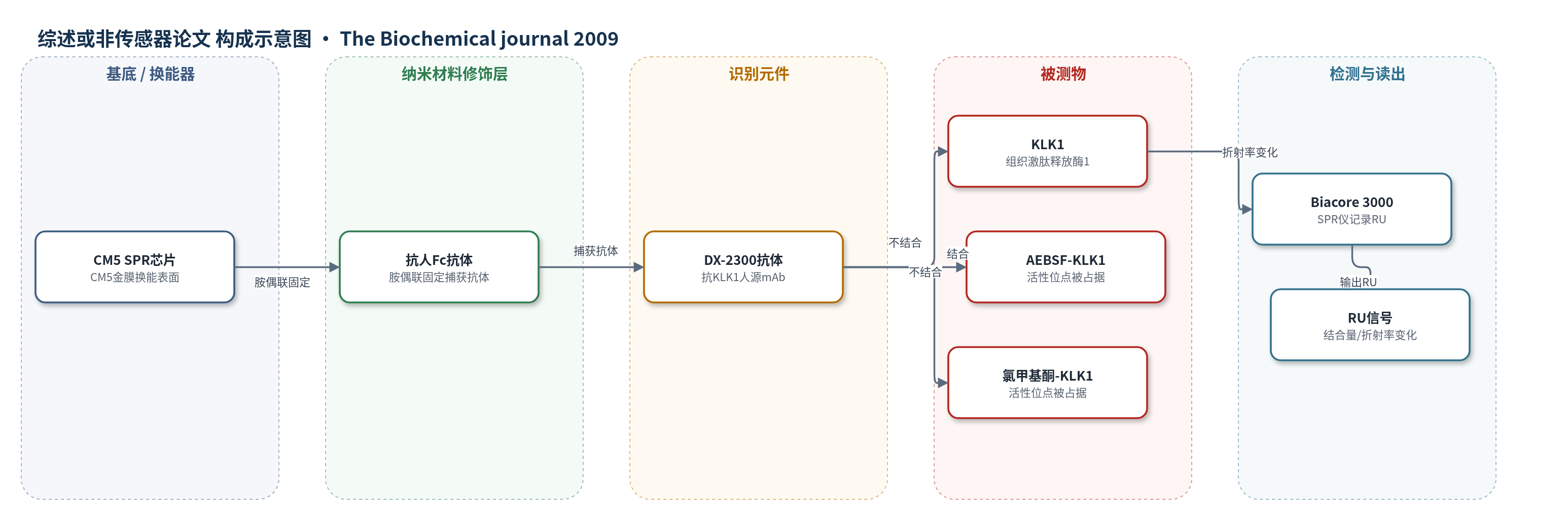
点击图片查看大图 · 依据论文自动绘制
传感器类型
综述或非传感器论文
检测对象
组织激肽释放酶1(KLK1/tissue kallikrein 1)蛋白或KLK1样酶活;样品基质:人尿、唾液、支气管肺泡灌洗液(BAL)、血清/血浆、细胞培养上清、羊尿
检测原理
本文主要使用SPR和荧光酶活检测。SPR中,DX-2300经抗人Fc抗体捕获于CM5芯片,KLK1流过时与DX-2300结合,界面质量/折射率增加,Biacore 3000记录共振单位(RU);若KLK1活性位点被AEBSF或H-D-Pro-Phe-Arg-chloromethane占据,DX-2300不能结合,RU响应降低,从而证明其识别活性位点。荧光酶活检测中,KLK1催化Pro-Phe-Arg-AMC水解释放AMC,AMC在360 nm激发、460 nm发射下产生荧光,荧光速率与KLK1活性成正比;DX-2300与KLK1竞争性结合,使酶活和荧光信号下降。KLK1浓度或活性越高,RU或荧光信号越强;未使用HCR、RCA等放大策略。
检测灵敏度
原文未报告LOD、线性范围、灵敏度斜率或R^2。
效应效果
DX-2300对21种丝氨酸蛋白酶在1 μM下均无抑制,选择性高;Ki=0.13 nM,SPR显示其不结合活性位点被AEBSF或H-D-Pro-Phe-Arg-chloromethane占据的KLK1。在人尿、唾液中完全抑制KLK1样活性,BAL中合成底物活性抑制约70%,100 nM DX-2300将激肽原酶活性从36±15 ng/mg降至0.15±0.22 ng/mg。HBE细胞中,ROS诱导MUC5AC阳性细胞比例由32.3±8.7%降至11.4±2.1%。过敏羊吸入2×10 mg DX-2300抑制迟相支气管收缩91%,PC400比值0.96,中性粒细胞由56±28×10^3降至8±2.1×10^3 cells/ml;HMMK诱导支气管收缩抑制49%和68%。作者认为其可治疗哮喘/COPD气道炎症。
传感器的构成
- SPR芯片基底:CM5金膜芯片,提供SPR换能表面
- 抗体捕获层:山羊抗人Fc片段特异性IgG,经胺偶联固定于CM5芯片,用于捕获DX-2300
- 识别元件:人源单克隆抗体DX-2300,抗KLK1,被捕获后识别KLK1
- 分析物流路:KLK1或经AEBSF/H-D-Pro-Phe-Arg-chloromethane预处理的KLK1,流过芯片表面
- 运行缓冲液:HBS-P(10 mM Hepes, pH 7.4, 150 mM NaCl, 0.005% surfactant P20),维持结合反应
- 参考/再生:参考流路模拟胺偶联封闭;10 mM glycine pH 1.5再生芯片表面
中文摘要
KLK1(组织激肽释放酶1)是组织激肽释放酶家族丝氨酸蛋白酶成员,也是人呼吸道中主要的激肽生成酶。DX-2300是一种全人源单克隆抗体,通过竞争性抑制机制抑制KLK1(Ki=0.13 nM)。在表面等离子共振(SPR)生物传感器检测中,当KLK1与已知活性位点抑制剂形成复合物时,未观察到DX-2300与KLK1结合,提示DX-2300识别KLK1活性位点。DX-2300对21种以1 μM浓度分别检测的丝氨酸蛋白酶均无抑制作用。作者通过测定人尿、唾液和支气管肺泡灌洗液中已知含有活性KLK1的KLK1样活性,验证了DX-2300用于特异性KLK1抑制的可行性。在气液界面培养的人气管支气管上皮细胞中,DX-2300阻断了氧化应激诱导的表皮生长因子受体激活以及下游黏液细胞增殖和高分泌,这些过程此前已被证明由KLK1介导。在哮喘过敏羊模型中,DX-2300同时抑制了过敏原诱导的迟相支气管收缩和卡巴胆碱气道高反应性。这些研究证明DX-2300是KLK1的强效、特异性抑制剂,并在气道疾病的体外和体内模型中有效。
英文摘要
KLK1 (tissue kallikrein 1) is a member of the tissue kallikrein family of serine proteases and is the primary kinin-generating enzyme in human airways. DX-2300 is a fully human antibody that inhibits KLK1 via a competitive inhibition mechanism (Ki=0.13 nM). No binding of DX-2300 to KLK1 was observed in a surface-plasmon-resonance biosensor assay when KLK1 was complexed to known active-site inhibitors, suggesting that DX-2300 recognizes the KLK1 active site. DX-2300 did not inhibit any of the 21 serine proteases that were each tested at a concentration of 1 microM. We validated the use of DX-2300 for specific KLK1 inhibition by measuring the inhibition of KLK1-like activity in human urine, saliva and bronchoalveolar lavage fluid, which are known to contain active KLK1. In human tracheobronchial epithelial cells grown at the air/liquid interface, DX-2300 blocked oxidative-stress-induced epidermal-growth-factor receptor activation and downstream mucus cell proliferation and hypersecretion, which have been previously shown to be mediated by KLK1. In an allergic sheep model of asthma, DX-2300 inhibited both allergen-induced late-phase bronchoconstriction and airway hyper-responsiveness to carbachol. These studies demonstrate that DX-2300 is a potent and specific inhibitor of KLK1 that is efficacious in in vitro and in vivo models of airway disease.