组成图示
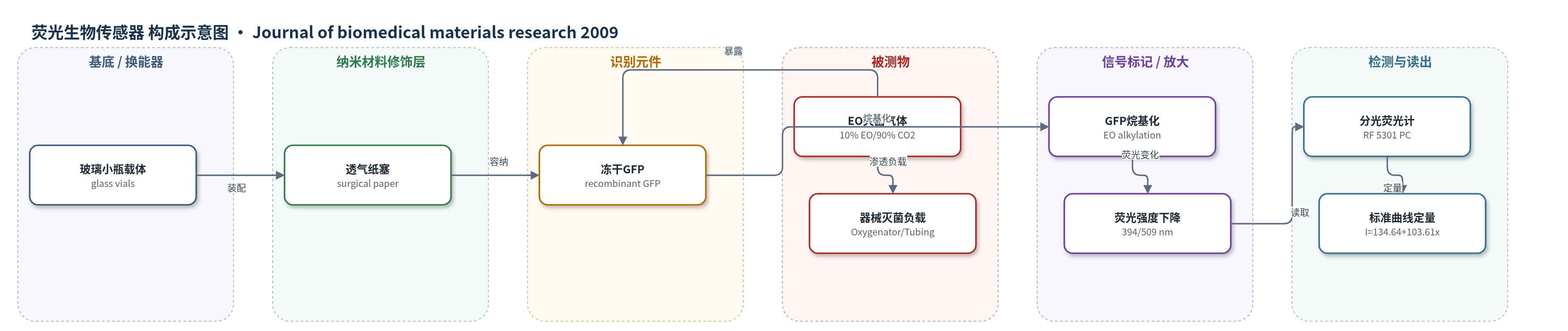
点击图片查看大图 · 依据论文自动绘制
传感器类型
荧光生物传感器
检测对象
环氧乙烷(ethylene oxide, EO)气体;样品基质:EO灭菌室中的医疗器械负载(膜式氧合器 Oxygenator、PVC管路 Tubing)
检测原理
GFP含有内源荧光团,激发和发射最大波长分别为394 nm和509 nm,可在无辅因子条件下产生荧光。将冻干GFP置于带透气手术级纸塞的玻璃小瓶中,使其与EO灭菌气体接触。EO是反应性烷基化剂,可烷基化GFP中的氨基酸残基,改变蛋白结构并降低荧光强度。EO气体在灭菌室负载中分布和渗透越强,GFP受到的烷基化作用越明显,剩余荧光强度越低。实验用分光荧光计测定处理后GFP的荧光强度,并按标准曲线换算为剩余GFP浓度,以初始浓度下降百分比反映EO暴露程度。该方法无需电极或酶放大,直接以荧光信号变化指示EO气体分布。
检测灵敏度
GFP标准曲线: I = 134.64 + 103.61x (GFP μg/mL);r^2 = 0.98
效应效果
GFP在17个灭菌室点位显示EO暴露后荧光下降,4 h与8 h周期中下降最小值与较冷点位(靠近门和中心)相关,提示可反映EO分布差异。2 h周期下降幅度为4.8%±3.2%至7.5%±2.5%,4 h为17.4%±3.0%至21.5%±6.8%,8 h为22.5%±3.2%至23.9%±3.9%;托盘间无显著差异,点位间存在差异(2 h周期0.17%至10.19%)。BI未检出芽孢生长。GC显示氧合器灭菌后EO残留35.45±3.78 mg/device,低于限值;管路72 h后EO为283.17±81.92 mg/device,需204 h通气降至14.97±10.63 mg/device。作者认为GFP可作为EO灭菌过程控制的潜在生物传感器。
传感器的构成
- 识别/传感元件:重组绿色荧光蛋白(GFP,Clontech,纯度95%),作为EO响应蛋白,EO烷基化导致荧光强度下降
- 样品容器/载体:玻璃小瓶(glass vials)带螺旋盖和手术级纸塞(surgical degree paper,100% cellulose,60 g/m2),允许EO气体渗透并与GFP接触
- 缓冲/保护介质:Tris-EDTA 10 mM缓冲液(pH 8.0),用于稀释GFP并维持蛋白状态;冻干后复水用无菌水
- 信号读出装置:分光荧光计(RF 5301 PC,Shimadzu),激发394 nm、发射509 nm,测定GFP荧光强度
- 定量标准:GFP标准曲线(I = 134.64 + 103.61x,x为GFP μg/mL;r^2 = 0.98),用于将荧光强度换算为剩余GFP浓度
中文摘要
环氧乙烷(EO)常用于心脏手术用膜式氧合器(Oxygenator)和管路(Tubing)的灭菌。EO及其衍生物氯乙醇(ECH)和乙二醇(EG)的残留可能危害患者,因此必须通过通气去除。本研究旨在估计这些器械达到安全使用限值所需的最短通气时间,并评估绿色荧光蛋白(GFP)作为生物传感器指示EO气体在灭菌室中分布和渗透的能力。2、4和8 h灭菌周期以Bacillus atrophaeus ATCC 9372作为生物指示剂(BI),并以GFP进行监测;EO、ECH和EG残留水平用气相色谱(GC)测定,并研究残留消散。结果显示,氧合器在灭菌过程结束后即达到安全限值,管路需通气204 h。2 h周期中,GFP浓度下降幅度为4.8%±3.2%至7.5%±2.5%;4 h周期为17.4%±3.0%至21.5%±6.8%;8 h周期为22.5%±3.2%至23.9%±3.9%。该结果表明GFP具有作为EO生物传感器的应用潜力。
英文摘要
Ethylene oxide (EO) is used to sterilize Oxygenator and Tubing applied to heart surgery. Residual levels of EO and its derivatives, ethylene chlorohydrin (ECH) and ethylene glycol (EG), may be hazardous to the patients. Therefore, it must be removed by the aeration process. This study aimed to estimate the minimum aeration time for these devices to attain safe limits for use (avoiding excessive aeration time) and to evaluate the Green Fluorescent Protein (GFP) as a biosensor capable of best indicating the distribution and penetration of EO gas throughout the sterilization chamber. Sterilization cycles of 2, 4, and 8 h were monitored by Bacillus atrophaeus ATCC 9372 as a biological indicator (BI) and by the GFP. Residual levels of EO, ECH, and EG were determined by gas chromatography (GC), and the residual dissipation was studied. Safe limits were reached right after the sterilization process for Oxygenator and after 204 h of aeration for Tubing. In the 2 h cycle, the GFP concentration decreased from 4.8 (+/-3.2)% to 7.5 (+/-2.5)%. For the 4 h cycle, the GFP concentration decreased from 17.4 (+/-3.0)% to 21.5 (+/-6.8)%, and in the 8 h cycle, it decreased from 22.5 (+/-3.2)% to 23.9 (+/-3.9)%. This finding showed the potentiality for GFP applications as an EO biosensor.