组成图示
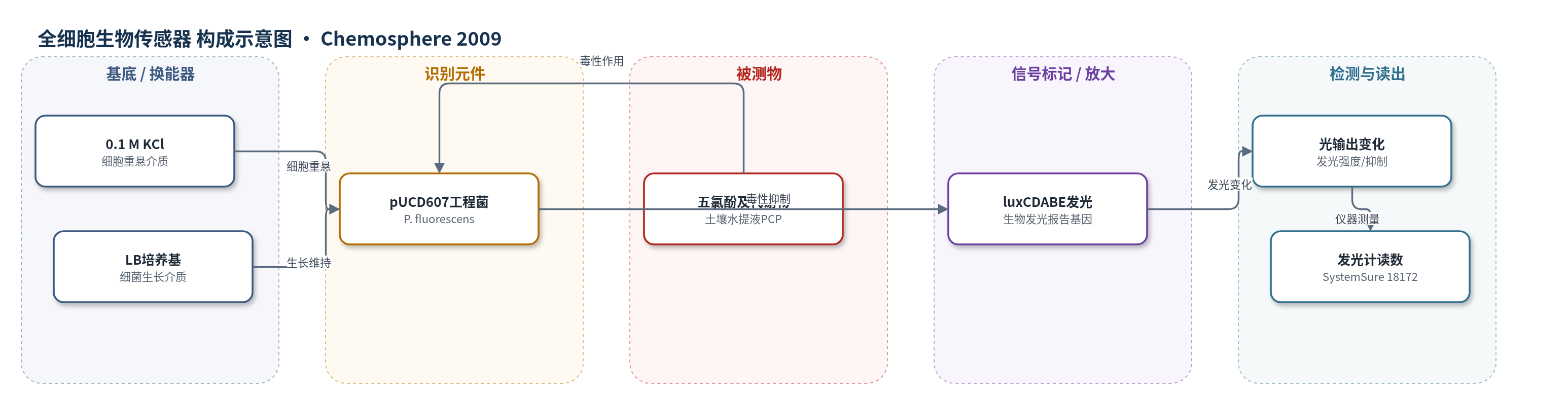
点击图片查看大图 · 依据论文自动绘制
传感器类型
全细胞生物传感器
检测对象
五氯酚(pentachlorophenol, PCP)及其降解代谢物;样品基质:非无菌堆肥改良土壤水提取液
检测原理
该检测基于全细胞微生物生物传感器。Pseudomonas fluorescens pUCD607 携带来自 Vibrio fischerii 的 luxCDABE 发光报告基因,在 LB 培养基中生长并维持质粒。将细菌重悬于 0.1 M KCl 后暴露于含五氯酚(PCP)及其代谢物的土壤水提取液。毒性物质进入细菌并干扰其代谢、膜功能或报告基因启动子调控,使生物发光强度下降。发光计测量光输出,以相对未污染对照的光抑制百分比表示毒性。PCP 或其代谢物毒性越强,光输出越低;该过程利用完整细菌作为识别与换能单元,并通过报告基因表达实现信号转换,无额外化学放大步骤。
检测灵敏度
原文未报告LOD、线性范围、灵敏度斜率或相关系数。
效应效果
该生物传感器用于非无菌土壤水提液生态毒性评估。未改良土壤20 d光发射为对照50%,60/120 d恢复至>75%;堆肥处理20 d>75%,但60/120 d降至C1 10.2±2%、7.2±2%和C2 4.1±3%、6.0±2%。该趋势与PCP降解率一致(120 d:NC 13±3%、C1 30±5%、C2 35±5%),提示形成毒性代谢物。蚯蚓NRRT也显示污染土壤毒性(120 d 12.2±3.3 min vs 84.3±8.5 min)。作者认为堆肥可促进PCP降解,但需结合生物传感器与蚯蚓标志物评价代谢物毒性。
传感器的构成
- 细胞悬浮介质:0.1 M KCl,用于暴露前重悬细菌并提供离子环境
- 识别/换能元件:Pseudomonas fluorescens pUCD607 工程菌,作为全细胞毒性识别与信号产生单元
- 报告基因/信号标记:luxCDABE(Vibrio fischerii)发光基因簇,受毒性相关启动子调控,产生生物发光
- 维持培养基:LB 肉汤,支持细菌生长与报告基因表达
- 选择压力:卡那霉素(kanamycin, 50 μg/mL),维持 pUCD607 质粒稳定
- 样品基质:非无菌堆肥改良土壤水提取液,提供 PCP 及其代谢物
- 读出装置:SystemSure luminometer Model 18172,测量光输出/光抑制百分比
中文摘要
本研究采用多种化学提取与生态毒理方法,考察堆肥改良对五氯酚(PCP)在土壤中生物可及性、生物可利用性和生态毒性的时间效应。实验在无菌和非无菌微宇宙中进行,于污染后20、60和120天采样。Porapak树脂提取显示PCP生物可及性约为施用量的75%,且未受老化和堆肥显著影响。水提取用于评估PCP对细菌的生物可利用性,结果始终低于50%,并随老化和堆肥添加显著降低。非无菌体系中,堆肥促进PCP生物降解,但发光细菌生物传感器Pseudomonas fluorescens pUCD607显示降解程度最高的样品毒性更高,提示可能形成毒性更强的代谢物。蚯蚓体积累结果与水提取趋势一致,表明随时间和堆肥添加生物可利用PCP减少;体腔细胞中性红保留时间试验未检测到堆肥或老化效应。结果表明,评估PCP等异生物质在土壤中的生物可利用性和生态毒性需综合多种化学与生物方法;堆肥可作为PCP污染土壤修复策略,但需关注有毒代谢物形成。
英文摘要
The influence of compost on the bioaccessibility, bioavailability and ecotoxicity of pentachlorophenol (PCP) as a function of time was studied by means of different chemical and ecotoxicological methods. Experiments were conducted in both sterile and non-sterile microcosms and samplings carried out at 20, 60 and 120d from initial contamination. PCP bioaccessibility, assessed by means of Porapak resin extraction, was around 75% of the applied dose with no aging or compost effects. Two different methods were applied to assess the bioavailability of PCP, respectively, to bacteria and earthworms and linked to ecotoxicological assays (biosensor and earthworm coelomocytes assays). Water extraction was applied to assess the bioavailability to bacteria: results showed that this fraction was always below 50%, with significant decreases as a result of aging processes and compost addition. In non-sterile microcosms, compost amendment increased the amount of PCP biodegraded, while the ecotoxicological assay with the biosensor Pseudomonas fluorescens pUCD607 indicated a higher toxicity in the most degraded samples, thus suggesting the formation of more toxic metabolites. Earthworm body accumulation results were rather in accordance with water extractions data, with decreasing bioavailable amounts as a result of time and compost addition. No compost or aging effects were instead detected by coelomocytes assay. Results indicate how different methods must be applied altogether to assess the bioavailability and ecotoxicity of xenobiotics such as PCP in soil. The addition of compost was also proven as an effective strategy for the remediation of PCP contaminated soils, although issues related to the possible formation of toxic metabolites must be taken into account.