组成图示
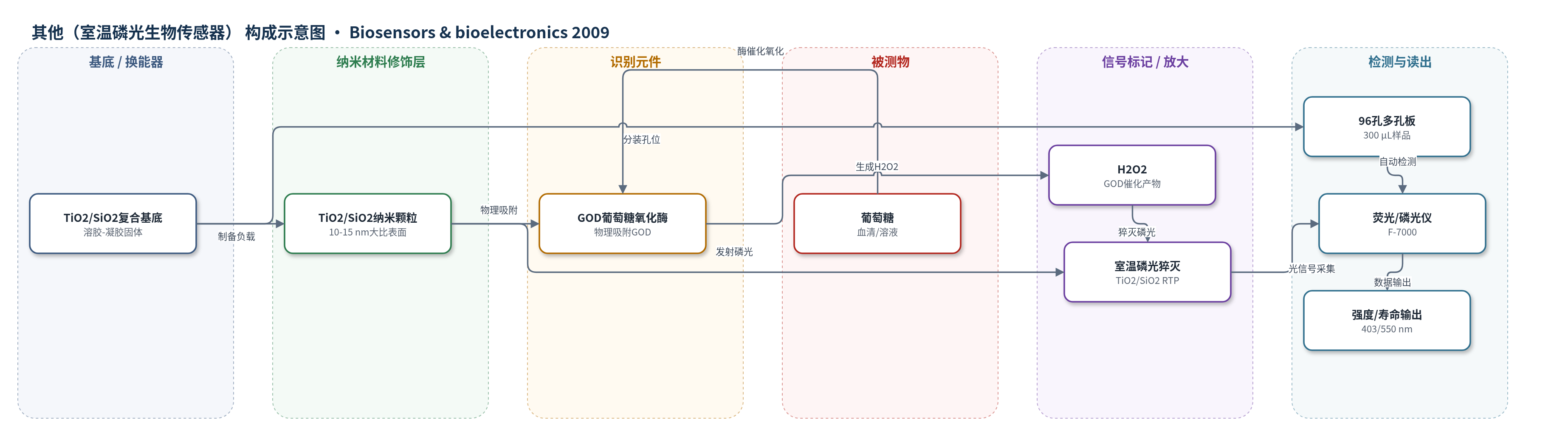
点击图片查看大图 · 依据论文自动绘制
传感器类型
其他(室温磷光生物传感器)
检测对象
葡萄糖(glucose);样品基质:人血清(human blood serum)、PBS缓冲液/葡萄糖溶液
检测原理
葡萄糖在固定化葡萄糖氧化酶(GOD)催化下发生氧化反应,生成过氧化氢(H2O2)。TiO2/SiO2纳米复合材料本身具有室温磷光(RTP),而H2O2可猝灭该磷光,使磷光强度下降、寿命缩短。传感器以TiO2/SiO2同时作为酶固定载体和光信号换能器,无需外源标记物。检测时,样品中的葡萄糖与GOD作用产生H2O2,H2O2扩散至TiO2/SiO2界面并猝灭其磷光;荧光/磷光分光光度计在403 nm激发、550 nm发射下采集磷光强度或时间分辨寿命。log[(P0-P)/P]与-log C呈线性,磷光变化随葡萄糖浓度增加而增强,从而实现定量检测。
检测灵敏度
LOD: 1.2 × 10⁻¹⁰ M;线性范围: 1.0 × 10⁻⁹–1.0 × 10⁻² M;R^2 = 0.9939;校准方程: y = -0.2489x + 1.5662(y=log[(P0-P)/P], x=-log C)
效应效果
该传感器选择性良好:在1.0×10⁻² M葡萄糖体系中,乳糖、尿酸、蔗糖、对乙酰氨基酚、Na+、K+、Ca2+、NO3−、PO4^3−和SO4^2−干扰容忍比均大于100。pH 4.0–10.0内响应稳定,相关系数均高于0.99;响应时间约6 s,RSD为5.9%。3个月后初始磷光强度由93.70降至89.76(约4.5%),R2由0.9939变为0.9930。241份人血清样本中,最大24.84 mM(CV 3.30),最小2.43 mM(CV 0.64);Error Grid分析与自动葡萄糖分析仪一致,F/T检验在90%置信水平无显著差异。磷光颜色可由白变黄,可肉眼辅助判断。
传感器的构成
- 基底/换能器:TiO2/SiO2纳米复合固体粉末,作为整体传感器基底和室温磷光换能器。
- 纳米材料修饰层:TiO2/SiO2溶胶-凝胶纳米颗粒(粒径约10–15 nm),构成多孔三维网络,提供大比表面积和稳定微环境。
- 识别元件:葡萄糖氧化酶(GOD),物理吸附于TiO2/SiO2表面及孔隙间,催化葡萄糖氧化。
- 信号标记物:无外源标记物;TiO2/SiO2自身室温磷光(RTP)为内源信号,被H2O2猝灭。
- 读出载体:96孔多孔板孔位(单孔约300 μL),承载固定化酶并配合荧光/磷光分光光度计检测。
中文摘要
本研究将葡萄糖氧化酶(GOD)直接固定于TiO2/SiO2纳米复合材料上,构建葡萄糖生物传感器。TiO2/SiO2纳米复合材料具有室温磷光,且其磷光可被过氧化氢(H2O2)猝灭;在GOD催化下葡萄糖氧化生成H2O2,因此可通过监测磷光变化间接检测葡萄糖。利用荧光分光光度计的96孔多孔板附件,该传感器对葡萄糖在1.0×10−9至1.0×10−2 M范围内呈良好线性响应,检出限为1.2×10⁻¹⁰ M。TiO2/SiO2既作固定载体又作信号换能器,磷光强度和颜色随葡萄糖加入明显变化,甚至可肉眼观察。基于该材料提出固体基底室温磷光法(SS-RTP)用于葡萄糖测定。该传感器具有宽线性范围、低检出限、高灵敏度和快速响应,并成功应用于人血清葡萄糖检测。GOD与TiO2/SiO2相互作用增大比表面积并提高酶稳定性,材料生物相容性好、无毒且化学稳定。
英文摘要
The direct immobilization of glucose oxidase (GOD) on TiO2/SiO2 nanocomposite and its application as glucose biosensor were investigated. The room-temperature phosphorescence of TiO2/SiO2 nanocomposite can be quenched by hydrogen peroxide (H(2)O(2)). The detection of glucose may be accomplished by monitoring the formation of hydrogen peroxide which generated in the oxidation process of glucose with the catalysis of GOD. To our surprise, by using a 96-hole polyporous plate accessory of fluorescence spectrophotometer, the biosensor exhibits excellent linear response to glucose concentrations ranging from 1.0 x 10(-9) to 1.0 x 10(-2)M with a detection limit of 1.2 x 10(-10)M. The TiO2/SiO2 nanocomposite can be used as both supporting material and signal transducer. The phosphorescence intensity and color of the biosensor change obviously and even could be observed with naked eyes by continuous addition of glucose. Based on the room-temperature phosphorescence of TiO2/SiO2 nanocomposite, a new method of solid substrate-room-temperature phosphorimetry (SS-RTP) for glucose determination is proposed. A glucose biosensor was fabricated with wide determination concentration range, low detection limit, high sensitivity, and fast response time. And the biosensor has been successfully applied to the determination of glucose in human blood serum. The coacervation of GOD enzyme and its interaction with TiO2/SiO2 nanocomposite enlarge the surface area and enhance the chemical stability of GOD. The nice biocompatibility, large surface area, good chemical stability and nontoxicity of the TiO2/SiO2 nanocomposite have made this material suitable for functioning as biosensor.