组成图示
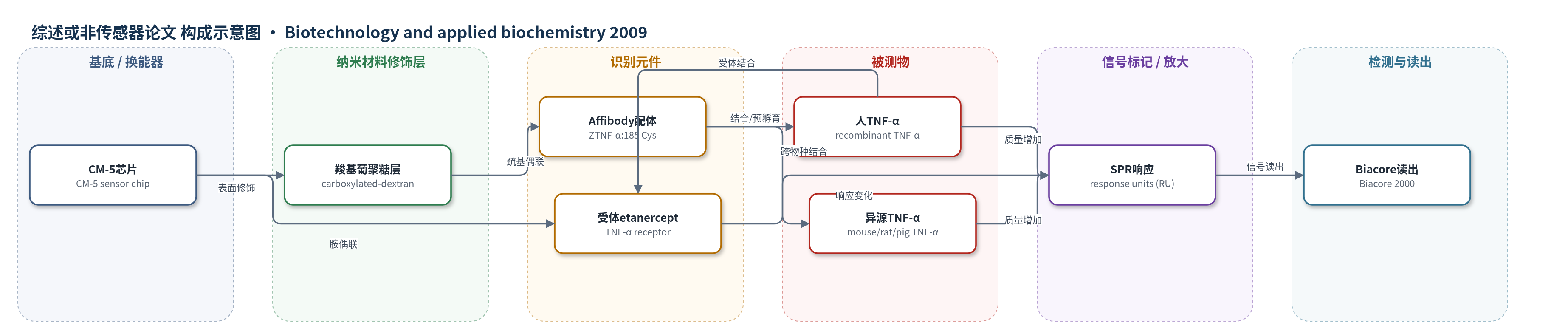
点击图片查看大图 · 依据论文自动绘制
传感器类型
综述或非传感器论文
检测对象
重组人TNF-α(tumour necrosis factor-α, TNF-α),以及鼠、大鼠、猪TNF-α;样品基质为重组蛋白溶液/HBS-EP缓冲液。
检测原理
该研究采用SPR生物传感器直接检测affibody与TNF-α的结合。C端含半胱氨酸的affibody通过巯基偶联固定于CM-5芯片的羧基化葡聚糖层,重组TNF-α以HBS-EP缓冲液流过表面。TNF-α与固定affibody结合后,芯片界面质量/折射率发生变化,Biacore 2000实时记录响应单位(RU);结合曲线按1:1 Langmuir模型拟合得到表观KD。竞争实验中,etanercept固定于芯片表面,TNF-α先与affibody或etanercept预孵育,再注入受体表面;若affibody占据TNF-α受体结合表位,则TNF-α与etanercept结合减少,响应降低,从而证明阻断作用。
检测灵敏度
未报告LOD、线性范围、灵敏度斜率或R^2;表观KD: 0.1–0.5 nM (ZTNF-α:185), 2–5 nM (ZTNF-α:210), 10–20 nM (ZTNF-α:192)。
效应效果
12个affibody中3个与人TNF-α结合最强,且对HSA和人多克隆IgG无结合,显示特异性。ZTNF-α:185对人TNF-α亲和力最高(KD=0.1–0.5 nM),ZTNF-α:210为2–5 nM,ZTNF-α:192为10–20 nM。跨物种实验中,人TNF-α结合最强,鼠和大鼠结合较好,猪TNF-α解离较快。竞争实验表明ZTNF-α:185与etanercept识别相同或重叠表位,可高效阻断TNF-α与受体结合。多聚体ELISA显示所有ZTNF-α:185构建体均浓度依赖抑制受体结合;20或40氨基酸连接肽二聚体抑制能力较强,三聚体比次佳二聚体强约两倍。作者认为该affibody可用于炎症诊断、成像及治疗。
传感器的构成
- 基底/换能器:CM-5传感器芯片(CM-5 sensor chip),SPR换能表面,用于固定配体并检测结合。
- 修饰层:羧基化葡聚糖层(carboxylated-dextran layer),提供表面偶联位点,支持affibody固定。
- 识别元件:C端半胱氨酸affibody(ZTNF-α:185、ZTNF-α:192、ZTNF-α:210),通过巯基偶联固定,特异性结合TNF-α。
- 竞争/受体元件:etanercept(可溶性TNF-α受体),固定于CM-5芯片,用于竞争/阻断实验。
- 读出系统:Biacore 2000 SPR仪器(Biacore 2000),实时监测响应单位(RU),参考流路扣除。
中文摘要
本研究通过噬菌体展示技术,从基于58个氨基酸的葡萄球菌蛋白A衍生Z结构域库中筛选出特异性结合人肿瘤坏死因子α(TNF-α)的affibody分子。TNF-α是参与多种炎症性疾病的促炎细胞因子,目前已有四种TNF-α阻断蛋白药物获批临床使用。经噬菌体筛选获得18个无半胱氨酸affibody序列,其中12个经序列聚类分析后选择为蛋白进行表征。对大肠杆菌表达并经IMAC纯化的12个affibody进行生物传感器结合研究,发现3个变体与人TNF-α结合最强。进一步动力学分析显示,ZTNF-α:185对人TNF-α具有亚纳摩尔亲和力(KD=0.1–0.5 nM),并能显著结合鼠、大鼠和猪TNF-α。竞争实验表明其结合位点与TNF-α受体结合位点重叠,可有效阻断TNF-α与受体结合。研究还构建了不同连接肽长度的6个二聚体和1个三聚体,发现延长连接肽的二聚体及三聚体能进一步增强受体结合抑制作用。
英文摘要
Affibody molecules specific for human TNF-alpha (tumour necrosis factor-alpha) were selected by phage-display technology from a library based on the 58-residue Protein A-derived Z domain. TNF-alpha is a proinflammatory cytokine involved in several inflammatory diseases and, to this day, four TNF-alpha-blocking protein pharmaceuticals have been approved for clinical use. The phage selection generated 18 unique cysteine-free affibody sequences of which 12 were chosen, after sequence cluster analysis, for characterization as proteins. Biosensor binding studies of the 12 Escherichia coli-produced and IMAC (immobilized-metal-ion affinity chromatography)-purified affibody molecules revealed three variants that demonstrated the strongest binding to human TNF-alpha. These three affibody molecules were subjected to kinetic binding analysis and also tested for their binding to mouse, rat and pig TNF-alpha. For ZTNF-alpha:185, subnanomolar affinity (KD=0.1-0.5 nM) for human TNF-alpha was demonstrated, as well as significant binding to TNF-alpha from the other species. Furthermore, the binding site was found to overlap with the binding site for the TNF-alpha receptor, since this interaction could be efficiently blocked by the ZTNF-alpha:185 affibody. When investigating six dimeric affibody constructs with different linker lengths, and one trimeric construct, it was found that the inhibition of the TNF-alpha binding to its receptor could be further improved by using dimers with extended linkers and/or a trimeric affibody construct. The potential implication of the results for the future design of affibody-based reagents for the diagnosis of inflammation is discussed.