组成图示
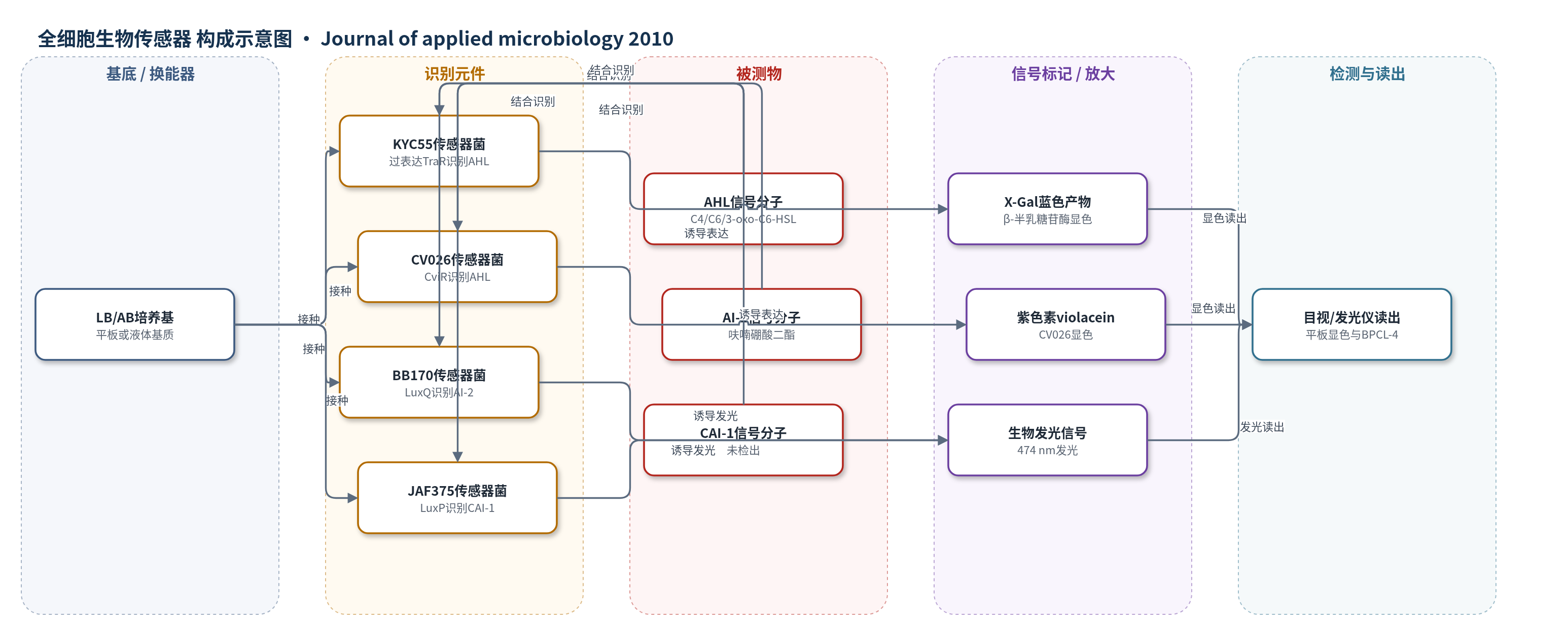
点击图片查看大图 · 依据论文自动绘制
传感器类型
全细胞生物传感器
检测对象
N-酰基高丝氨酸内酯(AHL,N-acylhomoserine lactones)、自诱导物-2(AI-2,autoinducer-2)、霍乱弧菌自诱导物-1(CAI-1,cholerae autoinducer 1);样品基质:爱德华氏菌 LTB-4 无细胞培养上清(LB 培养基,0.22 μm 过滤)
检测原理
待测菌 LTB-4 培养上清中的 AHL、AI-2 或 CAI-1 扩散进入相应全细胞生物传感器菌,与 LuxR 家族受体结合:AHL 结合 KYC55 的 TraR 或 CV026 的 CviR,AI-2 结合 BB170 的 LuxQ,CAI-1 结合 JAF375 的 LuxP。受体-信号分子复合物激活下游报告基因,形成基因表达放大。KYC55 中 lacZ 被诱导表达,X-Gal 被 β-半乳糖苷酶水解生成蓝色沉淀;CV026 中 violacein 合成基因被诱导,产生紫色色素;BB170 和 JAF375 中 lux 发光基因被诱导,产生 474 nm 生物发光。信号强度或显色范围随信号分子浓度/诱导倍数增加。双层平板法利用 AHL 在琼脂中扩散形成显色圈;TLC 分离后原位检测可分辨不同 AHL;CAI-1 检测通过降低 JAF375 背景发光提高信噪比。
检测灵敏度
—
效应效果
该方法以全细胞生物传感器菌为识别与换能元件,双层平板法无需提取上清即可快速显色,适用于不同培养基和生长阶段。KYC55 可检测 C4–C18 AHL,CV026 检测 C4–C8 AHL;修改后的 CAI-1 检测将 JAF375 背景发光由 45% 降至 6.0%,提高灵敏度。结果显示 LTB-4 全生长阶段产生至少 4 种 AHL(C4-HSL、C6-HSL、3-oxo-C6-HSL 及未鉴定 AHL),AI-2 活性在 OD600=1.0 时最高,稳定期较对数期低 3.5 倍,未检出 CAI-1。V. anguillarum VIB72、V. harveyi VIB295 和 V. parahaemolyticus VIB304 显著诱导 JAF375 发光(P<0.05),E. coli DH5a 为阴性。作者认为改进生物检测可阐明 LTB-4 群体感应信号谱,为干扰 QS 控制爱德华氏菌病提供依据。
传感器的构成
- 检测基底:LB 琼脂平板或双层琼脂平板,承载待测菌 LTB-4 与生物传感器菌,提供生长与扩散基质
- 识别/换能元件:根癌农杆菌 Agrobacterium tumefaciens KYC55 (pJZ372)(pJZ384)(pJZ410),过表达 AHL 受体 TraR,识别 AHL 并激活 lacZ 报告基因
- 识别/换能元件:紫色杆菌 Chromobacterium violaceum CV026,含 AHL 受体 CviR,识别 C4–C8 AHL 并诱导紫色素 violacein 合成
- 识别/换能元件:费氏弧菌 Vibrio harveyi BB170,luxN 突变保留 AI-2 受体 LuxQ,识别 AI-2 并诱导 lux 生物发光
- 识别/换能元件:费氏弧菌 Vibrio harveyi JAF375,luxN/luxQ 突变保留 CAI-1 受体 LuxP,识别 CAI-1 并诱导 lux 生物发光
- 信号标记物:X-Gal(5-bromo-4-chloro-3-indolyl-β-D-galactopyranoside),被 KYC55 诱导的 β-半乳糖苷酶水解生成蓝色产物
- 信号读出:目视平板蓝色/紫色显色,或 BPCL-4 超微弱发光分析仪在 474 nm 检测生物发光,OD600 分光光度计监测生长
中文摘要
本研究旨在阐明养殖大菱鲆新兴病原爱德华氏菌 LTB-4 的潜在群体感应(QS)信号分子。作者建立了一种灵敏、快速的双层平板法,利用生物传感器菌根癌农杆菌 KYC55 检测细菌中 N-酰基高丝氨酸内酯(AHL)相关化合物。结果表明,LTB-4 具有两套 QS 系统,一套基于 AHL,另一套基于自诱导物-2(AI-2)。LTB-4 产生的 AI-2 活性具有生长阶段依赖性,在 OD600 为 1.0 时达到最高。作者还改进了霍乱弧菌自诱导物-1(CAI-1)活性检测方案,降低了生物传感器菌费氏弧菌 JAF375 的背景发光,但未在 LTB-4 中检测到 CAI-1 活性。结论认为,LTB-4 在整个生长阶段至少产生 4 种 AHL;与 AHL 诱导的 QS 相比,AI-2 可能是早期指数期起主要作用的信号分子。该研究通过改进生物检测法明确了 LTB-4 的不同 QS 信号分子,提示其可能产生 C4-HSL、C6-HSL、3-oxo-C6-HSL 及一种未鉴定 AHL。
英文摘要
AIMS: The aim of this study was to elucidate the potential quorum-sensing (QS) signal molecules of an emerging pathogen (Edwardsiella tarda strain LTB-4) of cultured turbot (Scophthalmus maximus).
METHODS AND RESULTS: A sensitive and rapid double-layer plate method using biosensor strain Agrobacterium tumefaciens KYC55 was developed to detect the N-acylhomoserine lactone (AHL)-related compounds in bacteria. LTB-4 was found to have two QS systems, one was based on the AHLs and the other was based on the autoinducer-2 (AI-2). The AI-2 activity produced by LTB-4 was growth phase dependent and topped at OD(600) of 1.0. The protocol to detect cholerae autoinducer 1 (CAI-1) activity in bacteria was modified, lowering the background luminescence of biosensor strain Vibrio harveyi JAF375. CAI-1 activity could not be detected in LTB-4.
CONCLUSION: Edwardsiella tarda LTB-4 produced at least four kinds of AHLs during its whole growth phase. In comparison with the AHL-inducing QS, AI-2 may be the first predominant signal, functioning at early exponential phase. LTB-4 did not produce any CAI-1 activity.
SIGNIFICANCE AND IMPACT OF THE STUDY: Different QS signal molecules of Edw. tarda LTB-4 were clarified by improved bioassays. In contrast to earlier studies detecting two types of AHLs, strain LTB-4 produced at least four kinds of AHLs, which seemed to be C(4)-HSL, C(6)-HSL, 3-oxo-C(6)-HSL and an uncharacterized AHL molecule.