组成图示
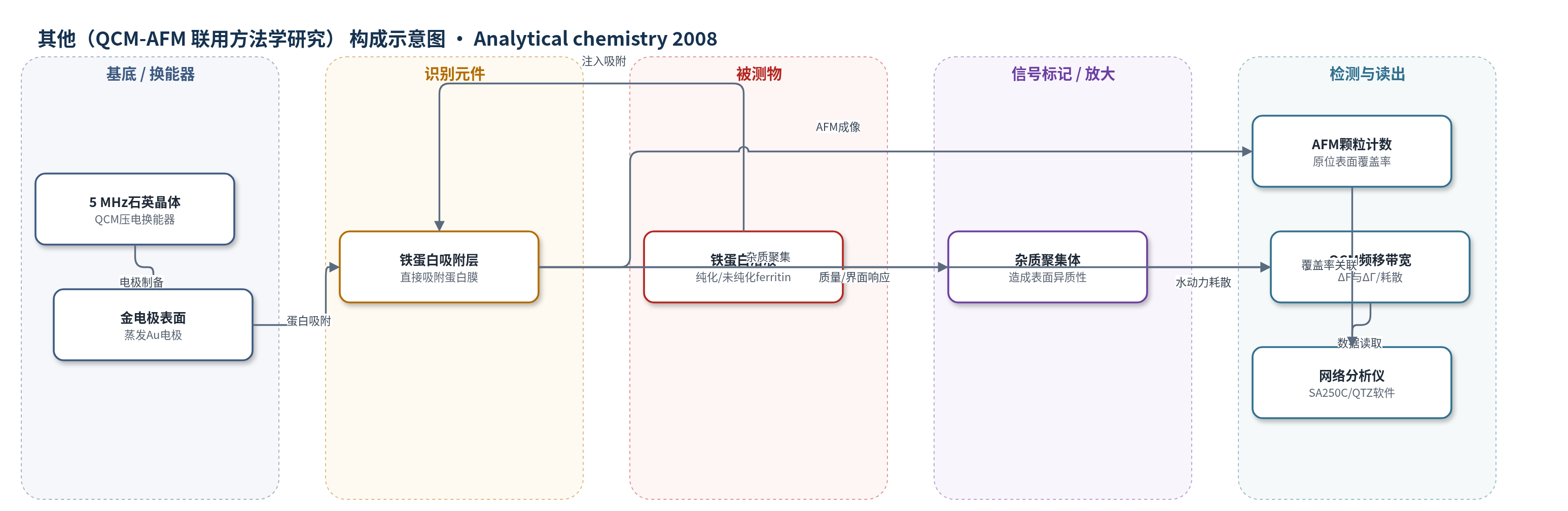
点击图片查看大图 · 依据论文自动绘制
传感器类型
其他(QCM-AFM 联用方法学研究)
检测对象
铁蛋白(ferritin,horse spleen ferritin);样品基质:10 mM HEPES pH 7.4、60–150 mM NaCl 缓冲液
检测原理
本工作未采用特异性识别元件,而是让马脾铁蛋白在清洁金表面直接吸附。铁蛋白吸附受溶液离子强度影响,NaCl浓度升高会削弱静电排斥并增加表面覆盖。QCM通过监测石英晶体多个泛音的谐振频率变化ΔF和带宽/耗散变化ΔΓ来响应界面质量与机械耦合。对薄而刚性均质膜,ΔF/n可用Sauerbrey关系换算为面密度;但铁蛋白膜在液相中并非刚性均质,尤其未纯化样品含二聚体、聚集体和分解产物,使表面粗糙并捕获溶剂。AFM显示这些聚集体造成异质膜,QCM频移与AFM计数得到的表面覆盖率呈非线性关系。作者认为偏离Sauerbrey行为主要源于水动力效应而非蛋白膜粘弹性,因此QCM信号同时包含吸附质量、捕获水和粗糙度引起的流体耦合贡献。
检测灵敏度
原文未报告LOD、线性范围、灵敏度斜率或相关系数。
效应效果
纯化铁蛋白最大平均频移约-86 Hz(n=5–13),Sauerbrey质量约1540 ng/cm2;未纯化样品在闭式滞点流池中约-95±8 Hz(10次实验)。纯化样品ΔΓ很小,未纯化样品ΔΓ和泛音依赖明显,(ΔΓ)/(-ΔF)对√n线性,给出横向粗糙度约23 nm(8次实验)。AFM显示未纯化含聚集体,纯化以单体为主。频移与覆盖率非线性:纯化在覆盖率0.1时约达50%最大频移,0.1–0.4完成其余;未纯化约70%最大频移在0.1出现。QCM质量相对AFM质量在覆盖率0.4时约1.8倍,与捕获水模型1.7倍一致。作者强调QCM解释需考虑杂质、异质性和水动力效应。
传感器的构成
- 换能器基底:5 MHz 石英晶体(quartz crystal),提供压电谐振与质量敏感换能。
- 电极/传感表面:蒸发金电极(gold electrodes),作为铁蛋白直接吸附表面。
- 吸附层:马脾铁蛋白(horse spleen ferritin)单体或含聚集体,直接吸附形成蛋白膜。
- 联用成像元件:AFM 液相流体池与探针,原位可视化并计数铁蛋白颗粒。
- 信号读出:SA250C 网络分析仪与 QTZ 软件,监测泛音频率和带宽/耗散变化。
中文摘要
石英晶体微天平(QCM或QCM-D)已成为生命科学和生物传感器研究中监测界面过程的重要工具,常用于蛋白吸附、吸附蛋白膜构象变化、脂体-表面相互作用、支撑双分子层形成以及生物传感器平台开发。然而,在液相中研究生物界面时,QCM数据的定量解释仍具挑战性。真空中常用Sauerbrey关系将吸附层引起的频率变化与吸附层质量相关联;但在液相软界面中常观察到偏离Sauerbrey关系,通常被解释为膜层的粘弹性。本研究开发并使用联用原子力显微镜(AFM)-QCM装置,研究铁蛋白在金表面的吸附。首先发现,该体系中偏离Sauerbrey关系几乎完全源于杂质造成的蛋白膜异质性。其次,利用AFM可视化单个吸附铁蛋白分子的能力,发现QCM测得的频率变化与蛋白表面覆盖率之间并不呈线性关系。
英文摘要
Quartz crystal microbalance (QCM or QCM-D) has become instrumental in life sciences and biosensor research. It is routinely and successfully used for monitoring interfacial processes, such as protein adsorption and conformational changes in the protein-adsorbed films, liposome-surface interactions and supported bilayer formation, and in the development of biosensor platforms. However, quantitative interpretation of QCM data from biological interfaces studied in liquid remains challenging. In vacuum, the so-called Sauerbrey relationship is routinely used to relate QCM frequency shifts due to the adsorbed layer to the mass of the adsorbed layer. Deviations from Sauerbrey relationship are typically observed when studying soft interfaces in liquids; these are interpreted in terms of layer viscoelastic properties. In this study, we develop and use a combined atomic force microscopy (AFM)-QCM setup to investigate the adsorption of protein ferritin on the surface of gold. First, we find that deviations from the Sauerbrey relationship in this system originate almost entirely from the heterogeneity of the protein films caused by the presence of impurities. Second, relying on the ability of AFM to visualize single ferritin molecules adsorbed on the surface, we find that the frequency shifts determined by QCM are not linearly related to the protein surface coverage.