组成图示
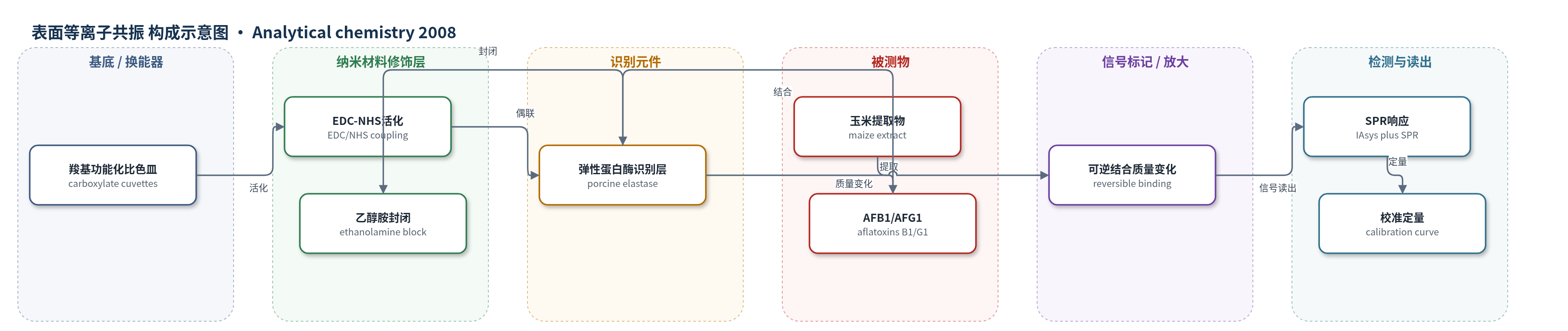
点击图片查看大图 · 依据论文自动绘制
传感器类型
表面等离子共振(SPR)生物传感器
检测对象
黄曲霉毒素B1(AFB1)、黄曲霉毒素G1(AFG1);样品基质:玉米(maize)提取物及加标玉米样品
检测原理
该传感器以羧基功能化SPR表面通过EDC/NHS共价固定猪中性粒细胞弹性蛋白酶,未反应羧基用乙醇胺封闭。样品中AFB1/AFG1与固定弹性蛋白酶的催化位点发生可逆、竞争性结合,结合事件使传感界面质量/折射率增加,从而引起SPR共振角/响应单位变化。结合过程符合单指数动力学,平衡响应随黄曲霉毒素浓度升高而增大,在低浓度范围内近似线性。方法不依赖酶催化或标记放大,而是利用酶-毒素可逆结合的直接质量响应;玉米样品经70%甲醇提取和C18固相萃取净化后稀释进样,结合约2 min即可读出,表面可用PBS或稀HCl再生重复使用。
检测灵敏度
LOD: 0.97 µg/kg;LOQ: 3.10 µg/kg;线性范围: 1.67-17.8 µg/kg;斜率: 9.2 ± 0.8;R^2 = 0.988
效应效果
该方法对AFB1、AFG1和AFM1具有相近亲和力,AFB2和AFG2结合能力低约5倍;其他霉菌毒素及农药(endosulfan、DDT、DDD、DDE)无特异性结合。加标玉米回收率为79%–81%,与ELISA(79%–80%)和HPLC(73%–74%)相当,SPE净化回收率100%±3%。PBS再生后50次循环响应变化<5%,日内最大CV 3.48%(8 ppb),日间最大CV 5.78%(3.33 ppb),不同表面间差异可忽略。检测仅需2 min,总前处理约40 min,比HPLC更快且试剂成本低于ELISA,适合作为食品中黄曲霉毒素快速筛查。
传感器的构成
- 基底/换能器:羧基功能化比色皿(carboxylate functionalized cuvettes,Neo-sensors)作为SPR传感表面,提供可共价偶联位点并产生SPR响应。
- 活化层:EDC-NHS(1-ethyl-3-(3-dimethylaminopropyl)carbodiimide hydrochloride 和 N-hydroxysuccinimide)活化羧基,形成活性酯用于共价偶联弹性蛋白酶。
- 识别元件:猪中性粒细胞弹性蛋白酶(porcine neutrophil elastase)共价固定于表面,作为可逆结合AFB1/AFG1的酶识别元件/诱饵。
- 封闭剂:乙醇胺(ethanolamine,1 M,pH 8.5)封闭未反应羧基,减少非特异性结合。
- 缓冲/再生介质:PBS(磷酸盐缓冲液)用于平衡、洗脱和中性再生;10 mM HCl 用于酸性再生。
中文摘要
黄曲霉毒素是曲霉属真菌产生的高毒性代谢物,可污染多种人类食品。本文提出一种用于黄曲霉毒素B1(AFB1)和G1(AFG1)的新型分析检测方法,可作为该类霉菌毒素的替代筛查技术。该测定方法基于表面等离子共振(SPR),以猪中性粒细胞弹性蛋白酶作为捕获这些黄曲霉毒素的“诱饵”。分析程序的选择与优化包括对AFB1抑制类型的初步研究:AFB1对蛋白酶的抑制程度取决于孵育时间和结合物浓度,表明其抑制具有竞争性和可逆性。基于该相互作用性质,可实现快速分析,单次检测仅需数分钟。检测条件通过校准溶液和黄曲霉毒素加标样品进行评估和优化。为将方法应用于受黄曲霉毒素污染的玉米,开发了快速固相萃取处理。所提出的AFB1和AFG1检测方法通过与色谱参考方法和标准酶联免疫吸附试验(ELISA)比较进行验证。该酶基生物传感器基于被阻断大分子与可溶性配体之间的可逆相互作用,具有分析快速、捕获表面可重复使用以及单次测试成本低等优点。
英文摘要
Aflatoxins are extremely toxic metabolites from Aspergillus species that can adulterate a wide range of human foodstuff. Herein, we propose a novel assay designed as an analytical test for aflatoxin B1 and G1 (AFB1 and AFG1, respectively) that could represent an alternative screening technique for this class of mycotoxins. The approach for the determination of these toxins is based on surface plasmon resonance using neutrophil porcine elastase as a "bait" for these aflatoxins. The selection and optimization of the analytical procedure involved a preliminary investigation on the type of inhibition by AFB1: the level of the protease inhibition exerted by AFB1 depended upon the incubation time and the concentration of the binding partners, showing the competitiveness and the reversibility of the inhibition. A posteriori, the nature of the interaction granted a rapid analysis, a single detection test requiring only a few minutes. For the development of the assay, the experimental conditions were evaluated and optimized with both calibration solution and aflatoxin-spiked samples. To apply this method to aflatoxin-contaminated maize, a rapid solid-phase extraction treatment was developed. The proposed assay for AFB1 and AFG1 was validated by comparison with both a chromatographic reference method and a standard enzyme linked immunosorbent assay procedure. This enzyme-based biosensor represents a new approach for the detection of aflatoxins based on the reversible interaction between a blocked macromolecule and a soluble ligand, having the major advantages in the relative rapidity, the reusability of the capturing surface, and low cost per single test.