组成图示
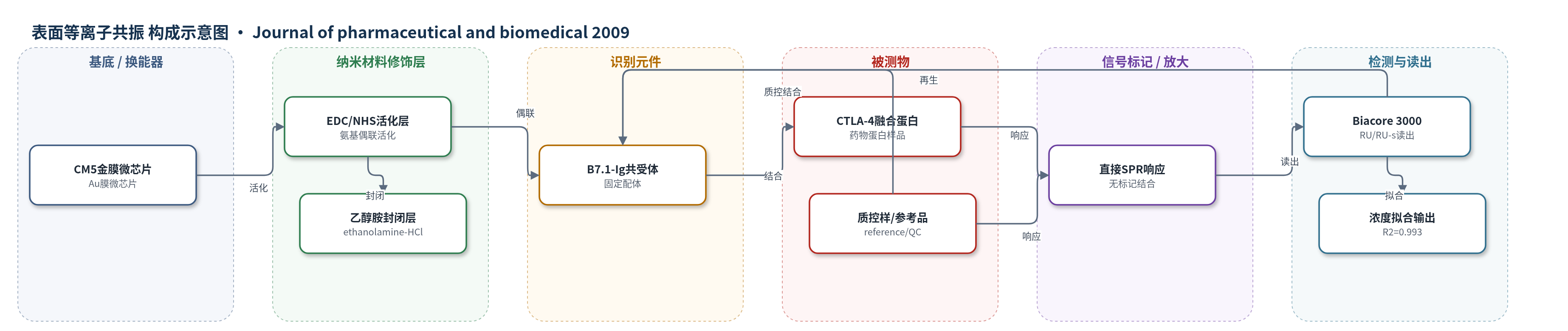
点击图片查看大图 · 依据论文自动绘制
传感器类型
表面等离子共振(SPR)生物传感器
检测对象
CTLA-4融合蛋白(CTLA-4 fusion protein);样品基质为HBS-EP缓冲液稀释的CHO细胞表达药物蛋白样品、参考品和质控样
检测原理
该传感器以CM5金膜微芯片为SPR换能基底,先用EDC/NHS活化表面,再通过氨基偶联将B7.1-Ig共受体共价固定,形成均一识别层,并用乙醇胺封闭剩余活性基团。样品中的CTLA-4融合蛋白与固定B7.1-Ig发生特异性结合,结合量随蛋白浓度增加而增加,使金膜表面质量/折射率发生变化,导致SPR共振响应改变。Biacore 3000实时监测结合相响应单位(RU)和结合斜率(RU/s),以参考品标准曲线将响应转换为浓度或相对结合活性。方法无需额外标记或酶放大,信号直接来自生物分子结合事件,芯片可用柠檬酸钠缓冲液再生并重复使用。
检测灵敏度
LOQ: 125 ng/mL;线性范围: 0.125–8.00 μg/mL;R^2 = 0.993
效应效果
该SPR生物传感器以BSA通道作阴性对照,结合具有特异性。芯片经40次再生循环基线稳定,基线漂移最高/最低变化为0.91%和0.28%,%CV为0.31%,结合能力变化<5.0%。线性范围0.125–8.00 μg/mL,R2=0.993,LOQ为125 ng/mL。质控样0.40、2.50、4.50 μg/mL回收率105.4%–114.2%,批内%CV 1.85%–2.99%;QC2首末次进样差异3.73%。三批次2.00 μg/mL样品回收率115.0%、88.4%、103.9%,批内%CV 1.07%–7.27%,平均回收率102.43%,批间%CV 13.03%。作者认为可替代传统酶免疫分析,稳定性、精密度和准确度更高,且芯片可再生复用。
传感器的构成
- 基底/换能器:CM5金膜微芯片(Au-membrane microchip),承载SPR换能并固定配体
- 表面活化层:EDC/NHS(1-ethyl-3-(3-dimethylaminopropyl) carbodiimide hydrochloride、N-hydroxysuccinimide),生成可偶联活性酯
- 识别元件:B7.1-Ig共受体(B7.1-Ig co-receptor),共价固定于芯片表面,特异性结合CTLA-4融合蛋白
- 封闭剂:乙醇胺盐酸盐(ethanolamine-HCl),封闭未反应活性基团,降低非特异结合
- 信号标记物:无额外检测剂,直接SPR响应
- 流动相/样品基质:HBS-EP缓冲液(HEPES、NaCl、EDTA、P20),稀释标准品、质控样和样品并维持结合条件
- 再生缓冲液:10 mmol/mL柠檬酸钠、100 mmol/mL NaCl(pH 4.0),洗脱结合物实现芯片再生
- 信号读出:Biacore 3000 SPR系统,以响应单位(RU)和结合斜率(RU/s)读出结合量
中文摘要
本研究开发并验证了一种基于表面等离子共振(SPR)的生物传感器技术,用于以参考品为标准对药物蛋白进行生物定量和质量控制。通过将受体共价固定于金膜微芯片表面,使受体表面均一化,从而作为生物传感器可靠检测药物蛋白活性。该方法仅需少量配体,且无需额外检测试剂。结果显示,受试产品与参考品具有等效结合能力,回收率范围为88.4%–115.0%;分析物与特异性配体的结合呈浓度依赖性和平行性。CTLA-4融合蛋白在低至125 ng/mL浓度下可被定量检测。批内精密度为1.07%–7.27%,批间精密度为13.03%。这些数据证明了改进型生物传感器方法在药物蛋白生物定量和质量控制中的实用性。该方法可作为传统检测方法的替代方案,其显著优势在于微芯片可再生,单个传感器可完成多次分析。
英文摘要
We developed and validated a biosensor-based surface plasmon resonance (SPR) technology for the biological quantification and quality control (QC) of pharmaceutical proteins using reference materials as the standard. The surface of the receptors was made homogeneous by covalently immobilizing the receptors onto Au-membrane microchips for use as biosensors for reliably detecting the activity of drug proteins. This assay used only limited amounts of ligands and no additional detection agents. The products were determined to have binding capacity equivalent to that of the reference materials and to exhibit a recovery range of 88.4-115.0%. The binding of analytes to the specific ligand is concentration dependent and parallel. CTLA-4 fusion proteins were quantitatively detectable at concentrations as low as 125 ng/mL. The intra-assay precision was in the range of 1.07-7.27%, and the inter-lot precision was 13.03%. These data proved the usefulness of improved biosensor-based assays in biological quantification and QC of pharmaceutical proteins. This approach is an alternative to traditional assays and offers a potentially significant advantage in that the microchip can be regenerated thus enabling multiple analyses to be performed with a single sensor.