组成图示
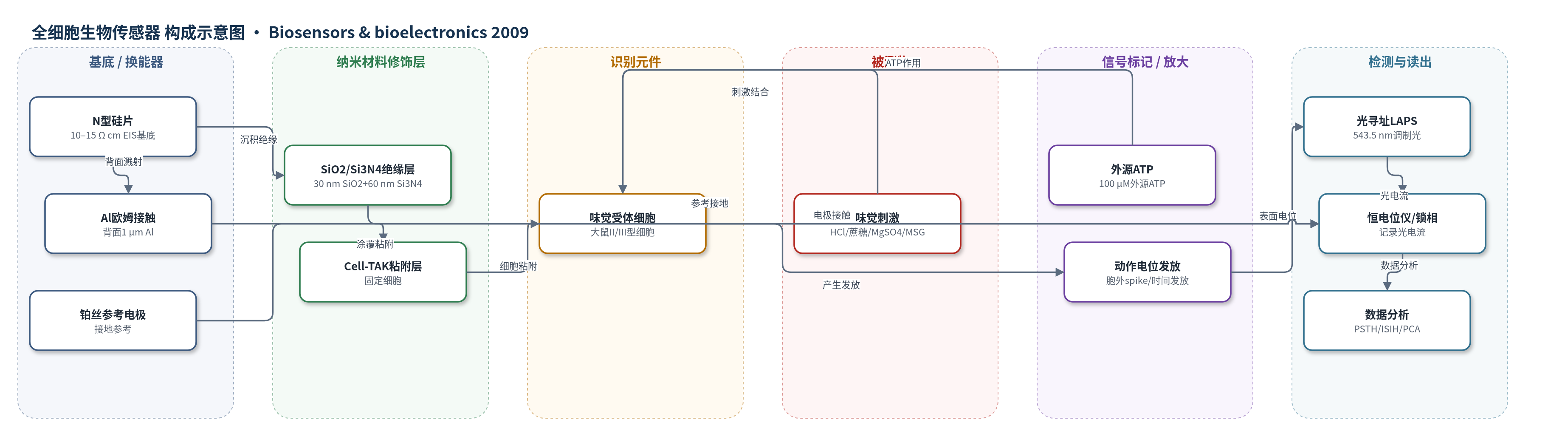
点击图片查看大图 · 依据论文自动绘制
传感器类型
全细胞生物传感器
检测对象
酸(HCl)、苦味剂(MgSO4)、甜味剂(蔗糖,sucrose)、鲜味剂(谷氨酸钠,MSG)、ATP(腺苷三磷酸);样品基质为Tyrode溶液(细胞外液)
检测原理
该传感器以完整味觉受体细胞为识别元件。酸、甜、苦、鲜等刺激与细胞表面受体或离子通道结合后,引起膜电位去极化并触发动作电位;胞外电位变化改变LAPS的EIS界面表面电位。LAPS采用N型硅/SiO2/Si3N4结构,543.5 nm调制光聚焦于细胞位置,表面电位变化调制光电流,由恒电位仪和锁相放大器读出。酸刺激下发放率随pH降低而升高,体现浓度依赖;不同刺激的时间发放模式经PSTH、ISIH和PCA分析可区分。外源ATP模拟II型细胞递质,对III型细胞自发发放产生增强或抑制。系统无化学放大,主要依赖细胞电生理响应与光寻址电位换能。
检测灵敏度
原文未报告LOD、线性范围、灵敏度斜率或相关系数。
效应效果
Tyrode液对照下自发发放少,噪声约15 μV;无细胞或HEK293细胞时未见发放尖峰,提示信号来自味觉细胞。酸刺激发放率随pH降低增加:pH 4为2.89±0.3 Hz(n=14),pH 2为3.8±0.65 Hz(n=12);混合味2.54±0.32 Hz(n=10),ATP 2.13±0.09 Hz(n=4)。PCA显示ATP与酸响应可区分。ATP对自发发放呈双效应:5个细胞由1.44±0.027 Hz升至2.52±0.096 Hz,3个细胞由1.475±0.038 Hz降至0.91±0.052 Hz,与膜片钳一致。作者认为可非侵入研究味觉编码。
传感器的构成
- 换能器基底:N型硅片(10–15 Ω cm),作为EIS结构半导体基底,承载表面电位变化。
- 绝缘层:30 nm SiO2与60 nm Si3N4叠层,隔离硅与电解液并允许表面电位调制。
- 欧姆接触:背面溅射1 μm Al层,提供电极接触。
- 参考电极:培养皿内铂丝,作为接地参考。
- 细胞粘附层:Cell-TAK组织胶涂覆LAPS表面,用于固定味觉受体细胞。
- 识别元件:大鼠舌乳头分离的味觉受体细胞(II/III型),表达酸、甜、苦、鲜受体,作为生物识别与信号发生单元。
- 刺激/信号介质:Tyrode溶液及HCl、MgSO4、蔗糖、MSG、ATP等味觉刺激,触发细胞动作电位。
- 信号读出:543.5 nm调制光、恒电位仪与锁相放大器,将表面电位变化转为光电流并记录。
中文摘要
味觉受体细胞分别表达酸、咸、甜、苦和鲜味受体,不同类型细胞之间存在细胞间通讯,但味觉感知机制及味觉受体细胞编码味觉信息的方式仍不清楚,是长期悬而未决的问题。为从新角度探索味觉感知并分析味觉发放响应,本文提出一种仿生味觉受体细胞生物传感器。该传感器以LAPS芯片为平台,将味觉受体细胞培养于芯片表面,记录不同味觉刺激下的时间发放响应,并研究发放率与时间发放特征。实验结果与膜片钳及分子生物学实验一致:发放率依赖刺激浓度;主成分分析表明不同类型味觉受体细胞的响应可被区分。此外,外源ATP用于模拟II型细胞释放的神经递质ATP对III型细胞的作用,观察到对自发发放既有增强也有抑制效应。该新型仿生混合生物传感器为非侵入性研究味觉感知与编码机制提供了潜在方案。
英文摘要
Taste receptor cells are the taste sensation elements expressing sour, salty, sweet, bitter and umami receptors, respectively. There are cell-to-cell communications between different types of cells. Nevertheless, the mechanism of taste sensation and taste information coded by taste receptor cell is not well understood at present and it is a long-standing issue. In order to explore taste sensation and analyze taste-firing responses from another point of view, we present a promising biomimetic taste receptor cell-based biosensor. The temporal firing responses to different tastants are recorded. Meanwhile, we investigate the firing rate and temporal firing of taste receptor cells. The experimental results are consistent with that from patch clamp and molecular biology experiment. Firing rate is dependent on the concentration of stimulus. PCA analysis (principal component analysis) of the temporal firing responses shows that the responses from different types of taste receptor cells can be distinguished. Furthermore, exogenous ATP is applied to mimic the effects of transmitter ATP (adenosine triphosphate) released from type II cells onto type III cells. Both enhanced and inhibitory effects on spontaneous firing are observed. This novel biomimetic hybrid biosensor provides a potential solution to investigate the taste sensation and coding mechanisms in a non-invasive way.