组成图示
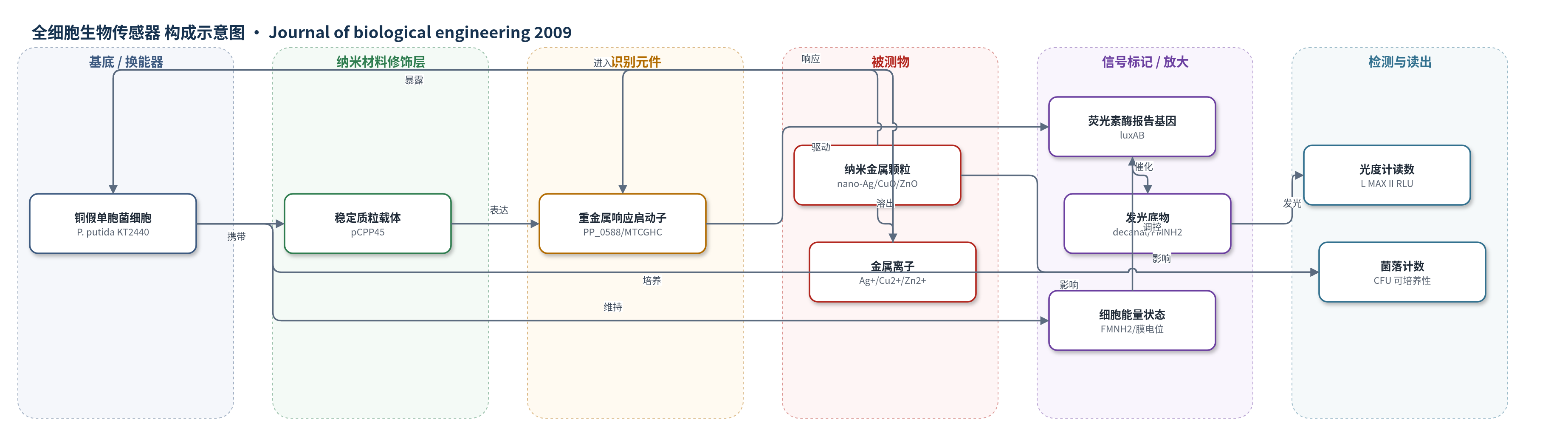
点击图片查看大图 · 依据论文自动绘制
传感器类型
全细胞生物传感器
检测对象
纳米银(nano-Ag)、纳米氧化铜(nano-CuO)、纳米氧化锌(nano-ZnO)及其金属离子(Ag+、Cu2+、Zn2+);样品基质:无菌蒸馏水悬浮液、450/200 nm 滤液
检测原理
该全细胞生物传感器以 P. putida KT2440 为换能器,其 PP_0588 启动子含重金属结合域 MTCGHC,驱动 luxAB 荧光素酶表达。当细胞暴露于纳米 Ag、CuO、ZnO 或金属离子时,纳米颗粒可损伤细胞膜、改变膜电位并干扰能量代谢,使细胞内 FMNH2 水平下降;同时金属离子可结合启动子响应元件,改变 luxAB 转录。加入癸醛后,荧光素酶催化 FMNH2 与癸醛氧化发光,发光强度(RLU)随毒性增强而下降;低剂量 Zn 可激活启动子,使发光升高。该体系无外加化学放大,依靠活细胞报告基因和能量状态变化实现信号转换。
检测灵敏度
毒性阈值(非 LOD):Ag 0.1–0.2 mg Ag/L;nano-Ag >0.2 mg Ag/L(0.25 mg Ag/L 无培养细胞);nano-CuO 5–7 mg Cu/L;Cu2+ 1.0 mg Cu/L;Zn2+ 0.1–0.5 mg Zn/L;nano-ZnO 7–10 mg Zn/L。
效应效果
该生物传感器可在数分钟内给出剂量依赖性发光下降,实验重复至少三次并报告均值与标准误,但未报告 RSD、回收率或标准曲线。与块体材料相比,纳米颗粒毒性显著,说明粒径决定活性;Ag 和 Cu 处理呈杀菌效应,Zn 处理呈抑菌效应。Cl- 对照无毒性,排除 CuCl2 中氯离子干扰。nano-Ag 与 nano-CuO 联合处理产生交互抑制,含 nano-ZnO 的混合无交互,提示作用位点不同。FlFFF/ICP-MS 显示商业纳米 CuO/ZnO 含约 5 nm 颗粒及 70–>300 nm 聚集体,大部分质量在 >300 nm。作者认为该全细胞发光生物传感器比富集培养基可培养性检测更敏感(nano-ZnO 7–10 mg/L 对比 S. aureus 126 mg/L;nano-Ag 0.3 mg/L 对比 E. coli/B. subtilis 70 mg/L),可用于环境纳米颗粒非靶标毒性预警。
传感器的构成
- 全细胞换能器:Pseudomonas putida KT2440 活细胞,作为传感主体,其膜完整性与能量状态决定发光响应
- 遗传载体:pCPP45 质粒,稳定携带 PP_0588-luxAB::npt 融合,提供报告基因表达框架
- 识别/响应元件:PP_0588 启动子,含重金属结合域 MTCGHC,响应金属离子/纳米颗粒诱导的细胞状态变化
- 信号标记物:luxAB 荧光素酶,催化癸醛与 FMNH2 氧化发光,输出相对光单位 RLU
- 发光底物/电子供体:decanal(癸醛)和细胞内 FMNH2,为荧光素酶反应提供底物与还原力
- 读出装置:L MAX II Luminometer,10 s 曝光记录发光强度
中文摘要
重金属纳米颗粒进入环境可能影响参与元素循环、污染物降解和植物生长的有益微生物。本文以具有生物修复潜力的土壤有益菌 Pseudomonas putida KT2440 为对象,构建携带 luxAB 报告基因的铜响应启动子生物传感器,评价商业纳米银、纳米氧化铜和纳米氧化锌的抗菌活性。结果显示,“as manufactured”纳米 Ag、CuO 和 ZnO 均引起生物传感器发光输出快速剂量依赖性下降;纳米 Ag 和纳米 CuO 处理伴随细胞死亡,而纳米 ZnO 主要呈抑菌作用。相应块体材料在相同金属浓度下无抑制活性,表明粒径决定活性。流动场流分级(FlFFF)结合 ICP-MS 显示,纳米 CuO 和 ZnO 水悬浮液中存在少量约 5 nm 颗粒以及 70–300 nm 聚集体,大部分质量聚集为大于 300 nm 的颗粒,因此商业制剂中可能同时存在微生物活性与非活性形态。结论表明,商业纳米 Ag、CuO 和 ZnO 对有益土壤微生物具有毒性,环境中的聚集作用可能降低其非靶标抗菌效应。
英文摘要
BACKGROUND: The release of heavy metal-containing nanoparticles (NP) into the environment may be harmful to the efficacy of beneficial microbes that function in element cycling, pollutant degradation and plant growth. Nanoparticles of Ag, CuO and ZnO are of interest as antimicrobials against pathogenic bacteria. We demonstrate here their antimicrobial activity against the beneficial soil microbe, Pseudomonas putida KT2440.
RESULTS: Toxicity was detected in a KT2440 construct possessing a plasmid bearing the luxAB reporter genes. "As manufactured" preparations of nano- Ag, -CuO and -ZnO caused rapid dose-dependent loss of light output in the biosensor. Cell death accompanied loss in Lux activity with treatments by nano-Ag and -CuO, but with -ZnO the treatments were bacteriostatic rather than bactericidal. Bulk equivalents of these products showed no inhibitory activity, indicating that particle size was determinant in activity. Flow Field-Flow Fractionation (FlFFF) of an aqueous suspension of the nano-CuO and ZnO revealed a small proportion of 5 nm NP and aggregated particulates with sizes ranging between 70 nm and 300 nm; the majority portion of material was aggregated into particles larger than 300 nm in size. Thus within the commercial preparation there may be microbially active and inactive forms.
CONCLUSION: The "as-made" NP of Ag, CuO and ZnO have toxic effects on a beneficial soil microbe, leading to bactericidal or bacteriostatic effects depending on the NP employed. The lack of toxicity from bulk materials suggests that aggregation of the NP into larger particles, possibly by factors present in the environment may reduce their nontarget antimicrobial activity.