组成图示
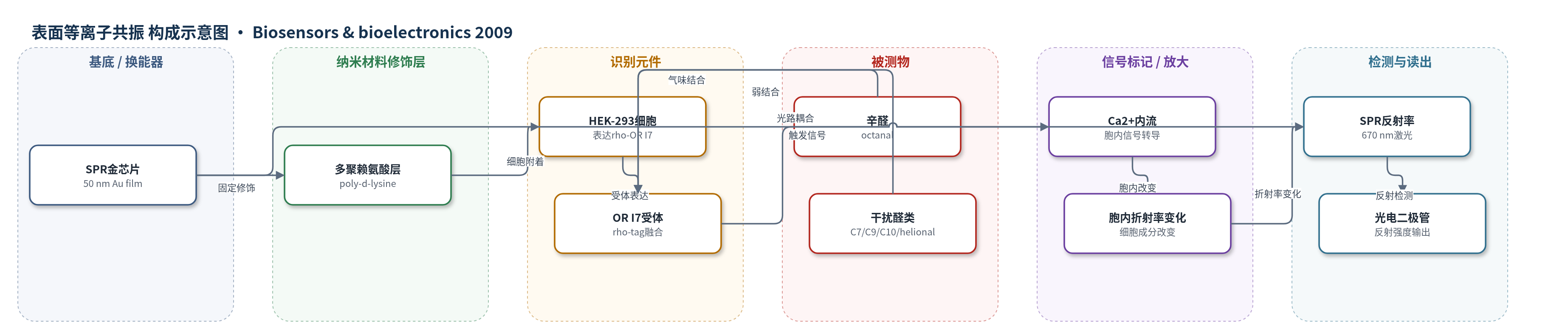
点击图片查看大图 · 依据论文自动绘制
传感器类型
表面等离子共振(SPR)生物传感器
检测对象
辛醛(octanal)、庚醛(heptanal)、壬醛(nonanal)、癸醛(decanal)、helional;样品基质为含1% DMSO的Ca2+标准缓冲液或无钙缓冲液
检测原理
该传感器以表达rho-tag-OR I7的HEK-293细胞为识别元件,固定在SPR金芯片上。当辛醛等气味分子与细胞膜上的OR I7结合时,激活G蛋白偶联受体通路,腺苷酸环化酶活化使胞内cAMP升高,进而打开CNG通道,引起Ca2+内流。Ca2+内流导致细胞内成分或细胞骨架发生瞬态变化,使芯片表面附近折射率改变。SPR系统通过670 nm p偏振激光监测金膜表面反射率,反射率变化随气味物浓度增加而增大,最大反射率与辛醛浓度对数呈线性关系。无钙缓冲液中无信号,说明信号依赖Ca2+内流;该细胞内信号转导过程起到信号放大作用。
检测灵敏度
测量范围: 10−1 M–10−4 M;最大反射率随辛醛浓度对数增加;原文未报告LOD、灵敏度斜率、R^2
效应效果
该SPR嗅觉生物传感器对辛醛响应最高,对庚醛(C7)、壬醛(C9)、癸醛(C10)等相似醛类响应较低,对helional仅可忽略,选择性良好。1% DMSO在裸金芯片上使反射率增加1.5%,实验统一1% DMSO以减小溶剂伪影;无钙缓冲液和野生型HEK-293细胞均无信号,说明响应依赖OR I7激活及Ca2+内流。数据来自至少3次独立实验(mean±SD),未报告RSD、长期稳定性或实际样品回收率。与Ca2+荧光法(10−7–10−5 M)、电嗅觉图(10−6–10−1 M)、LAPS(10−6–10−5 M)、QCM(10−11–10−2 M)和纳米囊SPR(10−9–10−5 M)相比,本文灵敏度较低,但可实时无标记监测细胞反应,作者认为阵列化多种嗅觉受体可用于生物光学鼻。
传感器的构成
- 基底/换能器:SPR传感芯片(18 mm × 18 mm,50 nm金膜,bare gold surface)与BK7棱镜(nD=1.515),用于激发表面等离子共振并检测反射率变化
- 修饰层:多聚-L-赖氨酸(poly-d-lysine,0.1 mg/mL)处理金表面,促进HEK-293细胞稳定附着
- 识别元件:稳定表达rho-tag-OR I7融合蛋白的HEK-293细胞(人胚胎肾细胞),OR I7位于细胞膜表面,识别气味分子
- 信号转导/放大元件:胞内Ca2+内流及cAMP/CNG通道相关细胞内变化,引起界面折射率变化
- 样品基质/缓冲液:Ca2+标准缓冲液(140 mM NaCl、5.4 mM KCl、1 mM MgCl2、10 mM HEPES pH 7.4、5 mM葡萄糖、2 mM CaCl2、1% DMSO);无钙缓冲液以2 mM EGTA替代CaCl2
- 读出装置:SPRi(K-MAC)系统,670 nm p偏振激光,光电二极管检测反射强度,25.0±0.1°C,流速50 µL/min
中文摘要
表面等离子共振(SPR)是一种可实时测量分子相互作用的强有力技术,也可用于检测分子与细胞之间的相互作用。本研究将基于SPR的生物传感技术应用于气味分子诱导细胞反应的实时监测。将大鼠嗅觉受体OR I7的N端融合rho-tag导入序列,使其稳定表达于人胚胎肾细胞(HEK-293)表面;随后将细胞固定于SPR传感芯片上。SPR响应强度与注入气味物的量呈线性关系。在所测试的含醛气味物中,对OR I7已知配体辛醛(octanal)的SPR响应最高。该响应被认为源于气味分子与细胞表面嗅觉受体结合后触发的胞内信号转导。该SPR系统与表达嗅觉受体的细胞相结合,为挥发性化合物的选择性、定量检测提供了一种新的嗅觉生物传感器系统。
英文摘要
Surface plasmon resonance (SPR) is a powerful technique for measuring molecular interaction in real-time. SPR can be used to detect molecule to cell interactions as well as molecule to molecule interactions. In this study, the SPR-based biosensing technique was applied to real-time monitoring of odorant-induced cellular reactions. An olfactory receptor, OR I7, was fused with a rho-tag import sequence at the N-terminus of OR I7, and expressed on the surface of human embryonic kidney (HEK)-293 cells. These cells were then immobilized on a SPR sensor chip. The intensity of the SPR response was linearly dependent on the amount of injected odorant. Among all the aldehyde containing odorants tested, the SPR response was specifically high for octanal, which is the known cognate odorant for the OR I7. This SPR response is believed to have resulted from intracellular signaling triggered by the binding of odorant molecules to the olfactory receptors expressed on the cell surface. This SPR system combined with olfactory receptor-expressed cells provides a new olfactory biosensor system for selective and quantitative detection of volatile compounds.