组成图示
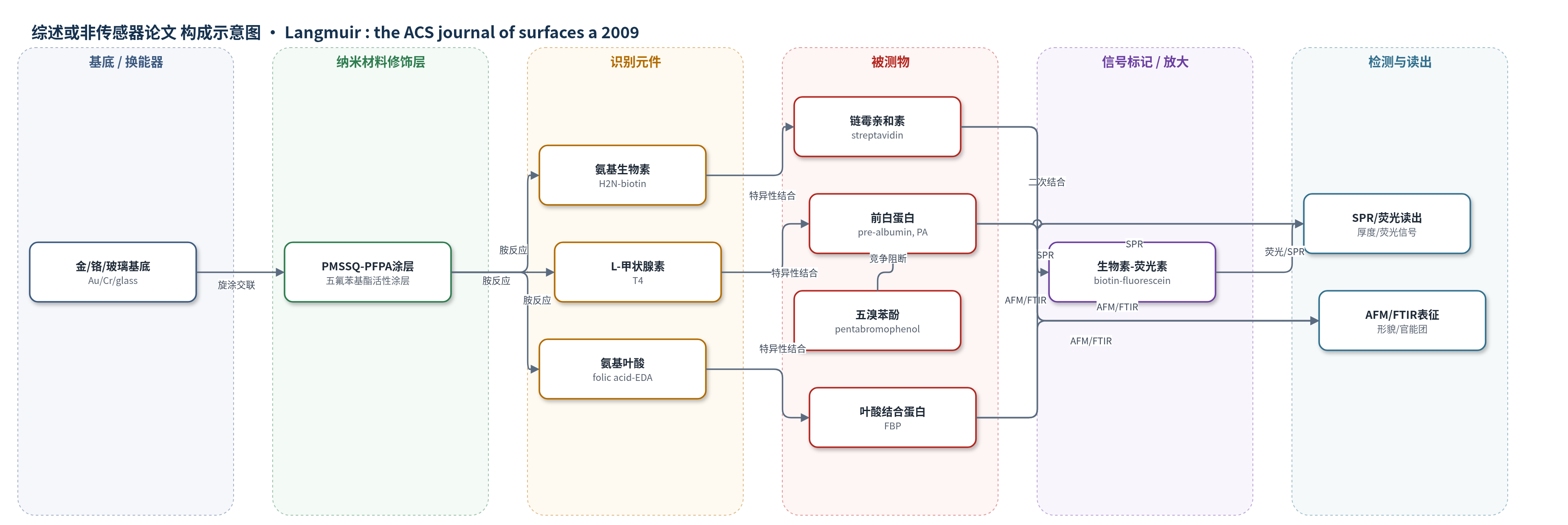
点击图片查看大图 · 依据论文自动绘制
传感器类型
综述或非传感器论文
检测对象
链霉亲和素(streptavidin)、前白蛋白(pre-albumin, PA)、叶酸结合蛋白(folate-binding protein, FBP);样品基质为 PBS 缓冲液/蛋白溶液,另以五溴苯酚(pentabromophenol)等酚类作为竞争阻断物。
检测原理
PMSSQ-PFPA 涂层中的五氟苯基酯与胺功能化结合位点发生表面类似反应,将生物素、T4 或叶酸共价固定于界面。目标蛋白通过生物素-链霉亲和素、T4-PA 或叶酸-FBP 特异性结合到表面,使界面质量/折射率增加,SPR 反射角或拟合厚度随之变化;若使用荧光标记蛋白或二次荧光探针,则产生荧光发射。竞争物(如五溴苯酚)先与 PA 结合并占据其 T4 结合位点,使 PA 无法结合 T4 表面,SPR 结合信号降低。该策略无酶催化或核酸放大,主要依靠高亲和生物识别和 SPR/荧光读出。
检测灵敏度
原文未报告 LOD、线性范围、灵敏度斜率或相关系数。
效应效果
该涂层可在金/玻璃、硅、PC、PDMS、PMMA、PTFE 等基底上形成稳定附着层。SPR 显示氨基生物素接枝厚度增加约 0.5 nm,链霉亲和素单层厚度增加 5.2 nm,接近其理论直径 5.6 nm;AFM 均方根粗糙度 0.834 nm。PA 在 T4 表面结合厚度增加 2.55 nm,FBP 在叶酸表面结合厚度增加 1.1 nm。PEG 化表面洗脱后无物理吸附,辛胺疏水表面残留 0.1 nm,显示特异性结合优于非特异吸附。T4 表面可被五溴苯酚和五氯苯酚阻断,而苯酚、4-氟苯酚、双酚 A 无影响。与玻璃 SAM 生物素化相比,荧光强度相近。作者认为该平台可用于 SPR 等生物传感器中的蛋白固定。
传感器的构成
- 基底:金/铬/玻璃(Au/Cr/glass)、硅(Si)、聚碳酸酯(PC)、聚四氟乙烯(PTFE)、聚二甲基硅氧烷(PDMS)、聚甲基丙烯酸甲酯(PMMA)等,提供附着面与 SPR 用金膜。
- 反应性涂层:聚甲基硅氧烷-聚五氟苯基丙烯酸酯(PMSSQ-PFPA)杂化聚合物,旋涂后 130 °C 退火 2 h 热交联,提供五氟苯基酯活性位点和基底无关粘附。
- 识别/结合位点层:氨基生物素(H2N-biotin)、L-甲状腺素(T4)、双(2-乙酰胺)叶酸(folic acid-EDA)等胺功能化分子,与五氟苯基酯反应共价固定,提供蛋白特异性结合位点。
- 目标蛋白层:链霉亲和素(streptavidin)、前白蛋白(pre-albumin, PA)、叶酸结合蛋白(folate-binding protein, FBP),通过生物素-链霉亲和素、T4-PA、叶酸-FBP 相互作用形成单层。
- 信号标记/检测:荧光标记链霉亲和素(streptavidin-CY3)、生物素-5-荧光素(biotin-5-fluorescein)、白蛋白蓝 580(albumin blue 580)用于荧光检测;SPR 作为无标记界面质量读出。
中文摘要
可靠生物传感器设计的关键在于制备可受控、可重复固定生物分子功能的薄膜,这要求在平面表面受控构建特异性结合位点。聚甲基硅氧烷-聚五氟苯基丙烯酸酯(PMSSQ-PFPA)杂化聚合物可在金、聚碳酸酯(PC)、聚四氟乙烯(PTFE)和玻璃等多种基底上形成稳定、附着良好的薄反应性涂层。将基底浸入所需胺溶液中,可在表面固定用于蛋白吸附的特异性结合位点。该通用策略可接枝生物素、L-甲状腺素和叶酸等多种连接分子。链霉亲和素、前白蛋白和叶酸结合蛋白的吸附过程通过表面等离子共振(SPR)、傅里叶变换红外光谱(FTIR)、荧光光谱和原子力显微镜(AFM)进行监测。所提出的蛋白固定策略包括四步:(a) 从四氢呋喃(THF)溶液旋涂 PMSSQ-PFPA 杂化聚合物;(b) 130 °C 退火 2 h 诱导 PMSSQ 部分热交联;(c) 与不同氨基功能化蛋白特异性结合位点进行表面类似反应;(d) 在表面受控组装蛋白。该方法有望用于未来生物传感器设计。
英文摘要
The key designing in reliable biosensors is the preparation of thin films in which biomolecular functions may be immobilized and addressed in a controlled and reproducible manner. This requires the controlled preparation of specific binding sites on planar surfaces. Poly(methylsilsesquioxane)-poly(pentafluorophenyl acrylates) (PMSSQ-PFPA) are promising materials to produce stable and adherent thin reactive coatings on various substrates. Those reactive surface coatings could be applied onto various materials, for example, gold, polycarbonate (PC), poly(tetrafluoroethylene) (PTFE), and glass. By dipping those substrates in a solution of a desired amine, specific binding sites for protein adsorption could be immobilized on the surface. The versatile strategy allowed the attachment of various linkers, for example, biotin, l-thyroxine, and folic acid. The adsorption processes of streptavidin, pre-albumin, and folate-binding protein were monitored using surface plasmon resonance (SPR), Fourier transform infrared (FTIR) spectroscopy, fluorescence spectroscopy, and atomic force microscopy (AFM). The presented protein immobilization strategy, consisting of four steps (a) spin-coating of PMSSQ-PFPA hybrid polymer from tetrahydrofuran (THF) solution, (b) annealing at 130 degrees C for 2 h to induce thermal cross-linking of the PMSSQ part, (c) surface analogues reaction with different amino-functionalized specific binding sites for proteins, and (d) controlled assembly of proteins on the surface, may find various applications in future biosensor design.