组成图示
点击图片查看大图 · 依据论文自动绘制
传感器类型
全细胞生物传感器
检测对象
N-丁酰高丝氨酸内酯(N-butyryl homoserine lactone, BHL);样品基质:工业废水、市政废水、人工废水(含多环芳烃 PAH)及细菌培养上清
检测原理
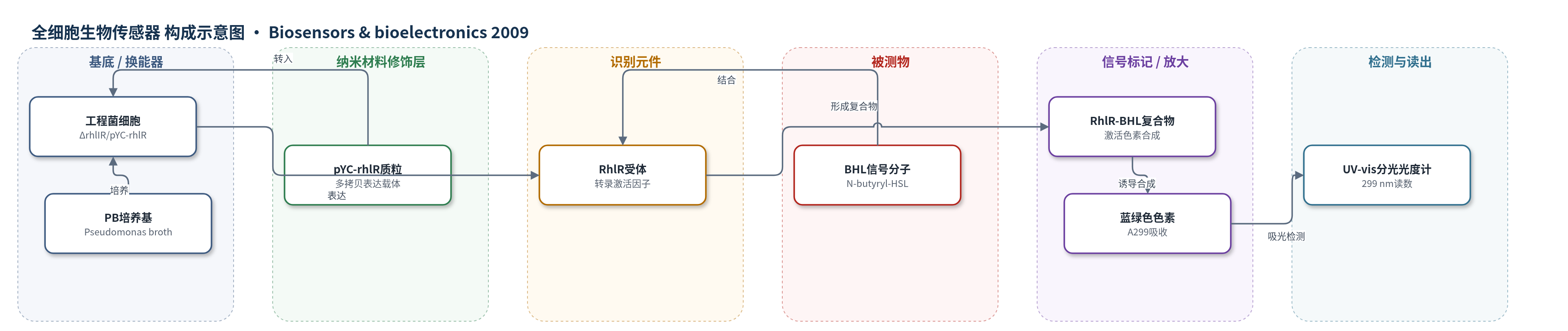
该全细胞生物传感器以工程菌 P. aeruginosa ΔrhlIR/pYC-rhlR 为识别与换能单元。菌株通过内框缺失 rhlIR 丧失 BHL 自产能力,多拷贝质粒 pYC-rhlR 过表达受体 RhlR。外源 BHL 自由扩散进入细胞,与 RhlR 结合形成 RhlR–BHL 复合物;该复合物作为转录激活因子激活色素合成酶基因表达,使细胞合成蓝绿色色素。色素产量随 BHL 浓度呈剂量依赖性增加,经氯仿提取后在 299 nm 产生强吸收,由 UV-vis 分光光度计测定 A299。信号放大主要来自 RhlR 的多拷贝过表达以及细胞内基因表达和酶促色素合成的级联放大,最终实现 BHL 的比色/分光光度定量。
检测灵敏度
LOD: 1.3 nM (S/N = 3);LOQ: 5.7 nM (S/N = 10);50%激活/效应浓度: 2.77 ± 0.45 μM;定量检测范围: 0.11–49.7 μM;剂量响应范围: 1 nM–100 μM;R^2 = 0.996
效应效果
系统选择性良好:5 μM OdDHL 单独或共加均无明显干扰,100 μM 酚、萘、菲不影响 BHL 响应,废水基质干扰可忽略。稳定性方面,菌株 10 次传代输出保持 92%–99%,-70 °C 甘油保存至少 3 个月,培养样品 -20 °C 保存 10 天仍稳定。加标回收率为 90%–105%,CV 2.5%–8.5%。灵敏度较 LC–MS 低约 300 倍、较 GC–MS 低约 4000 倍,较 C. violaceum CV026 色素传感器低约 4 个数量级,与 β-半乳糖苷酶传感器相当且定量范围更宽。可直接用于废水,无需提取;工业废水接种后 BHL 约 23 μM(OD600=1.1)和 36 μM(OD600=2.3)。
传感器的构成
- 生物识别/换能细胞:工程化铜绿假单胞菌 P. aeruginosa CGMCC 1.860 ΔrhlIR/pYC-rhlR,作为全细胞识别与信号放大单元
- 遗传修饰元件:多拷贝质粒 pYC-rhlR,携带 rhlR 基因并过表达受体 RhlR
- 识别元件:转录激活因子/受体 RhlR,识别并结合外源 BHL
- 信号输出元件:BHL 诱导表达的蓝绿色色素合成酶及色素产物,提供 299 nm 吸光信号
- 反应介质:Pseudomonas broth(PB)培养基,支持细胞生长与色素合成
- 样品前处理/提取溶剂:二氯甲烷或氯仿用于样品提取与色素提取,0.22 μm 滤膜用于直接检测过滤
- 检测读出:紫外-可见分光光度计(UV-vis spectrophotometer),测定 A299
中文摘要
N-酰基高丝氨酸内酯(AHL)是革兰氏阴性菌广泛保守的群体感应(QS)信号,在细菌相关疾病和环境污染物处理中具有重要意义,但缺乏快速、低成本的定量方法。本研究筛选出能降解芳香污染物的铜绿假单胞菌 Pseudomonas aeruginosa CGMCC 1.860,其蓝绿色色素产生受 RhlI–RhlR QS 系统调控。通过内框缺失 rhlIR 消除 BHL 自产能力,并引入多拷贝质粒 pYC-rhlR 过表达受体 RhlR,构建了全细胞生物传感器 P. aeruginosa ΔrhlIR/pYC-rhlR(rhlI-rhlR++)。外源 N-丁酰高丝氨酸内酯(BHL)进入细胞后与 RhlR 结合,激活色素合成,以 299 nm 吸光度作为输出进行分光光度定量。最优条件下,检出限为 1.3 nM,50% 激活浓度为 2.77±0.45 μM,定量限为 5.7 nM,定量范围为 0.11–49.7 μM。系统输出稳定,培养样品可在 −20 °C 保存 10 天,并耐受有毒芳香污染物干扰,可无需提取直接用于环境废水样品,为 QS 信号在环境过程中的定量研究提供了简单、稳定、低成本的工具。
英文摘要
N-acyl homoserine lactone (AHL) is a widely conserved quorum sensing (QS) signal of gram-negative bacteria and has received attention in fighting against human diseases and environmental pollution. However, a method for quantifying AHL is lacking although it is urgently required for diagnosis and bioprocess manipulation. This work screened out an aromatics degrader Pseudomonas aeruginosa for biosensing system development, which produced a blue-green pigment regulated by the RhlI-RhlR QS system. By taking advantage of the recognition of N-butyryl homoserine lactone (BHL, the signal molecule of RhlI-RhlR QS system and an AHL) by the product of rhlR, a new whole-cell biosensor P. aeruginosa Delta rhlIR/pYC-rhlR (rhlI(-)rhlR(++)) was developed. It was constructed through abolishing its BHL production by in-frame deletion of rhlIR and over-expressing rhlR by introducing a multi-copy plasmid pYC-rhlR into Delta rhlIR. By using the pigment production which responded to exogenous BHL as biosensor output, BHL quantification in samples was simply done spectrophotometrically. Under optimum conditions, the calibration curve had the limit of detection (LOD), the 50% activation/effect concentration, the limit of quantification (LOQ), and the quantitative detection range of 1.3 nM, 2.77+/-0.45 microM, 5.7 nM and 0.11-49.7 microM, respectively. The biosensor output was stable, culture samples could be stored 10 days under -20 degrees C, and this sensing system was resistant to interferences by toxic aromatic pollutants. It was successfully applied to environmental samples even without extraction. The new whole-cell biosensing system provided a simple, stable, toxic pollutants-tolerant, and cost-effective tool for quantitative investigation of the QS signals' role in environmental processes.