组成图示
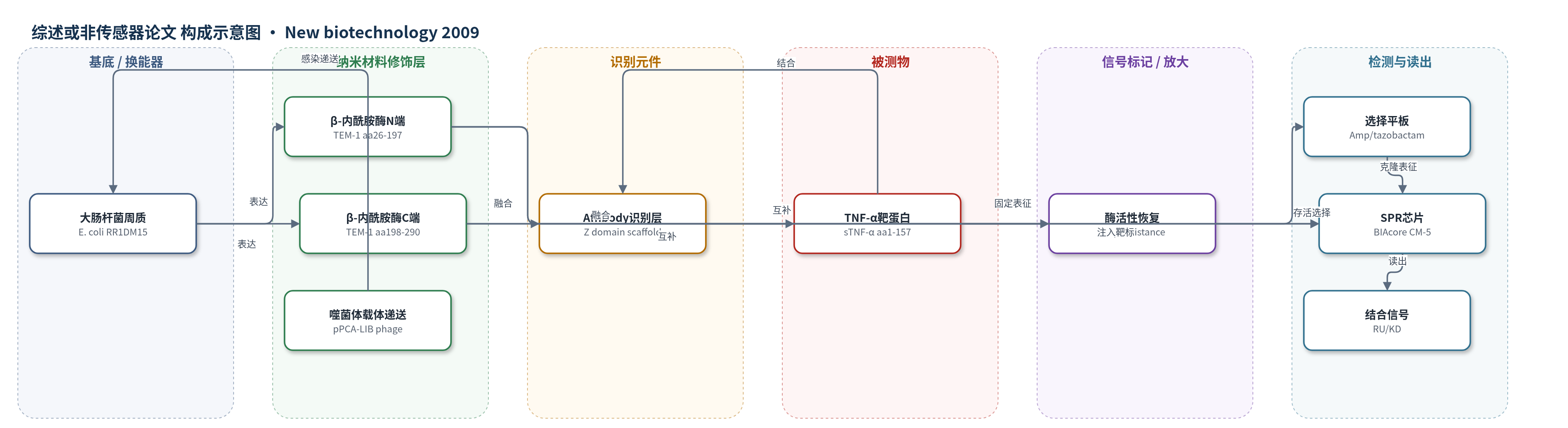
点击图片查看大图 · 依据论文自动绘制
传感器类型
综述或非传感器论文
检测对象
人肿瘤坏死因子-α(TNF-α,sTNF-α);样品基质:大肠杆菌周质提取物/细胞裂解液加标、HBS-EP 缓冲液
检测原理
本方法以 TEM-1 β-内酰胺酶两个无活性片段为报告系统。affibody 库成员融合 C 端片段,TNF-α 融合 N 端片段,二者均在大肠杆菌周质表达。当 affibody 与 TNF-α 特异性结合时,两个酶片段被拉近并互补,恢复 β-内酰胺酶活性,降解氨苄青霉素,使细胞在含 Amp 平板存活;结合越强或靶浓度越高,存活克隆越多。加入他唑巴坦可抑制泄漏酶活性,降低假阳性。后续 SPR 表征中,affibody 固定于 CM-5 芯片,TNF-α 流过时结合引起响应单位 RU 增加,平衡 RU 随 TNF-α 浓度变化,可拟合 KD;adalimumab 预混可竞争阻断结合。
检测灵敏度
KD: 14 nM、16 nM、27 nM;TNF-α 分析浓度范围: 50 pM–500 nM(trimer)
效应效果
29 个随机挑选的 affibody 克隆均显示 TNF-α 结合,34 个唯一序列中三个高亲和变体 KD 为 14、16、27 nM。交叉靶 PCA 中非配对组合无存活,低亲和 ZWT/ZSPA-1 需 15 μg/mL Amp,而 TNF-α 变体可在 50 μg/mL 生长,显示选择性。复杂大肠杆菌周质提取物加标低 nM TNF-α 可被 SPR 检出,转铁蛋白和 IgG 无结合。1 mM adalimumab 预混完全阻断结合,anti-PSMA 不阻断,提示表位重叠。选择平板从 Amp40 无 tazobactam >10^4 菌落降至 Amp80/tazobactam 约 500 菌落,背景约 10^-5。作者认为该方法适合高通量筛选高亲和选择性结合蛋白。
传感器的构成
- 宿主细胞:大肠杆菌 RR1DM15,提供周质表达与选择环境
- 分泌信号肽:OmpA 信号肽,将融合蛋白导向周质
- 报告酶N端:TEM-1 β-内酰胺酶 aa26–197,融合 TNF-α 靶蛋白,结合后恢复酶活性
- 报告酶C端:TEM-1 β-内酰胺酶 aa198–290,融合 affibody 库成员,介导识别
- 识别元件:affibody 三螺旋束蛋白库(Z domain scaffold),特异性结合 TNF-α
- 靶蛋白:可溶性人 TNF-α aa1–157,非膜锚定,作为选择靶标
- 信号读出:氨苄青霉素(Amp)/他唑巴坦(tazobactam)选择平板,通过 β-内酰胺酶恢复活性赋予存活表型
- 表征换能器:BIAcore 2000 与 CM-5 芯片,用于 SPR 亲和力、选择性和竞争分析
中文摘要
蛋白片段互补检测(PCA)基于不同报告蛋白,可用于监测活细胞中动态蛋白-蛋白相互作用。本研究构建基于 TEM-1 β-内酰胺酶基因分裂的 PCA 系统,用于在大肠杆菌周质中筛选特异性相互作用蛋白,并应用于从组合库中筛选结合人肿瘤坏死因子-α(TNF-α)的 affibody 分子。编码约 10^9 个 affibody 库成员与 β-内酰胺酶 C 端片段融合的载体,通过噬菌体感染递送至表达非膜锚定人 TNF-α 与报告蛋白 N 端片段融合蛋白的细胞。在含氨苄青霉素及他唑巴坦的选择平板上对 29 个变体分析,显示严格选择靶结合变体。三个变体对 TNF-α 的 KD 为 14–27 nM。交叉靶 PCA 和复杂细胞裂解液中低 nM TNF-α 加标检测证明选择性。生物传感器竞争实验显示 adalimumab 可完全阻断结合,提示表位重叠。结果表明 β-内酰胺酶 PCA 可严格筛选高亲和选择性结合蛋白。
英文摘要
Protein fragment complementation assays (PCAs) based on different reporter proteins have been described as powerful tools for monitoring dynamic protein-protein interactions in living cells. The present study describes the construction of a PCA system based on genetic splitting of TEM-1 beta-lactamase for the selection of proteins specifically interacting in the periplasm of Escherichia coli bacterial cells, and its application for the selection of affibody molecules binding human tumour necrosis factor-alpha (TNF-alpha) from a combinatorial library. Vectors encoding individual members of a naïve 10(9) affibody protein library fused to a C-terminal fragment of the beta-lactamase reporter were distributed via phage infection to a culture of cells harbouring a common construct encoding a fusion protein between a non-membrane anchored version of a human TNF-alpha target and the N-terminal segment of the reporter. An initial binding analysis of 29 library variants derived from surviving colonies using selection plates containing ampicillin and in some cases also the beta-lactamase inhibitor tazobactam, indicated a stringent selection for target binding variants. Subsequent analyses showed that the binding affinities (K(D)) for three selected variants studied in more detail were in the range 14-27 nm. The selectivity in binding to TNF-alpha for these variants was further demonstrated in both a cross-target PCA-based challenge and the specific detection of a low nm concentration of TNF-alpha spiked into a complex cell lysate sample. Further, in a biosensor-based competition assay, the binding to TNF-alpha of three investigated affibody variants could be completely blocked by premixing the target with the therapeutic monoclonal antibody adalimumab (Humira), indicating overlapping epitopes between the two classes of reagents. The data indicate that beta-lactamase PCA is a promising methodology for stringent selection of binders from complex naïve libraries to yield high affinity reagents with selective target binding characteristics.