组成图示
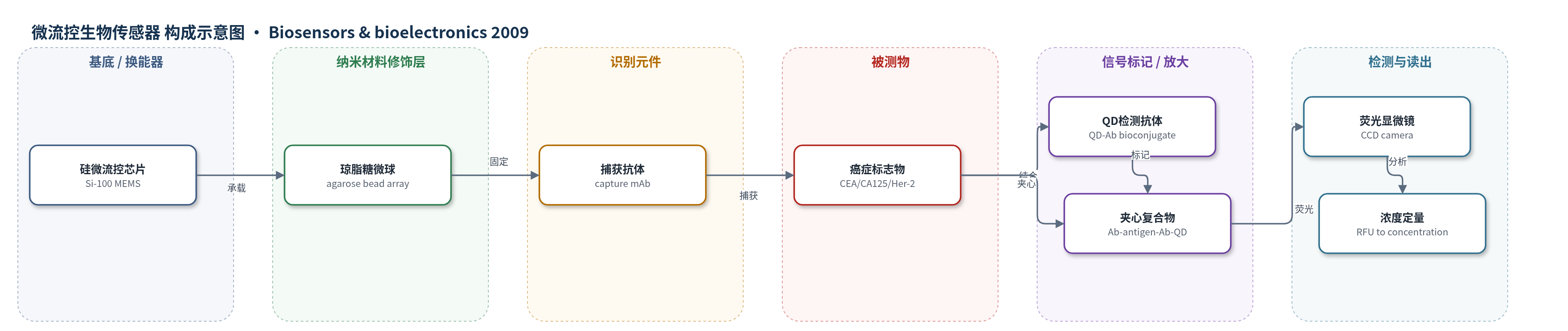
点击图片查看大图 · 依据论文自动绘制
传感器类型
微流控生物传感器
检测对象
癌胚抗原(CEA)、癌抗原125(CA125)、Her-2/Neu(C-erbB-2);样品基质:血清(serum)和全唾液(whole saliva)
检测原理
琼脂糖微球上固定的特异性捕获抗体从血清或唾液中捕获目标抗原,形成固相免疫复合物;洗涤后加入QD标记检测抗体,与已捕获抗原结合形成夹心复合物。CdSe/ZnS量子点在激发光下发射强荧光,其荧光强度与结合到复合物上的QD数量及抗原浓度成正比。微流控芯片提供封闭流路和微球定位,显微镜/CCD相机采集每个微球的荧光图像,ImageJ扣除背景和同型对照噪声后,将平均荧光强度经校准曲线换算为浓度。QD的高亮度、光稳定性和窄发射峰提供信号放大,使检出限显著降低;不同发射波长QD与空间微球阵列结合实现多重检测。
检测灵敏度
LOD: 0.02 ng/mL CEA (NBC-QD, 0.11 pM)、2.61 ng/mL CEA (NBC-AF488)、1.20 ng/mL CEA (ELISA);LOQ: 0.10 ng/mL CEA;LOD: 0.27 ng/mL Her-2/Neu (NBC-QD)、3.70 ng/mL Her-2/Neu (NBC-AF488)、1.50 ng/mL Her-2/Neu (ELISA);线性范围: 0–100 ng/mL CEA、0–60 ng/mL Her-2/Neu、0–400 U/mL CA125;校准: S = 5.144 [CEA] + 11.86 (R2 = 0.99);ELISA: S = 0.0562 [CEA] + 0.2071 (R2 = 0.98);灵敏度: NBC 斜率为 ELISA 的1.9倍;相关: R2 = 0.94 (saliva)、R2 = 0.95 (serum)
效应效果
系统选择性良好,同型对照噪声低于特异信号的10%,多重检测中非特异微球信号低于5%;用Her-2检测抗体替代CEA检测抗体时信号下降97.4%。批内RSD<10%,批间血清样本CV为6.5%,稀释线性R2=0.99。总分析时间27 min,远短于ELISA的4–24 h。QD信号较AF488提高约30倍,CEA LOD降至0.02 ng/mL,较ELISA低近2个数量级。唾液CEA免疫亲和耗竭后信号降低94.84%,证明信号真实;与ELISA/临床分析仪相关,唾液R2=0.94、血清R2=0.95。作者认为其适合POC多重癌症标志物筛查。
传感器的构成
- 微流控基底:各向异性刻蚀 Si-100 硅芯片、PMMA 基座与层压胶层,构成封闭微流控流路并承载微球阵列。
- 固相捕获载体:微孔琼脂糖微球(agarose bead array,孔径约100–300 nm),提供纳米网结构以捕获和富集抗原。
- 识别元件:特异性捕获单克隆抗体(capture mAb,CEA/CA125/Her-2/Neu,1.0 mg/mL),固定于琼脂糖微球上识别目标蛋白。
- 缓冲/封闭介质:PBS/BSA(含1% BSA),用于稀释、洗涤并降低非特异结合。
- 信号标记物:CdSe/ZnS 量子点(QD 565/QD 655,PEG-carboxy 涂层,SMCC 活化),作为高亮度荧光标记。
- 检测抗体:QD标记检测单克隆抗体(QD-Ab,DTT还原IgG片段偶联),与捕获抗原形成夹心复合物。
- 信号读出:显微镜、CCD相机与滤光片组采集微球荧光图像,经ImageJ定量转换为浓度。
中文摘要
本研究将半导体纳米颗粒量子点(QDs)整合到模块化微流控生物传感器中,用于癌胚抗原(CEA)、癌抗原125(CA125)和Her-2/Neu(C-erbB-2)三种重要癌症标志物的多重定量。该纳米生物芯片采用荧光转导信号,以QD标记的检测抗体与微流控系统中琼脂糖微孔微球阵列支持的抗原捕获相结合,完成夹心免疫分析,并已在血清和全唾液标本中验证其样品处理、分析物捕获和检测功能。与标准分子荧光团相比,QD探针使信号放大30倍,并使检出限降低近两个数量级,CEA检出限达0.02 ng/mL(0.11 pM),优于酶联免疫吸附试验(ELISA)。验证研究显示,纳米生物芯片系统测量结果与标准方法高度相关,唾液和血清的相关系数分别为R2=0.94和R2=0.95。该集成纳米生物芯片检测系统结合下一代荧光团,有望成为用于重要诊断和预后应用的敏感、多重检测工具。
英文摘要
The integration of semiconductor nanoparticle quantum dots (QDs) into a modular, microfluidic biosensor for the multiplexed quantitation of three important cancer markers, carcinoembryonic antigen (CEA), cancer antigen 125 (CA125), and Her-2/Neu (C-erbB-2) was achieved. The functionality of the integrated sample processing, analyte capture and detection modalities was demonstrated using both serum and whole saliva specimens. Here, nano-bio-chips that employed a fluorescence transduction signal with QD-labeled detecting antibody were used in combination with antigen capture by a microporous agarose bead array supported within a microfluidics ensemble so as to complete the sandwich-type immunoassay. The utilization of QD probes in this miniaturized biosensor format resulted in signal amplification 30 times relative to that of standard molecular fluorophores as well as affording a reduction in observed limits of detection by nearly 2 orders of magnitude (0.02 ng/mL CEA; 0.11 pM CEA) relative to enzyme-linked immunosorbent assay (ELISA). Assay validation studies indicate that measurements by the nano-bio-chip system correlate to standard methods at R(2)=0.94 and R(2)=0.95 for saliva and serum, respectively. This integrated nano-bio-chip assay system, in tandem with next-generation fluorophores, promises to be a sensitive, multiplexed tool for important diagnostic and prognostic applications.