组成图示
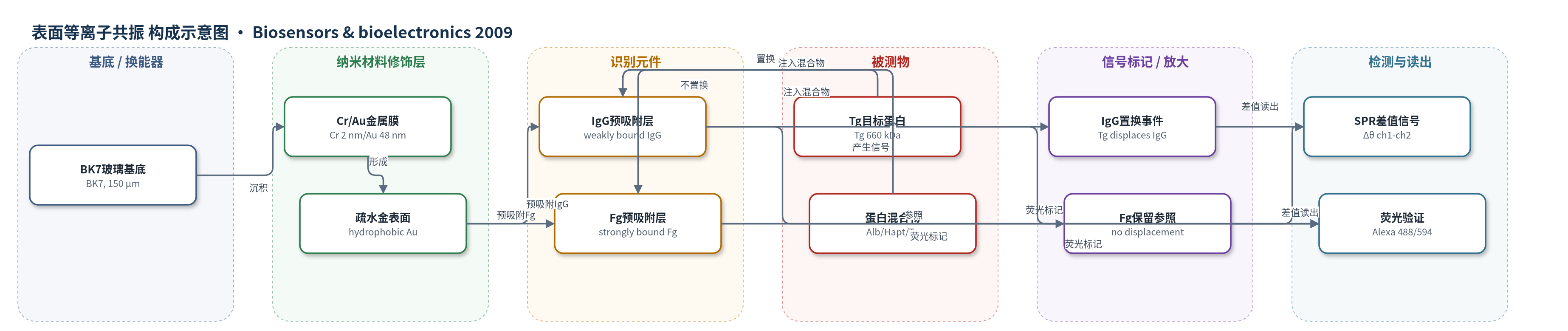
点击图片查看大图 · 依据论文自动绘制
传感器类型
表面等离子共振(SPR)生物传感器
检测对象
甲状腺球蛋白(thyroglobulin, Tg);样品基质:人血清蛋白混合物(PBS中albumin、haptoglobin、Tg),模拟血清Tg检测
检测原理
该传感器利用竞争性蛋白吸附(Vroman效应)实现无抗体固定检测。在疏水Au表面,五种人血清蛋白的吸附强度顺序为fibrinogen > Tg > IgG > haptoglobin > albumin。器件设置两个SPR通道:通道1预吸附弱结合IgG,通道2预吸附强结合fibrinogen。当含Tg的蛋白混合物流过时,Tg与通道1表面作用并置换IgG,使该通道表面质量/折射率发生变化;而通道2中fibrinogen结合更强,Tg不能置换,仅产生可被洗涤去除的弱吸附。SPR对金膜附近约200 nm内折射率变化敏感,置换事件引起SPR角度偏移。通过计算通道1与通道2的角度差,可扣除背景并放大Tg特异性响应;Tg浓度越高,置换IgG越多,差值角度变化越大。荧光标记实验进一步验证了IgG被Tg置换而fibrinogen保留的过程。
检测灵敏度
LOD: 1 pg/ml;线性范围: 1 pg/ml–1 μg/ml
效应效果
在Tg检测中,传感器选择性明显:单独注入Tg时通道1角度变化60.1 mDeg,通道2几乎无变化;Tg产生59 mDeg差值角度变化,而albumin、haptoglobin和IgG均小于5 mDeg。在albumin、haptoglobin和Tg混合物中,通道1变化58.9 mDeg,通道2仅3 mDeg,说明仅Tg引起有效置换。SPR角度变化可换算为表面分子数,文中给出120 mDeg对应1 ng/mm2,fibrinogen和Tg置换IgG分别产生142 mDeg和62 mDeg,对应2.10×10^11和4.72×10^10 molecules/cm2。校准曲线在1 pg/ml至1 μg/ml范围内线性,覆盖6个数量级。作者认为该方法可避免昂贵、耗时且劳动密集的抗体固定,并通过选择不同预吸附蛋白对扩展检测对象;但传感器不能直接分辨复杂血清中吸附性质相近的大量蛋白,仍需尺寸排阻色谱或电泳等前处理。
传感器的构成
- 基底:BK7玻璃基底(150 μm),承载金属膜并用于SPR棱镜耦合与微流控键合
- SPR换能金属膜:Cr 2 nm粘附层/Au 48 nm金膜(荧光器件为10 nm Au),形成疏水表面并产生SPR角度响应
- 微流控通道层:PDMS通道/间隔层,经氧等离子体键合形成双通道单出口器件,控制蛋白注入与洗涤
- 竞争识别层(通道1):预吸附IgG(150 kDa),作为弱结合蛋白,可被Tg置换
- 竞争识别层(通道2):预吸附fibrinogen(340 kDa),作为强结合蛋白,不被Tg置换
- 荧光标记物:Alexa Fluor 488标记IgG/fibrinogen、Alexa Fluor 594标记Tg,用于倒置显微镜验证置换
- 缓冲与洗涤液:PBS 1×(pH 7.4),溶解蛋白、稳定基线并去除未结合蛋白
- SPR读出系统:Bi SPR 1000、半圆柱棱镜、折射率匹配液与数据采集系统,实时监测角度变化
中文摘要
本文报道一种基于竞争性蛋白吸附的微流控生物传感平台,用于检测甲状腺球蛋白(Tg)。血清Tg是分化型甲状腺癌(DTC)治疗后残余甲状腺组织、复发和转移的高度特异生物标志物。传统Tg检测通常需要复杂的抗体固定,并需借助二级抗体形成夹心法以提高灵敏度。作者提出一种不使用抗体固定的微流控检测策略:在两个微流控通道表面分别预吸附两种已知蛋白,即免疫球蛋白G(IgG)和纤维蛋白原(fibrinogen),二者与表面的亲和力不同。当目标蛋白Tg流过时,Tg可置换弱结合的IgG,但不能置换强结合的纤维蛋白原,从而通过两通道表面状态差异实现选择性检测。表面等离子共振(SPR)传感图显示,白蛋白、触珠蛋白、IgG、纤维蛋白原和Tg五种人血清蛋白对表面具有不同吸附强度,其竞争吸附决定蛋白交换顺序。荧光标记实验进一步验证了吸附与交换过程。在含白蛋白、触珠蛋白和Tg的蛋白混合物中,该传感器可基于交换反应选择性检测Tg,避免依赖抗体作为捕获探针及其与换能器的连接。
英文摘要
We report a microfluidic sensing platform for the detection of thyroglobulin (Tg) using competitive protein adsorption. Serum Tg is a highly specific biomarker for residual thyroid tissue, recurrence and metastases after treatment for differentiated thyroid cancer (DTC). Conventional Tg detection techniques require complicated immobilization of antibodies and need to form a sandwich assay using additional secondary antibodies to enhance the sensitivity. We present a fundamentally different sensing technique without using antibody immobilization on a microfluidic platform. We engineer two surfaces covered by two known proteins, immunoglobulin G (IgG) and fibrinogen, with different affinities onto the surfaces. The microfluidic device offers a selective protein sensing by being displaced by a target protein, Tg, on only one of the surfaces. By utilizing the competitive protein adsorption, Tg displaces a weakly bound protein, IgG; however, a strongly bound protein, fibrinogen, is not displaced by Tg. The surface plasmon resonance (SPR) sensorgrams show that five human serum proteins, albumin, haptoglobin, IgG, fibrinogen and Tg, have different adsorption strengths to the surface and the competitive adsorption of individuals controls the exchange sequence. The adsorption and exchange are evaluated by fluorescent labeling of these proteins. Tg in a protein mixture of albumin, haptoglobin, and Tg is selectively detected based on the exchange reaction. By using the technique, we obviate the need to rely on antibodies as a capture probe and their attachment to transducers.