组成图示
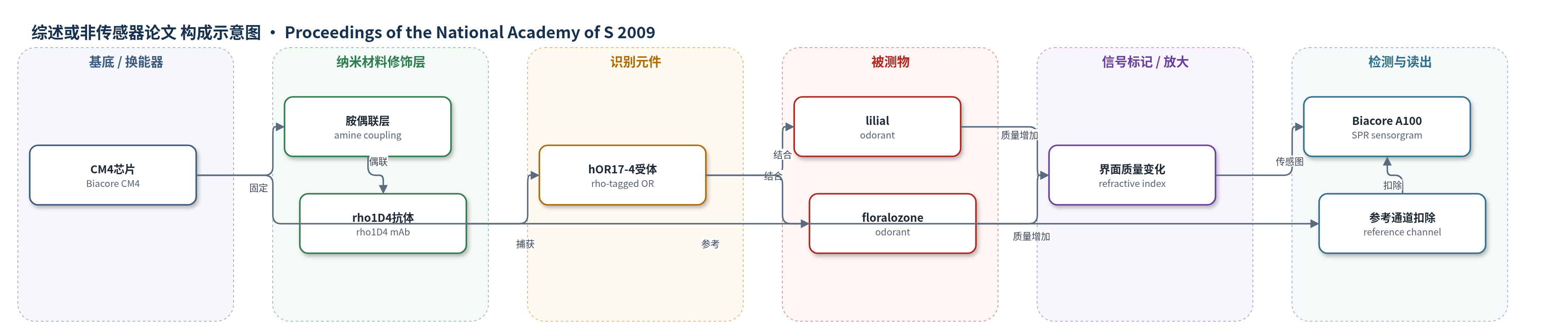
点击图片查看大图 · 依据论文自动绘制
传感器类型
综述或非传感器论文
检测对象
气味分子(odorants):百合醛(lilial)、花臭氧(floralozone)、紫罗兰酮(bourgeonal);样品基质:SPR 缓冲液(HBS/PBS)与异源 HEK293S 细胞
检测原理
该研究主要采用 SPR 与细胞钙信号两种检测方式。SPR 体系中,rho1D4 单克隆抗体经胺偶联固定于 Biacore CM4 芯片,再非共价捕获带 C 端 rho 标签的 hOR17-4;当 lilial 或 floralozone 等气味分子与受体结合时,芯片界面质量与折射率发生变化,Biacore A100 实时记录传感图,响应随气味分子浓度升高而增强。由于气味分子溶解度低,结合亲和力约为低微摩尔范围,未使用 HCR、RCA 或酶催化沉积等放大策略。细胞实验中,hOR17-4 激活 Gq/IP3 通路,使内质网释放 Ca2+,Fura-Red 荧光变化反映胞内钙浓度升高,从而判断受体被气味分子激活。
检测灵敏度
未报告 LOD、线性范围、灵敏度斜率或 R^2。
效应效果
该研究未报道传感器稳定性、RSD 或实际样品回收率。主要表现为:生物反应器悬浮培养可制备 >10 mg 单体 hOR17-4,纯化后纯度约 90%,产量约 3 mg/L;FC14 溶解效率较 DDM 提高约 10 倍。SPR 显示溶解受体对 lilial 和 floralozone 呈浓度依赖结合,对非特异气味分子 sulfuryl acetate 无响应;细胞钙信号中 bourgeonal 最低 1 μM 可激活,100 μM undecanal 可阻断,octanal 和 anethole 无响应,且近 100% 细胞响应,优于瞬时转染 <5%。作者认为该平台可用于 OR 结构功能研究和 OR 生物传感器器件开发。
传感器的构成
- 基底/换能器:Biacore CM4 芯片,葡聚糖表面,提供 SPR 折射率检测界面
- 修饰层:胺偶联化学(amine coupling),固定 rho1D4 单克隆抗体
- 识别元件:hOR17-4 受体蛋白,经 C 端 rho 标签被 rho1D4 抗体捕获并识别气味分子
- 稳定剂:fos-choline-14(FC14),维持 hOR17-4 溶解与结合活性
- 信号读出:Biacore A100 SPR 仪器,实时记录结合引起的传感图变化
中文摘要
嗅觉受体(OR)是 G 蛋白偶联受体,负责识别气味分子,但此前难以大规模制备有功能的 OR 蛋白。本文建立了一种哺乳动物表达系统,用于大规模生产和纯化功能性 OR。作者从四环素诱导的 HEK293S 细胞系中纯化人嗅觉受体 hOR17-4,并通过生物反应器悬浮培养扩大产量,经免疫亲和层析和尺寸排阻层析获得 >10 mg 单体 hOR17-4,表达产量达 3 mg/L。质谱鉴定了关键翻译后修饰,圆二色光谱显示受体约 50% 为 α-螺旋,与其他 GPCR 结构相似。去垢剂溶解的 hOR17-4 在体外可特异性结合已知激活气味分子 lilial 和 floralozone,表面等离子共振检测显示结合呈浓度依赖;异源细胞中钙离子动员实验也证实其可识别特定气味分子。该平台可用于 OR 结构功能研究及 OR 生物传感器器件开发。
英文摘要
Although understanding of the olfactory system has progressed at the level of downstream receptor signaling and the wiring of olfactory neurons, the system remains poorly understood at the molecular level of the receptors and their interaction with and recognition of odorant ligands. The structure and functional mechanisms of these receptors still remain a tantalizing enigma, because numerous previous attempts at the large-scale production of functional olfactory receptors (ORs) have not been successful to date. To investigate the elusive biochemistry and molecular mechanisms of olfaction, we have developed a mammalian expression system for the large-scale production and purification of a functional OR protein in milligram quantities. Here, we report the study of human OR17-4 (hOR17-4) purified from a HEK293S tetracycline-inducible system. Scale-up of production yield was achieved through suspension culture in a bioreactor, which enabled the preparation of >10 mg of monomeric hOR17-4 receptor after immunoaffinity and size exclusion chromatography, with expression yields reaching 3 mg/L of culture medium. Several key post-translational modifications were identified using MS, and CD spectroscopy showed the receptor to be approximately 50% alpha-helix, similar to other recently determined G protein-coupled receptor structures. Detergent-solubilized hOR17-4 specifically bound its known activating odorants lilial and floralozone in vitro, as measured by surface plasmon resonance. The hOR17-4 also recognized specific odorants in heterologous cells as determined by calcium ion mobilization. Our system is feasible for the production of large quantities of OR necessary for structural and functional analyses and research into OR biosensor devices.