组成图示
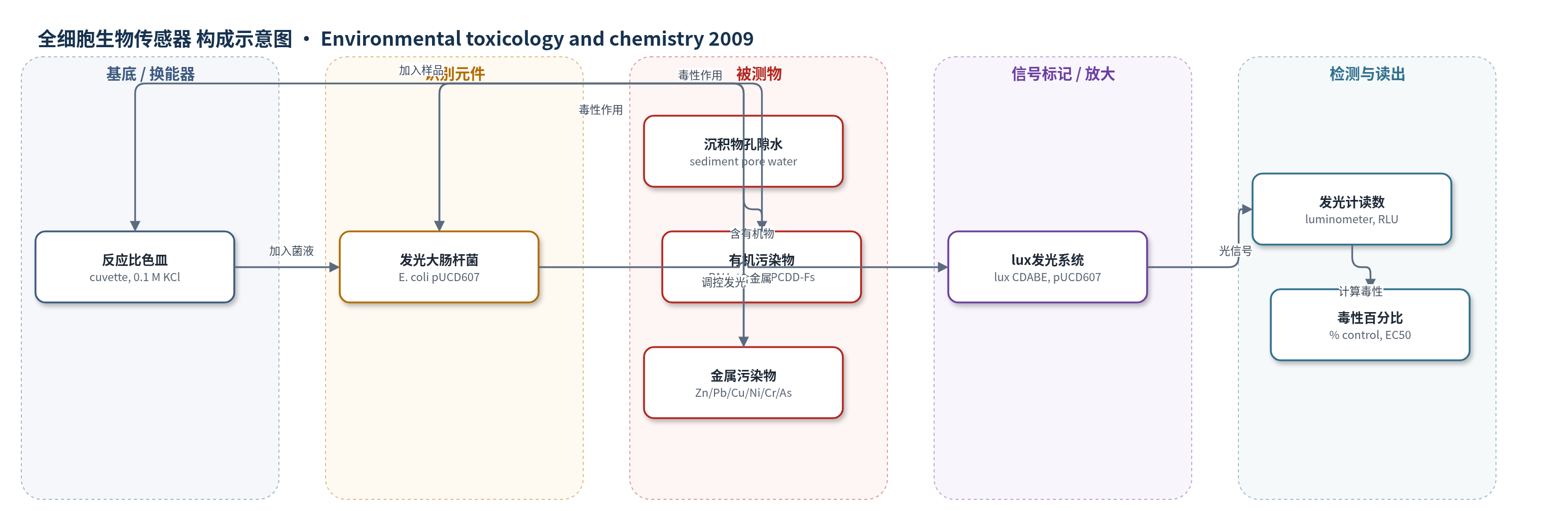
点击图片查看大图 · 依据论文自动绘制
传感器类型
全细胞生物传感器
检测对象
沉积物孔隙水中的毒性物质/污染物:重金属(Pb、Cr、Cu、Ni、Zn、Cd、As)、有机污染物(DDTs、PAHs、PCBs、PCDD/Fs);样品基质为湿地沉积物孔隙水
检测原理
该检测基于全细胞发光细菌生物传感器。大肠杆菌 E. coli HB101 pUCD607 携带来自 Vibrio fischeri 的 lux CDABE 基因,在正常代谢下产生生物发光。将复苏菌液加入含污染物的沉积物孔隙水后,污染物通过细胞膜或干扰代谢过程影响发光酶活性,使发光强度下降。暴露15 min后,用发光计测定相对光单位(RLU),并以0.1 M KCl对照发光为100%。污染物浓度越高,毒性越强,RLU越低;可用Zn标准曲线计算EC50进行质量控制。本方法未使用外源信号放大策略,信号直接来自细菌代谢生物发光。TIE中通过C18固相萃取去除有机物、Chelex-100树脂螯合金属,比较处理前后发光变化,从而识别毒性组分。
检测灵敏度
—
效应效果
该生物传感器用于11个湿地站点孔隙水毒性筛查,4个公园外未修复站点(S1、S4、S5、S9)发光显著低于对照(p<0.05),7个公园内站点与对照相近或略高,提示修复区无明显毒性。结果与化学分析及Tenax生物可利用性数据一致,4个未修复站点二噁英浓度均大于200 pg I-TEQ/g。TIE显示Chelex-100去除金属后RLU基本不变,C18去除有机物后S4和S5发光显著恢复(p<0.05),说明中等极性和疏水有机物是主要毒性来源;S1和S9仍低,提示存在其他毒性物质。Zn标准曲线给出EC50约25 mg/L、EC10约9 mg/L。作者认为化学分析结合生物传感器可快速筛查污染场地并优先修复。
传感器的构成
- 识别/换能元件:发光大肠杆菌 E. coli HB101 pUCD607,作为全细胞毒性识别与生物发光信号产生元件
- 遗传信号元件:lux CDABE 基因(来自 Vibrio fischeri)与多拷贝质粒 pUCD607,介导生物发光
- 菌剂形式:冻干发光大肠杆菌培养物,使用前以0.1 M KCl复苏
- 反应介质:0.1 M KCl 溶液,作为复苏介质和阴性对照基质
- 信号读出装置:发光计(luminometer)与比色皿(cuvettes),记录相对光单位(RLU)
中文摘要
本研究评估澳大利亚悉尼奥运公园内7个修复或残留湿地及边界外4个未修复站点的沉积物污染与毒性,采用化学分析和发光细菌生物传感器(大肠杆菌 E. coli HB101 pUCD607)检测。测定了沉积物及其孔隙水中金属(Pb、Cr、Cu、Ni、Zn、Cd、As)和持久性有机污染物(DDT及其代谢物、多环芳烃 PAHs、多氯联苯 PCBs、二噁英/呋喃 PCDD/Fs)浓度。沉积物中锌浓度最高(84–618 mg/kg),8个站点的 Pb、Zn、Ni 超过澳大利亚生态触发值;11个站点 DDTs 均超标,6个站点 PAHs 和5个站点 PCBs 超标。公园外4个未修复站点二噁英浓度大于200 pg I-TEQ/g。孔隙水毒性测试同样识别出这4个站点具有明显毒性,与污染物生物可利用部分(孔隙水和 Tenax 提取数据)及二噁英水平一致。初步毒性鉴定评价(TIE)表明有机污染物是大肠杆菌毒性主因,无证据显示金属贡献孔隙水毒性。
英文摘要
The present study assessed contamination and toxicity of sediments from seven remediated and remnant wetland sites within Sydney Olympic Park, Australia, and four unremediated sites adjacent to its boundary using chemical analysis and a luminescent bacterial biosensor assay (Escherichia coli). Concentrations of metals (Pb, Cr, Cu, Ni, Zn, Cd, and As) and persistent organic chemicals (DDT and its metabolites, dichlorodiphenyldichloroethane and dichlorodiphenyldichloroethylene; polycyclic aromatic hydrocarbons; polychlorinated biphenyls; and polychlorinated dibenzo-p-dioxins and dibenzofurans) in sediments and their pore-water samples were determined. Zinc concentrations were the highest of the metals in the sediments (84-618 mg/kg), and at eight sites, metal concentrations in sediments exceeded the Australian ecological trigger values for Pb, Zn, and Ni. Concentrations of organic contaminants in the sediments exceeded the trigger values at all 11 sites for DDTs, at 6 sites for polycyclic aromatic hydrocarbons, and 5 sites for polychlorinated biphenyls. Sediment samples from the four unremediated sites outside the Sydney Olympic Park had dioxin concentrations greater than 200 pg (toxic equivalency per gram). The same four sites were identified as contaminated in pore-water toxicity tests with the luminescent biosensor, generally consistent with the bioavailable fractions of the contaminants (pore-water and Tenax extraction data), as well as dioxin levels, in the sediments. Preliminary toxicity identification and evaluation tests of the pore water from the four sites outside the park demonstrated that organic contaminants were the main cause of toxicity to E. coli, with no evidence that metals contributed to the toxicity of the pore water.