组成图示
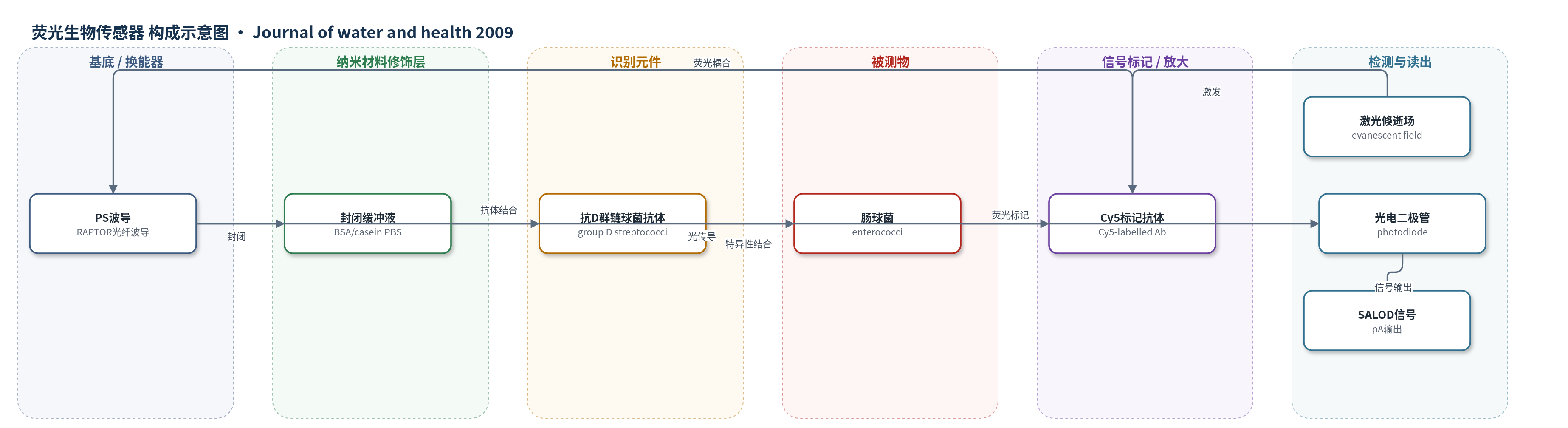
点击图片查看大图 · 依据论文自动绘制
传感器类型
荧光生物传感器
检测对象
肠球菌(Enterococci);样品基质:海滩海水/海洋休闲水(beach waters / marine recreational waters),100 L超滤浓缩液及100 mL直接采集样品
检测原理
100 L海水经死端中空纤维超滤、超声、筛分、离心浓缩,提高肠球菌浓度。浓缩液在RAPTOR聚苯乙烯光纤波导表面孵育,肠球菌与抗D群链球菌抗体结合;Cy5标记抗体结合识别抗体/目标,形成荧光标记免疫复合物。激光在波导中产生倏逝场,激发波导表面100–1000 nm内Cy5荧光;部分发射耦合回波导,由光电二极管检测为pA。用抗M. tuberculosis抗体做非目标基线,计算SALOD。肠球菌越多,结合Cy5荧光越多,SALOD越高;当环境水超过10^5 CFU/100 mL时浓缩液达到传感器检测限,产生阳性。无核酸/酶放大,主要靠大体积超滤和离心浓缩放大。
检测灵敏度
LOD: 10^5 CFU ml^-1
效应效果
现场56份100 L海水经死端超滤、超声、筛分和离心后,肠球菌平均提高322倍,离心再提高约2个数量级,最终浓缩液较环境水至少高4个数量级,摘要称提高超过26,000倍;回收率37%–195%,平均107%。RAPTOR对超标样品(>10^5 CFU/100 mL)产生阳性SALOD 7–280 pA,43份优质水无阳性;1份100 CFU/100 mL中等水出现假阳性(SALOD 20 pA,浓缩液150,500 CFU/mL)。与EPA 1600相比,特异性98%(剔除假阳性为100%),对超标样品敏感性83%;RAPTOR阳性与超标关系Nagelkerke R^2=0.819(P<0.001)。流程2.5 h,较24 h培养法显著缩短,适合海滩水质同日监测。
传感器的构成
- 换能器/基底:RAPTOR 光纤波导(fibre optic polystyrene waveguides,PS波导),承载倏逝场并传导荧光信号
- 识别元件:抗D群链球菌多克隆抗体(group D streptococci polyclonal antibody,兔IgG),特异性识别肠球菌
- 信号标记物:Cy5标记抗体(Cy5-labelled antibody,文中为Cy5标记山羊抗兔二抗),结合识别抗体并产生荧光
- 封闭剂:blocking buffer(1% BSA和casein,0.01 M Dulbecco's PBS),降低非特异结合
- 基线对照:抗M. tuberculosis抗体(anti-M. tuberculosis antibody),用于非目标基线校正
中文摘要
标准微生物水质检测方法需培养24小时以上,无法实现同日评估,增加公众暴露于粪便病原体的风险。本研究评估高容量中空纤维死端超滤与生物传感器检测联用,用于检测南加州海滩海水中肠球菌,以支持同日发布水质不佳通知。2007年5月至7月每周从4个采样点采集56份100 L超滤样品和100 mL直接采集样品。超滤后处理包括超声、微筛去除干扰颗粒,并离心二次浓缩。采用EPA方法1600测定直接采集样品和超滤样品中肠球菌水平,以计算回收率和浓缩因子。每份最终浓缩液用RAPTOR倏逝波生物传感器分析。结果显示最终浓缩液中肠球菌水平较环境水提高超过26,000倍;当环境浓度超过单样品监管标准(>10^5 CFU/100 mL)时可检测到肠球菌,且检测与超标高度相关。联合流程仅需2.5小时,而EPA方法1600需24小时。该现场研究证明超滤、二次浓缩与生物传感器分析可实现肠球菌快速检测,具有水质监测应用潜力。
英文摘要
Same-day microbial water quality assessments are not possible with standard methods, which increases the possibility of public exposure to fecal pathogens. This study examined the efficacy of high-volume hollow fibre ultrafiltration coupled to biosensor detection for enterococci in marine waters to allow same-day public notification of poor water quality. Fifty-six 1001 ultrafiltered samples and 100 ml grab samples were collected weekly from May to July 2007. Post-ultrafiltration processing included sonication and micron sieve passage to remove interfering particulates, followed by centrifugation for secondary concentration. Levels of enterococci in grab and ultrafiltration samples were determined by a standard method (EPA method 1600) for calculation of recovery efficiencies and concentration factors. Each final retentate was analysed with the RAPTOR evanescent wave biosensor. Enterococci levels increased over 26,000-fold in final retentates. Enterococci were detected when ambient concentrations exceeded the regulatory standard for a single sample (> or = 105 CFU/100 ml), and detection was highly correlated with breaches of the single-sample regulatory limit. The combined procedure required 2.5 h for detection compared with 24h for EPA method 1600. This field study achieved rapid detection of enterococci by ultrafiltration, secondary concentration and biosensor analysis, and demonstrates its potential usefulness for water quality monitoring.