组成图示
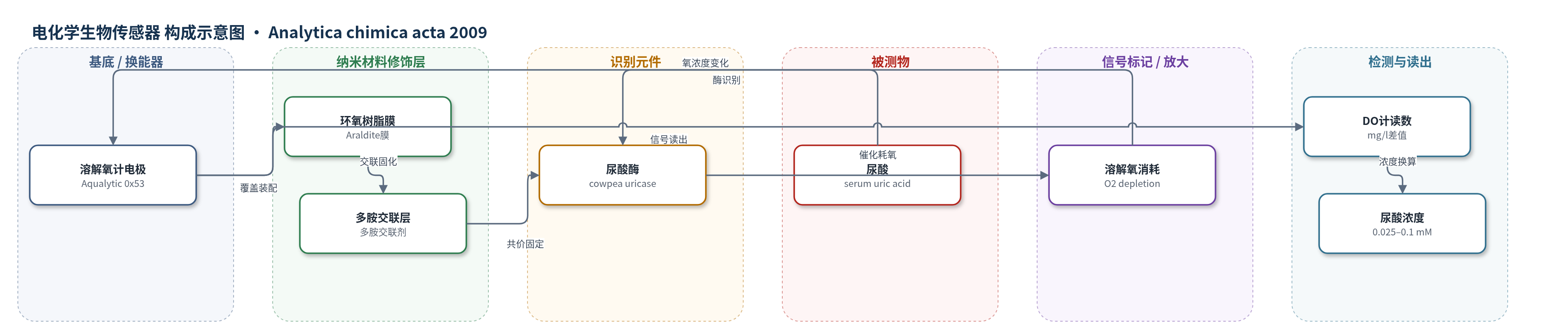
点击图片查看大图 · 依据论文自动绘制
传感器类型
电化学生物传感器
检测对象
尿酸(uric acid, UA);样品基质:血清(serum)、尿酸标准溶液/反应混合物
检测原理
尿酸从血清或标准溶液中扩散进入环氧树脂膜,与固定化菜豆叶尿酸酶接触并被催化氧化,同时消耗溶解氧并生成尿囊素和过氧化氢。由于酶膜覆盖在溶解氧计组合电极上,酶催化反应使电极附近局部溶解氧浓度下降;DO计通过氧电极换能机制检测该氧浓度变化,并以mg/l显示。加样前后DO读数的差值反映被尿酸酶消耗的O2量,在0.025–0.1 mM尿酸范围内与尿酸浓度呈线性关系。该体系未使用额外化学放大,灵敏度主要来自尿酸酶的催化周转和DO计对氧耗的连续监测;最佳条件为pH 8.5、35 ℃,响应时间10–12 s。
检测灵敏度
LOD: 4.25 μg/ml;线性范围: 0.025–0.1 mM;相关系数: r = 0.996(摘要)/ r = 0.98(正文)
效应效果
传感器响应10–12 s,便携。批内CV<6.5%,批间CV<5.0%;血清加标回收率93.6±2.34%和87.18±3.17%。与标准酶法比色法相比,摘要r=0.996、正文r=0.98,回归y=0.984x+0.0674。干扰物中葡萄糖、尿素、NaCl、胆固醇、抗坏血酸分别使活性下降11%、38%、25%、13%、56%,MgSO4和CaCl2无影响。4 ℃保存并重复使用100次、60天后活性下降32%。健康男性血清尿酸均值4.92 mg/dl,女性3.11 mg/dl,痛风患者9.4–13.6 mg/dl。作者认为其简单、敏感、快速,适合低浓度尿酸检测。
传感器的构成
- 换能器电极:Aqualytic溶解氧(DO)计组合电极(Model 0x53),用于检测溶解氧浓度变化
- 固定化膜:Araldite环氧树脂膜(epoxy resin membrane),多孔、水透、耐温耐化学,作为酶固定载体
- 交联层:Araldite固化剂/多胺交联剂(polyamine crosslinker),与环氧基和酶氨基反应形成共价网络
- 识别元件:菜豆叶(Vigna unguiculata)纯化尿酸酶(uricase),催化尿酸氧化并消耗O2
- 密封装配:Parafilm,将酶膜覆盖固定在DO电极传感部分
- 反应介质:20 mM Tris–HCl缓冲液(pH 8.5/8.8,O2饱和),提供酶反应环境
- 样品基质:血清(serum)或尿酸标准溶液,提供被测尿酸
中文摘要
本研究从20日龄菜豆叶中纯化尿酸酶,固定化于环氧树脂膜,保留游离酶80%活性,偶联产率0.056 mg/cm2。将尿酸酶–环氧树脂膜覆盖在Aqualytic溶解氧(DO)计组合电极传感部分,构建尿酸生物传感器。传感器检测固定化尿酸酶氧化尿酸时溶解氧的消耗,耗氧量与尿酸浓度成正比。其在pH 8.5、35 ℃下10–12 s内最佳响应,尿酸0.025–0.1 mM与消耗O2(mg/l)线性。用于血清测定,健康男性均值4.92 mg/dl,女性3.11 mg/dl;加标回收率93.6±2.34%和87.18±3.17%,批内、批间CV<6.5%和5.0%。与标准酶法比色法相关r=0.996,回归y=0.984x+0.0674。葡萄糖、尿素、NaCl、胆固醇、抗坏血酸分别致活性下降11%、38%、25%、13%、56%,MgSO4和CaCl2无影响。酶电极4 ℃保存并重复使用100次、60天后活性下降32%。
英文摘要
Uricase purified from 20-day-old leaves of cowpea was immobilized on to epoxy resin membrane with 80% retention of initial activity of free enzyme and a conjugation yield of 0.056 mg/cm(2). The uricase epoxy resin bioconjugate membrane was mounted over the sensing part of the combined electrode of 'Aqualytic' dissolved O(2) (DO) meter to construct a uric acid biosensor. The biosensor measures the depletion of dissolved O(2) during the oxidation of uric acid by immobilized uricase, which is directly proportional to uric acid concentration. The biosensor showed optimum response within 10-12s at a pH 8.5 and 35 degrees C. A linear relationship was found between uric acid concentration from 0.025 to 0.1 mM and O(2) (mg/l) consumed. The biosensor was employed for measurement of uric acid in serum. The mean value of uric acid in serum was 4.92 mg/dl in apparently healthy males and 3.11 mg/dl in apparently healthy females. The mean analytic recoveries of added uric acid in reaction mixture (8.9 and 9.8 mg/dl) were 93.6 +/- 2.34 and 87.18 +/- 3.17% respectively. The within and between batch CVs were < 6.5 and < 5.0%, respectively. The serum uric acid values obtained by present method and standard enzymic colorimetric method, showed a good correlation (r - 0.996) and regression equation being y - 0.984x + 0.0674. Among the various metabolites tested only, glucose (11%), urea (38%), NaCl (25%) and cholesterol (13%) and ascorbic acid (56%) caused decrease, while, MgSO(4) and CaCl(2) had no effect on immobilized enzyme. The enzyme electrode showed only 32% decrease during its use for 100 times over a period of 60 days at 4 degrees C.