组成图示
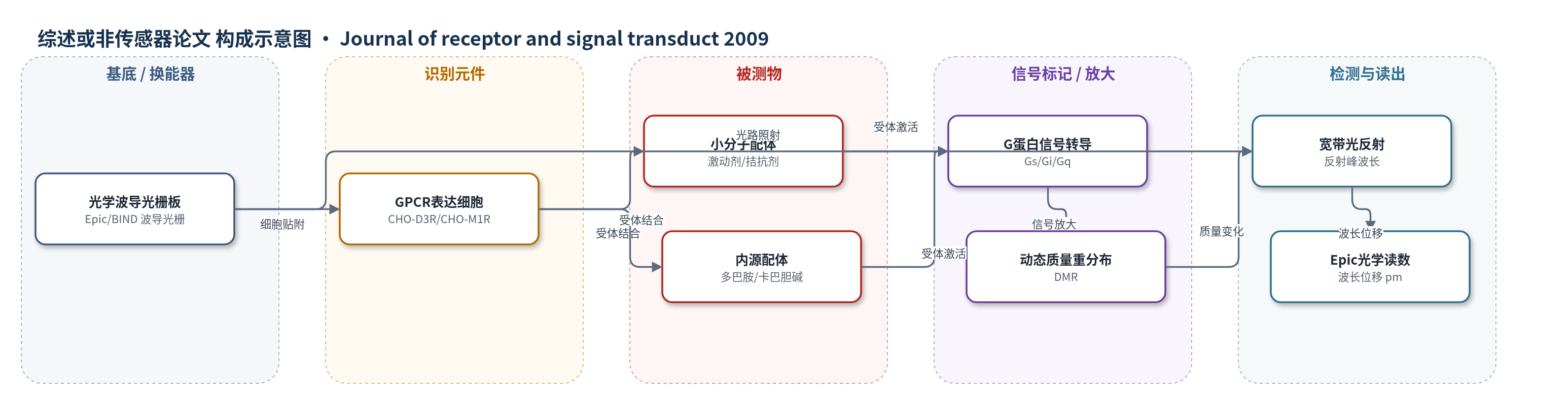
点击图片查看大图 · 依据论文自动绘制
传感器类型
综述或非传感器论文
检测对象
GPCR 配体/药物候选物(小分子化合物,如阿米舒必利 amisulpride、氟哌啶醇 haloperidol、多巴胺 dopamine、卡巴胆碱 carbachol);样品基质:贴壁细胞培养体系(CHO-D3R、CHO-M1R 细胞)。
检测原理
贴壁 GPCR 细胞接种于光学波导光栅板底部,配体与细胞膜 GPCR 结合后,受体构象改变并激活 Gs、Gi 或 Gq 信号通路。下游信号级联引起细胞骨架重排、内吞/外排或信号蛋白向细胞膜附近移动,形成动态质量重分布(DMR)。波导光栅附近质量/折射率变化使宽带光反射峰波长发生位移,Epic 系统实时读取该位移。激动剂通常产生正 DMR,反向激动剂降低基础活性产生负 DMR,拮抗剂抑制激动剂诱导的 DMR。信号放大来自细胞内信号转导级联,而非外源标记。
检测灵敏度
原文未报告 LOD、线性范围、灵敏度斜率或相关系数;仅图注给出测试浓度范围 0.02–10,000 nM。
效应效果
文中引用双盲研究显示,Epic 光学生物传感器可从 12 个化合物中区分激动剂、中性拮抗剂和反向激动剂,并在 CHO-D3R 与 CHO-M1R 两种细胞系上完成药理 profiling。阿米舒必利在 CHO-D3R 上诱导剂量依赖性负 DMR,与多巴胺(50 nM)诱导的正 DMR 相反,而在 CHO-M1R 上无此效应,提示 D3R 选择性反向激动;氟哌啶醇在 D3R 呈反向激动,在 M1R 呈低效价部分激动,并剂量依赖性拮抗卡巴胆碱(500 nM)响应。作者强调该平台无标记、非侵入、实时动力学,可统一检测 Gs/Gi/Gq 通路,适用于早期药物发现。
传感器的构成
- 基底/换能器:光学波导光栅微孔板(Epic/BIND),底部为波导光栅表面,细胞贴附并作为光学换能界面。
- 识别元件:表达 GPCR 的贴壁细胞(CHO-D3R、CHO-M1R 或内源 GPCR 细胞),细胞膜受体作为配体识别元件。
- 信号元件:细胞内 G 蛋白信号转导与动态质量重分布(DMR),无荧光标记或报告基因,信号来自细胞骨架/信号蛋白向膜附近移动。
- 读出层:宽带光照射波导光栅,反射峰波长位移(pm)随 DMR 变化被 Epic 系统读取。
中文摘要
当前 GPCR 细胞学检测常依赖荧光染料装载、荧光标记靶标或报告基因表达,这些操作可能改变靶 GPCR 的细胞生理状态,并受化合物脱靶干扰。无标记光学生物传感器技术可提供非侵入性方法研究 GPCR 激活与信号转导。该平台仅用一套检测体系即可评价药物对耦联不同信号通路(Gs、Gi、Gq)的多种 GPCR 的作用,具有较高灵敏度,并能检测反向激动作用,因此是研究药物药理学的便捷工具。其实时动力学测量可进一步揭示药物诱导的生物学响应。将该平台用于早期药物发现,可提供候选药物的作用机制和药理学特征信息。
英文摘要
Current GPCR cell-based assays often rely on the measurement of a loaded fluorescent dye, fluorescently tagged targets, or the expression of a reporter. These manipulations may alter the cellular physiology of the target GPCR, and the measurements may be subject to off-target interference of compounds. Label-free optical biosensor-based technologies that provide a noninvasive methodology to study GPCR activation and signaling have been developed. These technologies enable the evaluation of drug effects on various GPCRs that couple to different signal transduction pathways using only one assay platform. This technology is highly sensitive and detects inverse agonism, therefore providing a convenient tool to study the pharmacology of drugs. Furthermore, its real-time kinetic measurements give researchers additional information about the biological responses induced by the drug. This assay platform when applied in early drug discovery efforts can provide valuable information on the mechanism of action and pharmacology profiles of drug candidates.