组成图示
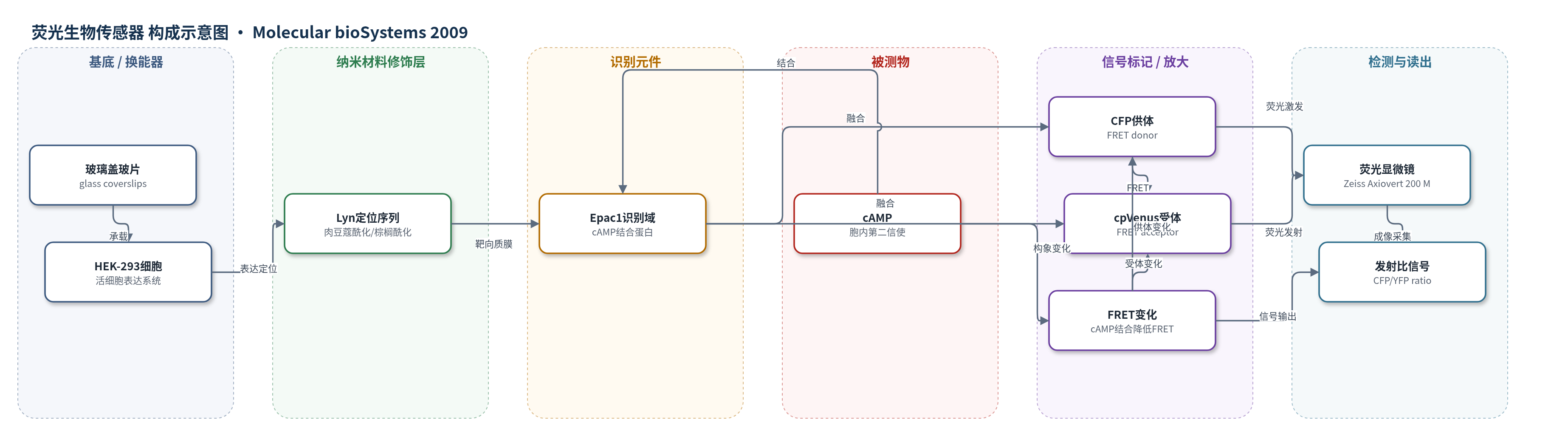
点击图片查看大图 · 依据论文自动绘制
传感器类型
荧光生物传感器
检测对象
环磷酸腺苷(cAMP);样品基质:HEK-293 活细胞(胞质及质膜/膜筏区域,HBSS 成像缓冲液)
检测原理
ICUE3/lynICUE3 由 CFP、Epac1 和 cpVenus 组成,Epac1 为 cAMP 结合识别域。当胞内 cAMP 浓度升高时,cAMP 结合 Epac1 并诱导其构象变化,改变 CFP 与 cpVenus 之间的距离或取向,使 FRET 效率降低。CFP 供体荧光增强、cpVenus 受体荧光减弱,因此在 420 nm 激发下 cyan/yellow 发射比升高。荧光显微镜交替采集 475 nm CFP 和 535 nm cpVenus 发射并计算比值,实现单细胞实时读出。该传感器未使用酶催化或核酸扩增放大,而是通过环状置换 cpVenus(L194)提高动态范围,并用 Lyn 定位序列将探针靶向质膜/膜筏区域,增强对受体附近 cAMP 变化的局部灵敏度。
检测灵敏度
原文未报告 LOD、线性范围、灵敏度斜率或相关系数;报告动态范围:ICUE3 102.2 ± 2.9%、lynICUE3 49.0 ± 2.4%(50 μM Fsk)。
效应效果
MbCD 耗竭胆固醇后,1 mM Iso 刺激使 cAMP 最大响应由 49.9 ± 4.7% 增至 62.9 ± 1.9%,t1/2 由 15 ± 3 s 延至 26 ± 3 s;50 μM Fsk 直接激活 AC 无显著差异,ritodrine 在 MbCD 后产生 21.8 ± 3.9% 响应,说明效应依赖 β2-AR。膜分级显示 β2-AR 从 4/5 分数消失,提示受体重分布;β-arrestin 招募 FRET 探针未受 MbCD 影响。EP2-R 位于非筏区,MbCD 不增强最大响应(13.8 ± 2.3% 对 14.6 ± 2.1%),但加快 t1/2(51.5 ± 2.8 s 对 66.9 ± 5.4 s,p=0.0224)。该方法具有高时间分辨率,可研究膜筏对不同受体通路的调控。
传感器的构成
- 表达载体:pcDNA3 质粒,携带 ICUE3 编码序列并转染 HEK-293 细胞
- 荧光供体:CFP,位于 Epac1 一端,作为 FRET 供体
- 识别元件:Epac1,cAMP 结合域,结合 cAMP 后发生构象变化
- 荧光受体:cpVenus(L194 环状置换 Venus),作为 FRET 受体,cAMP 结合后 FRET 降低
- 膜定位序列:Lyn 肉豆蔻酰化/棕榈酰化序列(GCIKSKRKDKD),将 lynICUE3 靶向质膜/膜筏区域
- 成像基底:玻璃盖玻片(glass coverslips),承载 HEK-293 细胞用于荧光显微镜成像
- 成像介质:HBSS 缓冲液,维持细胞并作为成像环境
中文摘要
膜筏和小窝蛋白作为信号平台受到关注,尤其在 HIV、神经及心血管疾病发病机制中的作用。β-肾上腺素受体(β-AR)介导的环磷酸腺苷(cAMP)信号是膜筏研究重点,因为该通路多个组分被膜微区室化,但膜筏如何在细胞环境中调控信号动力学仍不清楚。本文报道一种基于单细胞实时荧光成像的活细胞检测方法,利用改进的 FRET 型 cAMP 生物传感器监测膜筏对第二信使动力学的调控。用甲基-β-环糊精(MβCD)耗竭胆固醇后,HEK-293 细胞中 β2-AR 介导的 cAMP 积累增强并延长,表明膜筏完整性有助于塑造 β-AR 信号。单细胞成像与膜分级实验显示,该增强和动力学改变由受体介导,并与受体重分布相关。此外,胆固醇耗竭效应具有受体类型特异性:刺激被膜筏排除的前列腺素 E 受体时,MβCD 处理未产生同样增强。研究强调活细胞实时成像检测具有高灵敏度和时空分辨率,有助于理解健康与疾病状态下膜微区室的精细调控。
英文摘要
Recently, membrane rafts and caveolae have received much attention for their role as signaling platforms, particularly due to their involvement in the pathogenesis of a number of diseases, including HIV as well as neurological and cardiovascular conditions. Signaling mediated by the beta-adrenergic receptor (beta-AR), a member of the large family of G-protein coupled receptors (GPCRs) that transduce extracellular messages via the ubiquitous second messenger, cAMP, has been a focus of raft studies since multiple components of the pathway are compartmentalized by these membrane microdomains. However, how these membrane rafts behave and regulate signaling dynamics in a cellular context is poorly understood. Here, we describe a live-cell assay based on single-cell, real-time fluorescence imaging, via an improved FRET-based cAMP biosensor, to monitor raft regulation of second messenger dynamics. Upon cholesterol depletion with methyl-beta-cyclodextrin (MbetaCD), beta(2)-AR-mediated cAMP accumulation was enhanced and prolonged in HEK-293 cells, demonstrating that membrane raft integrity helps shape beta-AR signaling. Single-cell imaging in parallel with fractionation studies reveal that the enhancement and change of dynamics are mediated by the receptor and correlated with its redistribution. Finally, the effect of cholesterol depletion is receptor-type specific as MbetaCD treatment did not show the same effect when the raft-excluded prostaglandin E receptor was stimulated. This study highlights the potential of a live-cell, real-time imaging assay for studying membrane rafts, including high sensitivity and spatiotemporal resolution, to achieve a better understanding of the nuances of membrane microdomains in both healthy and diseased states.